Facts
The petitioner, a first-semester postgraduate student in the Department of Media Studies at Mahatma Gandhi Central University, challenged his suspension by office order dated 25 July 2024, issued on the recommendation of the Chief Proctor.
Source reference: paras. 2–9; pp. 1–4The suspension followed the petitioner’s complaints regarding alleged irregularities in the promotion of a University employee and his publication of those allegations on social media.
Source reference: paras. 2–9; pp. 1–4The petitioner had been served show-cause notices dated 12 July and 19 July 2024, to which he submitted replies.
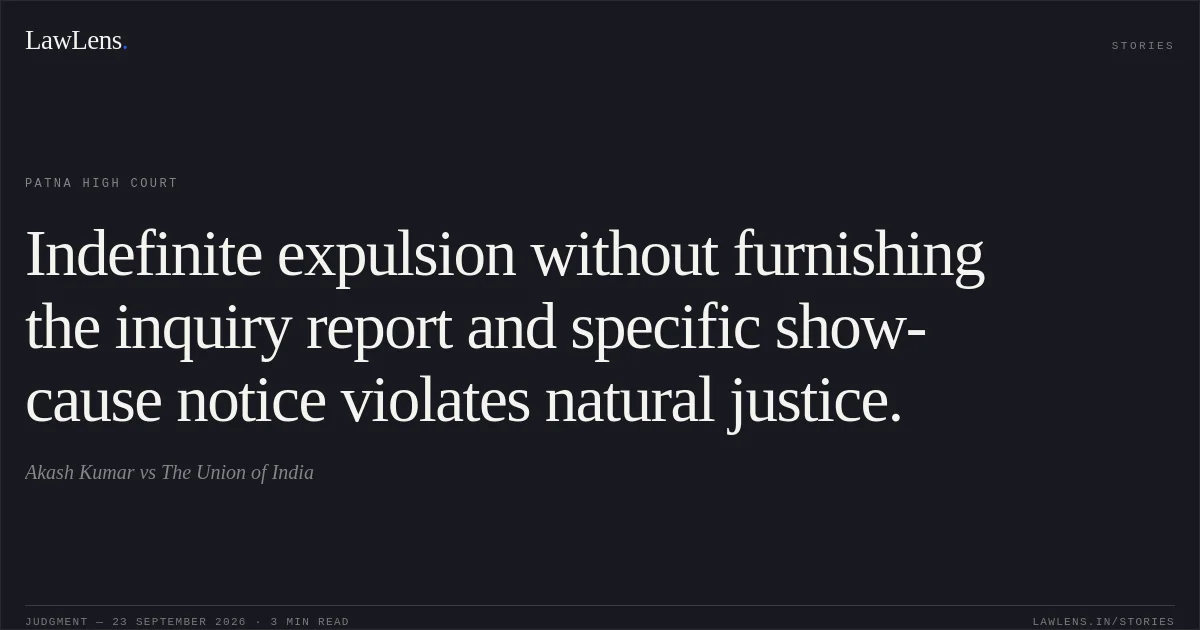
Source reference: paras. 6–8; pp. 3–4During the pendency of the writ petition, the University issued an order dated 14 August 2024 expelling him with immediate effect, prohibiting his entry into University premises and debarring him from admission to any University programme.
Source reference: para. 3; p. 2The petitioner contended that the expulsion was indefinite, that no specific show-cause notice proposing expulsion had been served, and that the report of the Discipline Committee had not been supplied to him.
Source reference: paras. 9–12; pp. 3–5The University asserted that the petitioner had repeatedly staged unlawful dharnas, disrupted institutional functioning, and had been expelled after consideration by the Proctorial Board and Discipline Committee.
Source reference: paras. 14–17; pp. 5–6Issues
Whether the petitioner’s expulsion for an indefinite and unspecified period, without a specific show-cause notice proposing expulsion and without furnishing the Discipline Committee’s report, violated the principles of natural justice and the governing University ordinances?
Source reference: paras. 18–23; pp. 7–9Whether the order of expulsion was legally sustainable when the applicable disciplinary framework did not authorize an indefinite period of expulsion?
Source reference: paras. 20–23; pp. 8–9Whether the legality of the petitioner’s suspension required adjudication at that stage, when the suspension had been imposed in contemplation of disciplinary proceedings that culminated in the expulsion order?
Source reference: para. 21; p. 8Law Applied
The Court applied Ordinance No. 17 framed under the Central Universities Act, 2009, particularly Clause 4, which permits punishments including fine, campus ban, expulsion and rustication; Clause 6, which requires that an accused student be given a fair opportunity to defend himself before punishment is imposed; and Clause 22(b), which limits the Proctor’s power to suspending or rusticating a student for a maximum period of two weeks.
Source reference: paras. 18–20; pp. 7–8The Court also referred to Clause 12(2) of Model Ordinance 49, which similarly restricts the Proctor’s power to suspension or rustication for up to two weeks, and to the requirement under Rule 28(4) of the Second Schedule to the Central Universities Act, 2009 that the period of suspension be specified.
Source reference: para. 9; p. 4The governing rule of natural justice required a fair opportunity of defence, including notice of the proposed punishment and access to the material relied upon, such as the inquiry report.
Source reference: paras. 19, 21–23; pp. 7–9Relying on X v. Maharashtra National Law University & Ors., 2024 SCC OnLine Bom 3258, the Court held that indefinite expulsion is harsh, disproportionate and capable of causing “academic death” by permanently depriving a student of educational opportunity.
Source reference: para. 24; pp. 9–10Reasoning
The Court found that although disciplinary proceedings had been initiated and the petitioner had received notices concerning his alleged misconduct, he had not been served with the Discipline Committee’s report or a specific show-cause notice explaining why the extreme punishment of expulsion should be imposed.
Source reference: paras. 21–22; p. 8Consequently, the petitioner was denied a meaningful opportunity to rebut the evidence and address the proposed punishment, contrary to Clause 6 of Ordinance No. 17 and the principles of natural justice.
Source reference: paras. 18–23; pp. 7–9The Court further held that the expulsion order imposed an indefinite and unspecified prohibition, which was not shown to be authorized by the Act or the applicable ordinances and had disproportionate consequences for the petitioner’s academic career.
Source reference: paras. 22–24; pp. 8–10The Court did not adjudicate the legality of the suspension at that stage because it was treated as an interim measure connected with the disciplinary proceedings that had culminated in the impugned expulsion.
Source reference: para. 21; p. 8Holding
The Court held that the order dated 14 August 2024 expelling the petitioner was unsustainable because it imposed indefinite expulsion without the requisite procedural safeguards and violated natural justice.
The expulsion order was accordingly set aside.
Source reference: paras. 25–26; p. 10The University was directed to reinstate the petitioner, permit him to complete his course and allow him to appear in examinations.
Source reference: paras. 25–26; p. 10The petitioner was also expected to maintain discipline within the institution.
Source reference: para. 27; p. 11The writ petition was allowed.
Source reference: para. 28; p. 11Acts & Sections Cited
2 provisions across 1 statute referred to in this judgment. Each provision opens on LawLens.
Central Universities Act, 20092
Original Court PDF
Akash KumarvsThe Union of India
Click to open original judgment
Original judgment, available to read, download and summarize on LawLens.in