Facts
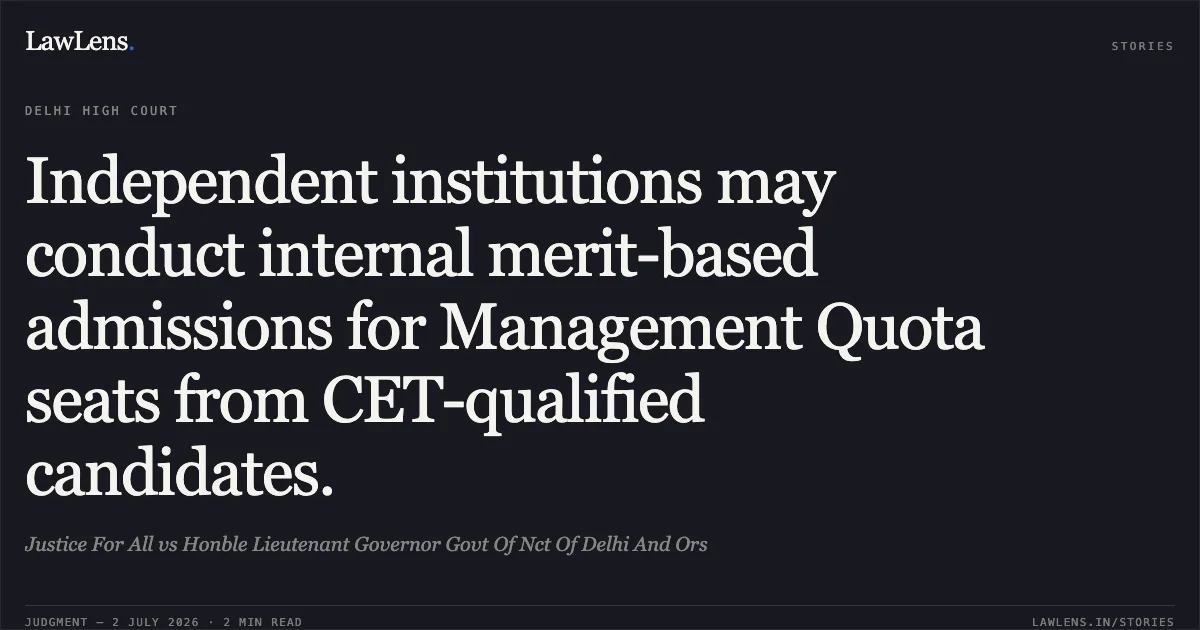
The Petitioner filed a Public Interest Litigation (PIL) challenging the validity of Rule 8(2)(a)(v) of the Delhi Professional Colleges or Institutions (Prohibition of Capitation Fee, Regulation of Admission, Fixation of Non-Exploitative Fee and Other Measures to Ensure Equity and Excellence) Rules, 2007
Source reference: p. 1-2The Petitioner also challenged the 2026-27 Admission Brochure, specifically provisions allowing the de-reservation of seats and the conversion of "Delhi Quota" seats to "Outside Delhi Quota" during Management Quota Admissions
Source reference: p. 2The Petitioner sought directions for a centralized, online counseling process for the 10% Management Quota Seats (MQS) and the implementation of a Standard Operating Procedure (SOP) recommended by the Admission Regulatory Committee (ARC)
Source reference: p. 2Issues
1. Whether Rule 8(2)(a)(v) of the 2007 Rules is ultra vires the Delhi Professional Colleges or Institutions Act, 2007, particularly Section 2(d), by allowing institutions to prepare their own merit lists for Management Quota Admissions
Source reference: p. 2-3 / para. 62. Whether the court should direct the State to mandate a common, centralized online counseling process for Management Quota Seats to ensure transparency and merit
Source reference: p. 2 / para. 4Law Applied
Rule 8(2)(a)(v) specifies that institutions shall draw their own merit lists and conduct counseling for MQS
Source reference: p. 4 / para. 10The Court primarily applied Section 12(a) of the Delhi Professional Colleges or Institutions Act, 2007, which allocates 10% of seats as Management Quota Seats
Source reference: p. 3 / para. 7It also interpreted Section 13, which mandates admissions through a Common Entrance Test (CET), and its proviso, which specifically empowers institutions to fill MQS via advertisement from CET-qualified candidates based on merit in the qualifying examination
Source reference: p. 3-4 / para. 8, 11Section 4(12) of the Act establishes the Admission Regulatory Committee (ARC) to regulate admission procedures and suggest guidelines for fair and transparent processes
Source reference: p. 5 / para. 13Reasoning
The Court rejected the Petitioner’s contention that Rule 8(2)(a)(v) contradicts the Act. It reasoned that Section 13 of the Act distinguishes between the 90% general seats and the 10% MQS
Source reference: p. 3 / para. 7, 9While the general seats are filled via centralized counseling by a designated agency, the proviso to Section 13 explicitly grants institutions the right to fill MQS independently, provided the candidates have qualified the CET
Source reference: p. 3-4 / para. 9, 11The Court observed that requiring centralized counseling for MQS would render the proviso to Section 13 redundant
Source reference: p. 5 / para. 12Regarding the lack of transparency or procedural discrepancies in MQS admissions, the Court noted that the ARC is the statutory body empowered under Section 4(12) to regulate such procedures and suggest improvements to the government
Source reference: p. 5 / para. 13Holding
The Court upheld the validity of Rule 8(2)(a)(v), finding no inconsistency with the parent Act
The Petition was disposed of without granting the primary prayers for online centralized counseling. However, the Court granted the Petitioner liberty to file an exhaustive representation regarding procedural discrepancies (such as online counseling needs and de-reservation issues) before the Admission Regulatory Committee (ARC) within a fortnight. The ARC was directed to consider such representation and take appropriate measures with expedition
Source reference: p. 5-6 / para. 14, 15Acts & Sections Cited
6 provisions across 1 statute referred to in this judgment. Linked provisions open on LawLens.
Delhi Professional Colleges or Institutions Prohibition of Capitation Fee Regulation of Admission Fixation of Non-Exploitative Fee and Other Measures to Ensure Equity and Excellence Act, 20076
Original Court PDF
Justice For AllvsHonble Lieutenant Governor Govt Of Nct Of Delhi And Ors
Click to open original judgment
Original judgment, available to read, download and summarize on LawLens.in


