Facts
The Appellant, Indian Railways, sought to procure 100 MW of power via inter-state open access from Gujarat for its traction substations in Maharashtra
Source reference: p.3, para 5.1Transmission utilities and various State Electricity Regulatory Commissions (SERCs) disputed the Railways' status, primarily whether it qualifies as a "deemed distribution licensee" (DDL) exempt from certain surcharges
Source reference: p.2, para 4The Railways contended that under Section 11 of the Railways Act, 1989, it has independent statutory authority to distribute electricity
Source reference: p.4, para 5.2(b)In 2015, the CERC ruled in favor of the Railways
Source reference: p.6, para 5.4On 12.02.2024, the APTEL set aside the CERC order, holding that the Railways is primarily a consumer and not a DDL under the Electricity Act, 2003
Source reference: p.10, para 5.7Issues
1. Whether the activities provided under Section 11(g) and (h) of the Railways Act constitute "distribution" of electricity and qualify the Appellant as a DDL
Source reference: p.26, para 14(i)2. Whether the Indian Railways qualifies as an "Appropriate Government" under Section 2(5) and Section 14 of the Electricity Act
Source reference: p.26, para 14(ii)3. Whether the Indian Railways, even if held to be a DDL, is exempt from paying Cross-Subsidy Surcharge (CSS) and Additional Surcharge (AS) for open access under Section 42
Source reference: p.26, para 14(iii)4. Whether a proposed but unpassed legislation (Draft Electricity Amendment Bill, 2025) can be used as an aid to interpret existing statutory gaps
Source reference: p.26, para 14(iv)Law Applied
Electricity Act, 2003, specifically Section 2(17) defining a distribution licensee, Section 2(19) defining a distribution system, and Section 14, which provides for deemed licensee status
Source reference: p.27-28Section 11 of the Railways Act, 1989, regarding the power to erect electrical installations
Source reference: p.29, para 19The precedent in Sesa Sterlite Ltd. v. OERC (2014), which established that an entity consuming electricity for its own use, even if technically a licensee, is a "consumer" for the purpose of surcharges
Source reference: p.50, para 58Functional test for "Appropriate Government" from SAIL v. National Union Waterfront Workers (2001)
Source reference: p.40, para 42Principle that a legislative casus omissus cannot be supplied by courts, as seen in Vodafone International Holdings BV v. Union of India (2012)
Source reference: p.56, para 67Reasoning
The Court reasoned that "distribution" under the Electricity Act requires the twin functions of maintaining a system and supplying electricity to third-party consumers
Source reference: p.27, para 16It found that the Railways’ "distribution installations" under Section 11 of the Railways Act are for internal conveyance and self-consumption, not for sale to consumers, thus failing the definition of a distribution system
Source reference: p.30, para 21Although the Court acknowledged the Railways functions under the authority of the Central Government (satisfying the functional test for "Appropriate Government"), it held that this nominal status does not grant DDL benefits without the substantive act of distribution
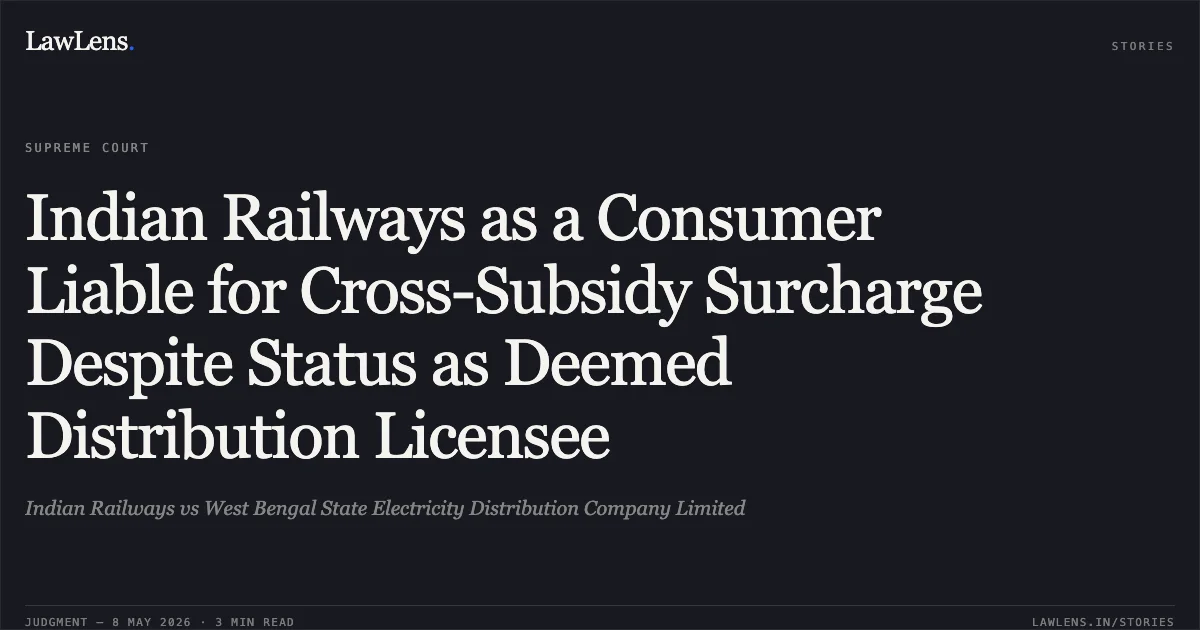
Source reference: p.43-44, para 47-48Applying the Sesa Sterlite functionality test, the Court determined that since the Railways uses the procured power for its own traction and operations, it is a "consumer" under Section 2(15)
Source reference: p.50, para 57Consequently, it is liable to pay CSS and AS under Section 42(2) and 42(4) to compensate DISCOMS for stranded costs and the loss of cross-subsidy
Source reference: p.46-47Finally, the Court noted that the Draft Electricity (Amendment) Bill, 2025—which proposes a 5-year phase-out of CSS for Railways—proves that such an exemption does not exist in the current law
Source reference: p.53-55, para 64-65Holding
The Supreme Court dismissed the appeals and upheld the APTEL judgment. It held that the Indian Railways is not a Deemed Distribution Licensee and is a "consumer" for the purpose of open access
The Court ordered the Railways to pay the outstanding Cross-Subsidy Surcharge and Additional Surcharge as computed by the respective DISCOMS. The interim protection against the payment of these charges was vacated
Source reference: p.59Acts & Sections Cited
13 provisions across 2 statutes referred to in this judgment. Each provision opens on LawLens.
Electricity Act, 2003
Railways Act, 19893
Original Court PDF
Indian RailwaysvsWest Bengal State Electricity Distribution Company Limited
Click to open original judgment
Original judgment, available to read, download and summarize on LawLens.in