Facts
The Plaintiff, a partnership firm in the music acquisition and production business, claimed exclusive copyright over the audio-visual recordings, sound recordings, and underlying works of two songs, “Nyaya Ellide” and “Omme Ninnanu” (“Original Works”)
Source reference: p.2These rights were allegedly acquired via an Assignment Deed dated 31.08.2020 from "Sangeetha"
Source reference: p.4The Plaintiff alleged that Defendant Nos. 1 and 2 unauthorizedly exploited these works in their film “Bachelor Party”
Source reference: p.2Although the Defendants initially approached the Plaintiff for a license in January 2024, they proceeded to release the film theatrically and on OTT platforms (Defendant No. 3, Amazon Prime) without securing one
Source reference: p.4-5On 12.08.2024, the Court granted an ex-parte ad-interim injunction directing the Defendants to deposit ₹20,00,000
Source reference: p.5The Defendants sought a return of the plaint for lack of jurisdiction and a vacation of the injunction, while the Plaintiff filed for contempt due to the Defendants' failure to deposit the amount within the stipulated four weeks
Source reference: p.5-6Issues
1. Whether the Plaintiff is the prima facie owner of the copyright in the Original Works?
Source reference: p.50 / para. 87(i)2. Whether the Defendants' usage of the works (7 seconds and 31 seconds) constitutes fair use or de minimis?
Source reference: p.50 / para. 87(ii)3. Whether Section 33 of the Copyright Act bars the Plaintiff from issuing licenses as it is not a registered copyright society?
Source reference: p.50 / para. 87(iii)4. Whether the Court has territorial and pecuniary jurisdiction to entertain the suit?
Source reference: p.51 / para. 87(viii-ix)5. Whether the Defendants committed willful disobedience of the Court’s order dated 12.08.2024?
Source reference: p.51 / para. 87(xi)Law Applied
Section 55(2) of the Copyright Act, 1957, which establishes a legal presumption of ownership in favor of the publisher/author named on the work unless proven otherwise
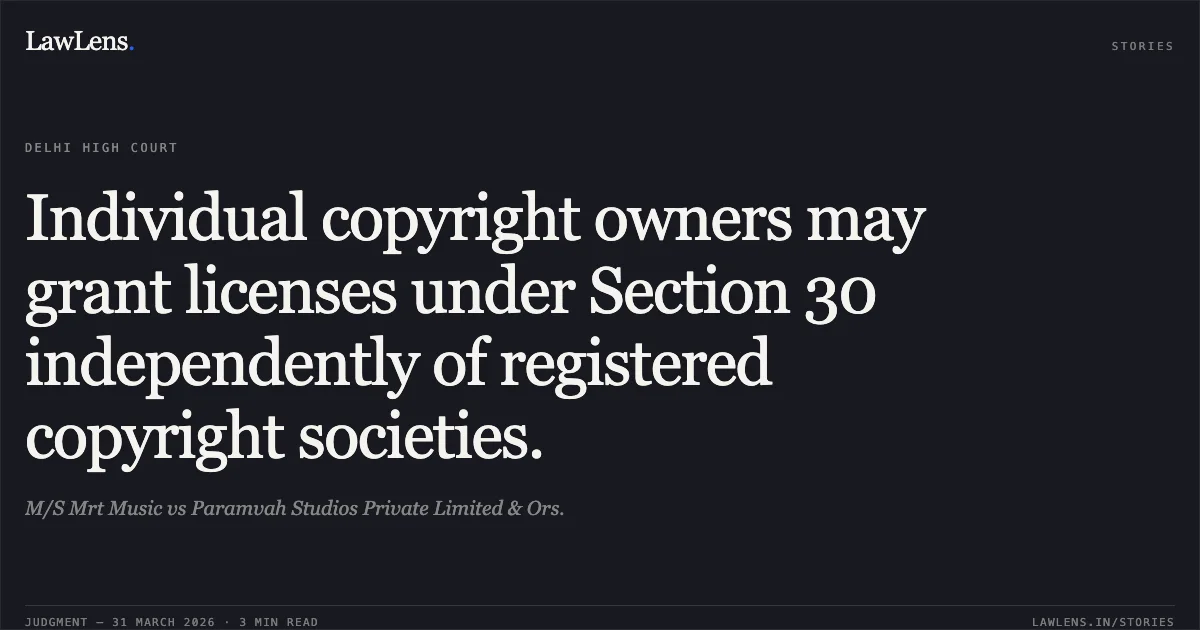
Source reference: p.52The Court relied on Section 30, affirming the right of an individual owner to grant licenses, and distinguished Section 33, noting that the restriction on the "business of licensing" applies to collective societies, not individual owners
Source reference: p.58-59Regarding jurisdiction, the Court applied Section 20(c) of the CPC and Section 62 of the Copyright Act, holding that the accessibility of infringing content on OTT platforms within the forum state confers jurisdiction
Source reference: p.66The Court followed the qualitative test for infringement established in Shemaroo Entertainment Ltd. v. News Nations Network
Source reference: p.54The Court followed the jurisdictional principles for digital content in Nilesh Girkar v. Zee Entertainment
Source reference: p.18, 66Finally, it applied Order XXXIX Rule 2A of the CPC regarding the consequences of disobeying interim orders
Source reference: p.70Reasoning
The Court found that the Plaintiff established prima facie ownership through a valid chain of assignments, bolstered by the fact that the Defendants themselves had negotiated for a license, thereby recognizing the Plaintiff's rights
Source reference: p.51-52The Defendants' "de minimis" defense was rejected; the Court reasoned that the use was a "conscious creative call" essential to the script's emotional beat, making the qualitative significance more important than the temporal duration
Source reference: p.54-55Addressing Section 33, the Court distinguished Azure Hospitality, clarifying that the Plaintiff, as a record label and individual assignee, is not a "copyright society" and retains the right to license its own property under Section 30
Source reference: p.59-60On jurisdiction, the Court held that since the film was accessible and downloadable in Delhi via Amazon Prime, the cause of action (infringement) occurred within its territory
Source reference: p.66The Court further noted that the Plaintiff's valuation of damages at ₹2,00,01,000 was sufficient to meet the pecuniary threshold of a Commercial Suit
Source reference: p.67Regarding contempt, the Court held that the Defendants' "bona fide belief" that they did not need to comply while a modification application was pending was legally untenable; an order must be obeyed until stayed or vacated
Source reference: p.70Holding
The Court dismissed the Defendants' application for return of the plaint and the application to vacate the injunction
It held that the Plaintiff is the exclusive copyright owner and that the Defendants' use was not de minimis
Source reference: p.71In light of the Defendants' belated deposit of ₹20,00,000, the Court directed the Registry to release said amount to the Plaintiff in lieu of a permanent injunction against the film's current exhibition
Source reference: p.71-72The Court found the Defendants guilty of willful disobedience of the 12.08.2024 order and, to purge the contempt, directed them to pay an exemplary cost of ₹5,00,000 to the Plaintiff within two weeks
Source reference: p.72All pending interlocutory applications were disposed of accordingly
Source reference: p.72Acts & Sections Cited
20 provisions across 4 statutes referred to in this judgment. Each provision opens on LawLens.
Code of Civil Procedure, 19082
Copyright Act, 1957
Contempt of Courts Act, 19711
Cinematograph Act, 19521
Original Court PDF
M/S Mrt MusicvsParamvah Studios Private Limited & Ors.
Click to open original judgment
Original judgment, available to read, download and summarize on LawLens.in