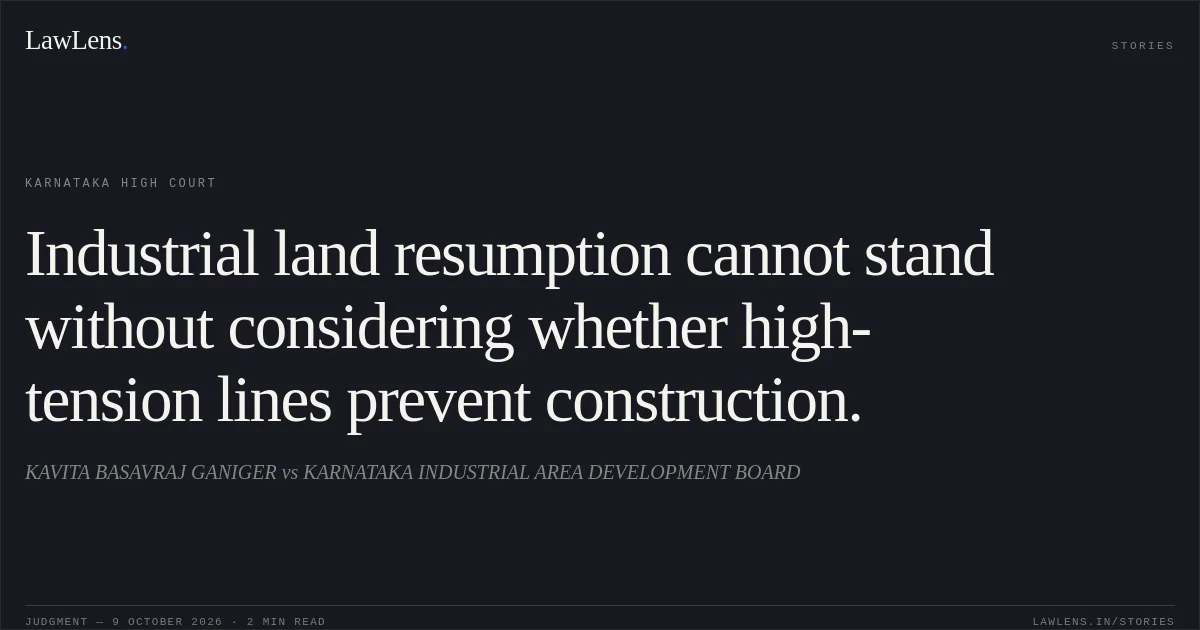
Facts
The petitioner was initially allotted Plot No. 163/B1 in Belur Industrial Area in 2007.
Source reference: p. 2At her request, KIADB allotted her an alternative plot, No. 171/E, measuring 4,004 square metres, and the parties executed a lease-cum-sale agreement on 29 April 2010.
Source reference: p. 2; p. 4The petitioner did not complete construction or submit the required utilisation plan, stating that high-tension lines running through the plot prevented construction.
Source reference: pp. 2–3; p. 5After proceedings under Section 34-B of the Karnataka Industrial Areas Development Act, 1966, KIADB ordered her to surrender the plot by 15 December 2016.
Source reference: p. 3She challenged that order, contending that KIADB had failed to properly consider the high-tension-line issue.
Source reference: pp. 2–3Issues
Whether KIADB’s order directing surrender of the plot was liable to be quashed for failing to adequately consider the petitioner’s contention that high-tension lines passing through the plot prevented construction.
Source reference: pp. 5–6Whether the matter should be remitted to KIADB to assess the effect of the high-tension lines and, if the plot remained usable, allow the petitioner to submit an alternative utilisation plan.
Source reference: p. 6Law Applied
The Court considered the Karnataka Industrial Areas Development Act, 1966, including the proceedings under Section 34-B and the reference to Section 14 in the record.
Source reference: pp. 3–4It also considered the lease-cum-sale agreement, which required the petitioner to submit a comprehensive plan for utilisation of the land and provided for termination and resumption in the event of non-compliance.
Source reference: pp. 3–5No judicial precedents were cited.
Source reference: no citationThe Court’s reasoning required KIADB to consider the petitioner’s material contention about the physical suitability of the allotted land before determining the consequences of her failure to develop it.
Source reference: pp. 5–6Reasoning
The Court noted that photographs showed two lines of electricity poles running through the plot and that the petitioner had made representations about the resulting difficulty in constructing a building.
Source reference: p. 5Although KIADB’s order referred to her representation, it dismissed the contention without adequately examining whether the high-tension lines made construction impracticable.
Source reference: pp. 5–6The Court also recognised that the petitioner had not submitted a feasible plan as required by the agreement and that KIADB’s concern about her failure to establish the industry had substance.
Source reference: p. 6In the circumstances, the Court held that the effect of the lines required specific reconsideration, with a site visit if necessary, before a final decision was made.
Source reference: p. 6Holding
The Court quashed KIADB’s order dated 15 November 2016 and remitted the matter to the Chief Executive Officer of KIADB for reconsideration, specifically addressing whether the high-tension lines prevented construction; a site inspection could be conducted if required.
If the plot was found usable, the petitioner was to be given an opportunity to submit an alternative plan.
Source reference: p. 6The inquiry and decision were directed to be completed within three months of receipt of the certified copy of the order.
Source reference: p. 7The petitioner could apply for a fresh allotment, to be considered subject to prevailing market rates and applicable conditions, and the interim order was extended until then.
Source reference: p. 7The petition was disposed of.
Source reference: p. 7Acts & Sections Cited
2 provisions across 1 statute referred to in this judgment. Each provision opens on LawLens.
KARNATAKA INDUSTRIAL AREAS DEVELOPMENT ACT, 19662
Original Court PDF
KAVITA BASAVRAJ GANIGERvsKARNATAKA INDUSTRIAL AREA DEVELOPMENT BOARD
Click to open original judgment
Original judgment, available to read, download and summarize on LawLens.in
![Authorities must consider employees’ claims under cited precedents, subject to similarity and applicable rules.. Anwar Ul Hassan Chesti vs D/o Health And Medical Education Ut Of Jammu & Kashmir. CAT - ['Srinagar']. LawLens](/stories/thumbnails/authorities-must-consider-employees-claims-under-cited-precedents-subject-to-similarity-an-ea3a30d13510422ca1f750e161753fd2.webp)