Facts
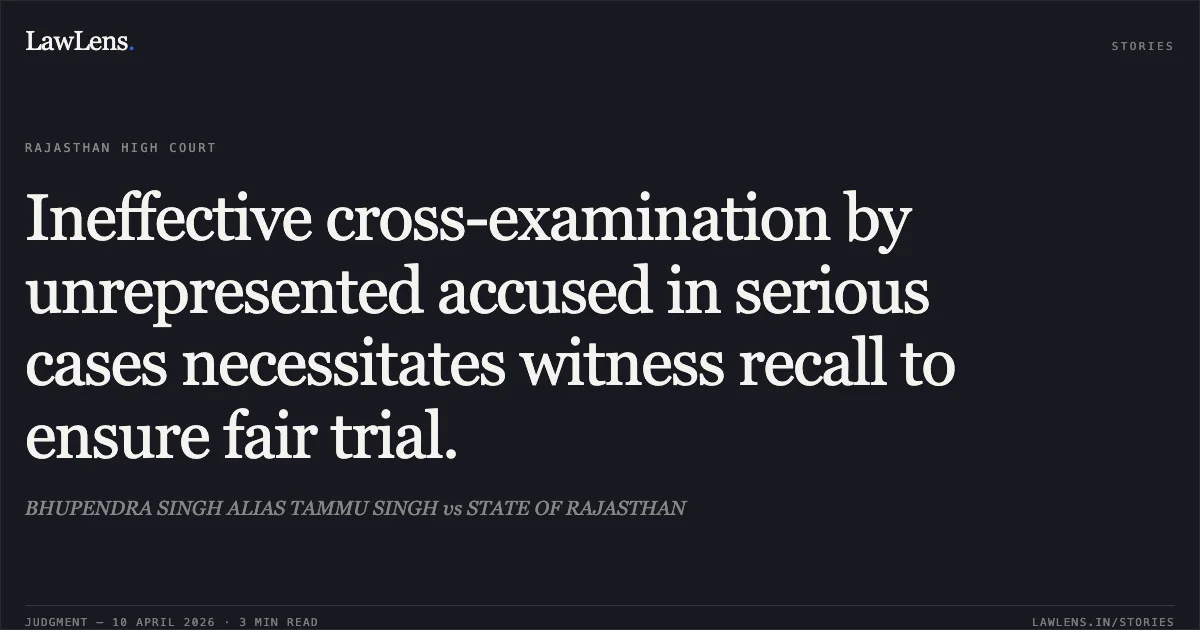
The petitioner is facing trial for murder under the Bharatiya Nyaya Sanhita (BNS) before the Additional Sessions Judge No. 3, Chittorgarh.
Source reference: para 3On April 23, 2024, a material prosecution witness and eyewitness, Rajesh Lal (PW-9), was examined. Due to the absence of the petitioner’s engaged counsel, the petitioner, who was unversed in law, conducted a perfunctory cross-examination himself.
Source reference: para 3Subsequently, the petitioner filed an application to recall PW-9 for further cross-examination, which the trial court declined via order dated February 10, 2026.
Source reference: para 1The petitioner challenged this refusal through a criminal writ petition, asserting a violation of the right to a fair trial.
Source reference: para 1Issues
1. Whether the trial court's refusal to recall a material eyewitness for effective cross-examination by a legal professional, following a perfunctory cross-examination by a lay accused, constitutes a violation of the right to a fair trial.
Source reference: paras 3.1–3.32. Whether the inconvenience caused to a witness by a recall order outweighs the prejudice caused to an accused facing potential life imprisonment or capital punishment.
Source reference: para 3.4Law Applied
Section 348 of the Bharatiya Nagarik Suraksha Sanhita (BNSS), which governs the power to summon material witnesses or examine persons present.
Source reference: para 4The court primarily applied Section 348 of the Bharatiya Nagarik Suraksha Sanhita (BNSS), which governs the power to summon material witnesses or examine persons present. It relied on the constitutional and procedural mandate of "Fair Trial" and "Due Process," emphasizing that the right to cross-examine a material witness is a core component of natural justice.
Source reference: para 3.1, 4The court also invoked the principle that in cases of grave magnitude (death or life imprisonment), procedural rigidity must yield to a liberal, justice-oriented approach to ensure the accused is afforded a meaningful defense.
Source reference: paras 3.2, 3.3Reasoning
The court reasoned that a criminal trial for murder is a solemn judicial inquiry into the life and liberty of an individual, not a mere ritual.
Source reference: para 3.1It observed that a lay accused cannot be expected to possess the "dexterity" of a trained legal practitioner to impeach the credibility of an eyewitness.
Source reference: para 3.2The court held that the absence of counsel on the date of examination resulted in a "vitiated" opportunity that was ostensibly granted but substantively hollow.
Source reference: para 3.2It further noted that "elevating form over substance" by treating a perfunctory cross-examination as complete would render the concept of a fair trial a "hollow incantation".
Source reference: para 3.2While acknowledging the inconvenience to the witness, the court determined that such hardship could be mitigated through monetary costs, whereas the prejudice to the accused would be irreversible.
Source reference: para 3.4The court found the petitioner's request bona fide, as there were no signs of dilatory tactics.
Source reference: para 3.5Holding
The High Court allowed the petition and quashed the order dated February 10, 2026.
The court held that the trial court’s approach was "overly technical" and occasioned a failure of justice.
Source reference: para 3.6The application under Section 348 of the BNSS was allowed, and the trial court was directed to secure the presence of PW-9 for the limited purpose of cross-examination.
Source reference: para 4To balance equities, the court ordered the petitioner to deposit Rs. 5,000 as costs to be paid to the witness.
Source reference: para 4.3The court further directed that the cross-examination be completed in a single day without any adjournments and be confined to relevant aspects of the case.
Source reference: paras 4.1, 4.2Acts & Sections Cited
1 provisions across 1 statute referred to in this judgment. Each provision opens on LawLens.
Bharatiya Nagarik Suraksha Sanhita, 20231
Original Court PDF
BHUPENDRA SINGH ALIAS TAMMU SINGHvsSTATE OF RAJASTHAN
Click to open original judgment
Original judgment, available to read, download and summarize on LawLens.in