Facts
The petitioner, an MD (Medicine), pursued DrNB Cardiology during the 2021–2024 batch and cleared the DrNB final examination in January 2025. Her provisional DrNB Cardiology pass certificate was issued on 29 May 2025.
Source reference: paras. 3–4She qualified the FET-2024, secured Rank 14, and was allotted an FNB Cardiac Electrophysiology seat at Narayana Hrudayalaya, Bengaluru, where she joined on 18 August 2025.
Source reference: para. 4The FET-2024 Information Bulletin prescribed 31 December 2024 as the cut-off date for obtaining the feeder postgraduate qualification.
Source reference: paras. 6, 36–37In her FET application, OPJR registration, and self-appraisal, the petitioner declared 31 December 2024 as her postgraduate qualification date, although she obtained the DrNB qualification only on 29 May 2025.
Source reference: paras. 42–49Upon detecting the discrepancy, NBEMS issued a show-cause notice dated 8 May 2026 and thereafter cancelled her candidature by letter dated 22 May 2026.
Source reference: paras. 9–10The petitioner challenged the cancellation under Article 226, seeking reinstatement and permission to complete the fellowship.
Source reference: no citationIssues
Whether the petitioner was eligible for admission to the FNB Cardiac Electrophysiology fellowship under the FET-2024 eligibility conditions, despite obtaining the feeder DrNB Cardiology qualification after 31 December 2024.
Source reference: para. 35; paras. 38–41Whether NBEMS could subsequently cancel the petitioner’s candidature after allotting her a seat, provisionally verifying her documents, permitting her to join, and allowing her to undergo approximately nine months of training.
Source reference: para. 35; paras. 62–69Whether the cancellation was arbitrary, disproportionate, discriminatory, or violative of Article 14 of the Constitution.
Source reference: para. 35; paras. 71–74Law Applied
The Court applied the FET-2024 Information Bulletin, particularly Clause 5.1, which permitted candidates possessing or likely to possess the prescribed qualification by 31 December 2024 to apply; Clause 5.3, which fixed 31 December 2024 as the eligibility cut-off; and Clauses 3.2 and 3.17, which provided that eligibility would be determined at counselling, admission, or registration and that candidature could be cancelled if ineligibility was subsequently detected.
Source reference: paras. 36, 39Clause 2.1 of the Counselling Handbook required candidates to have qualified in the eligible feeder specialty by 31 December 2024, while Clause 5.2 authorised cancellation where false or fabricated documents were submitted.
Source reference: para. 37The Court also applied the principle that subsequent acquisition of an eligibility qualification cannot retrospectively cure ineligibility as on the prescribed cut-off date.
Source reference: paras. 40–41, 59–61It distinguished Abha George v. AIIMS, 2022 SCC OnLine Del 366, and Dr. Praveen George Paul v. AIIMS, W.P.(C) 5089/2023, which concerned candidates who had not misrepresented their eligibility.
Source reference: paras. 54–57The Court relied on Rajendra Prasad Mathur v. Karnataka University, 1986 Supp SCC 740, and Guru Gobind Singh Indraprastha University v. Ram Narayan Tiwari, 2018 SCC OnLine Del 12786, on the limits of equitable relief and estoppel in cases of ineligibility or misrepresentation.
Source reference: paras. 54, 67It further held that vacant seats cannot justify continuation of an admission contrary to prescribed eligibility requirements.
Source reference: para. 70Reasoning
The Court held that the petitioner was ineligible because she had neither qualified the DrNB examination nor obtained the provisional pass certificate by 31 December 2024; her examination was conducted only in January 2025 and the certificate was issued on 29 May 2025.
Source reference: paras. 40–41The phrase “likely to be in possession” did not assist her because, as of the cut-off date, she had not even appeared in the final examination.
Source reference: para. 41The Court further found that she had repeatedly represented—through the FET application, OPJR particulars, and self-appraisal—that she had passed by 31 December 2024, amounting to material misrepresentation.
Source reference: paras. 42–49, 56–57Consequently, the provisional allotment, hospital verification, joining, and nine months of training could not create a vested right or operate as estoppel against NBEMS, particularly because the governing rules expressly permitted cancellation upon later detection of ineligibility.
Source reference: paras. 50–52, 63–66The Court also rejected the Article 14 challenge: NEET-SS and FET were distinct examinations governed by separate regulatory frameworks, and the uniformly applicable cut-off date was within NBEMS’s policy domain.
Source reference: paras. 71–74Nevertheless, the Court criticised NBEMS for failing to detect the defect earlier despite having information indicating the petitioner’s course duration and joining date, and imposed institutional costs for its administrative lapse.
Source reference: paras. 79–83Holding
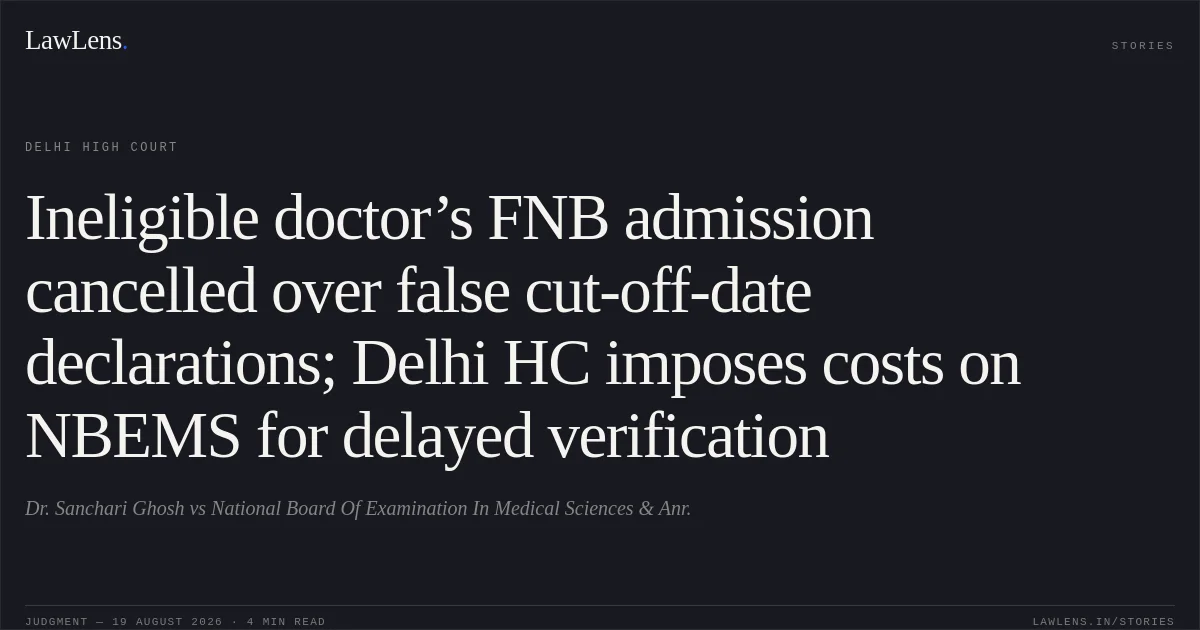
The Court answered all issues in favour of NBEMS. It held that the petitioner was ineligible for FET-2024 admission, that NBEMS was entitled to cancel her candidature upon detecting the eligibility defect, and that the cancellation was neither arbitrary nor violative of Article 14.
The writ petition was dismissed and the cancellation letter dated 22 May 2026 was upheld.
Source reference: para. 75The petitioner was directed to pay token costs of ₹1,000, while NBEMS was directed to pay ₹10,000 to the Delhi High Court Legal Services Committee in view of its deficient verification process.
Source reference: paras. 82–84Original Court PDF
Dr. Sanchari GhoshvsNational Board Of Examination In Medical Sciences & Anr.
Click to open original judgment
Original judgment, available to read, download and summarize on LawLens.in