Facts
The petitioners are descendants of Panchabhai Thebabhai, who held lands in Village Haripar, District Rajkot
Source reference: para. 4.1This dispute involves mutated entries in Village Form No. 6, specifically Entry No. 305, which deleted the names of several forefathers following an alleged application to forgo their shares
Source reference: para 4.1The petitioners, having challenged these entries in civil suits, filed an application under the Right to Information (RTI) Act, 2005, seeking documents related to Entry No. 305
Source reference: para. 4.2The Public Information Officer (Respondent No. 3) provided some documents but stated that records for Entry No. 305 were unavailable
Source reference: para. 8The First and Second Appellate Authorities upheld this, noting that a physical verification/scrutiny (Rojkam) was conducted in the presence of the applicant, where the records could not be traced
Source reference: para 9, 11The petitioners moved the High Court seeking to quash the orders denying the information
Source reference: para 3Issues
1. Whether the respondent authorities are legally obligated to provide information under the RTI Act when the record is established as non-existent or untraceable after due scrutiny
Source reference: para 6.2, 122. Whether the failure to provide untraceable records constitutes a "mala fide denial" or "destruction" of information warranting disciplinary action or a writ of certiorari
Source reference: para 12Law Applied
The Court primarily applied the provisions of the Right to Information Act, 2005, specifically focusing on the definition of providing "information" which is contingent upon the existence of records.
Source reference: para 12It relied on the precedent set in Special Civil Application No. 7188 of 2021 (Gujarat High Court), which established that if an authority provides details of a diligent search and demonstrates the inability to find records via a Panch Rojkam, they cannot be compelled to provide non-existent data
Source reference: para 12The court also considered Section 20(2) of the RTI Act, determining that disciplinary recommendations are only applicable if information is "mala fidely denied," "knowingly incorrect," or "misleadingly" withheld, rather than simply untraceable
Source reference: para 12Reasoning
The Court analyzed that the Respondent No. 3 had acted transparently by inviting the applicant to the Gram Panchayat office to personally verify the records
Source reference: para 8A Rojkam (official report of proceedings) was drawn on 05.04.2023, which the applicant signed, acknowledging that the documents could not be traced despite verification
Source reference: para 8, 9, 11The Court reasoned that under Article 226, it cannot delve into factual disputes regarding the non-preservation or historical destruction of records unless there is a specific finding of mala fide intent
Source reference: para 12Since the authorities fulfilled their duty by searching for the records and communicating the results of that search, no "inaction" or "arbitrariness" was found in the impugned orders
Source reference: para 13Holding
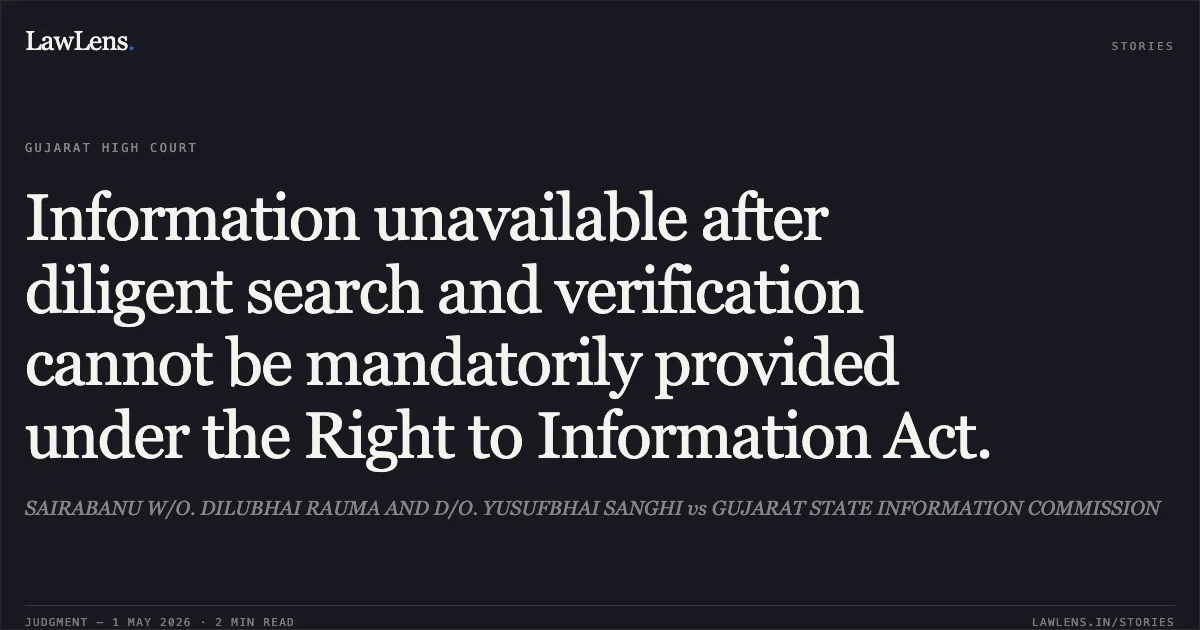
The Court dismissed the petition, ruling that the authorities cannot be directed to provide information that is not available on record after a verified search
The Court discharged the Rule but granted the petitioners liberty to use the response (acknowledging the missing documents) as evidence in their pending civil litigations to support their claims regarding the disputed land entries
Source reference: para 14Acts & Sections Cited
2 provisions across 1 statute referred to in this judgment. Each provision opens on LawLens.
Right to Information Act, 20052
Original Court PDF
SAIRABANU W/O. DILUBHAI RAUMA AND D/O. YUSUFBHAI SANGHIvsGUJARAT STATE INFORMATION COMMISSION
Click to open original judgment
Original judgment, available to read, download and summarize on LawLens.in