Facts
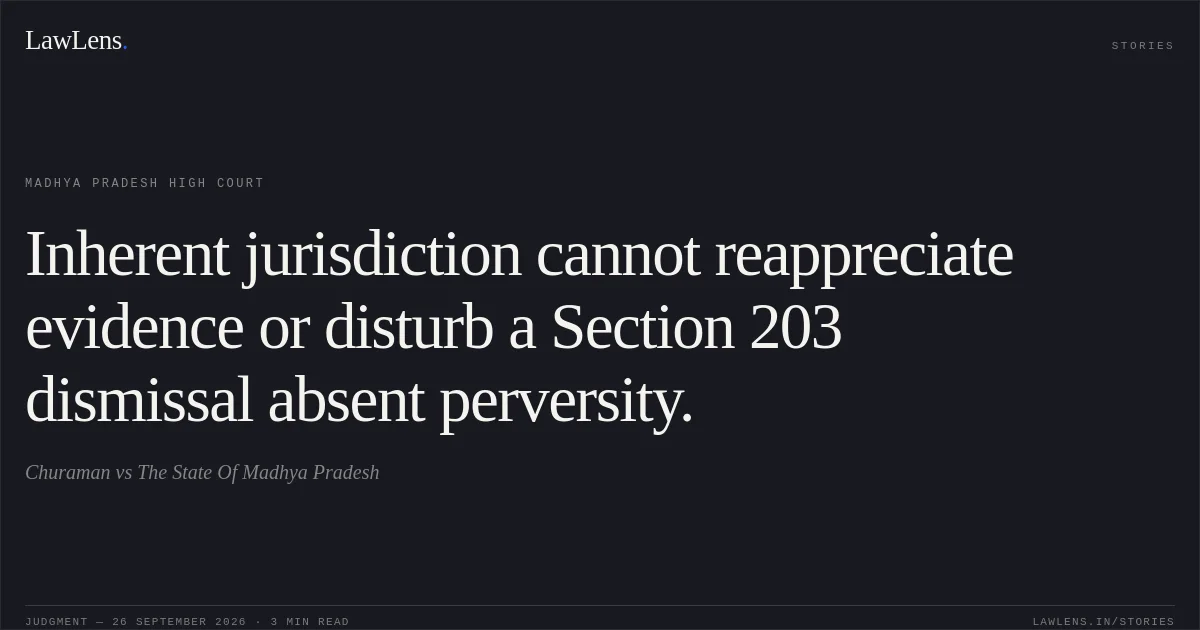
The complainant filed an application under Section 482 of the Code of Criminal Procedure, 1973, challenging the order dated 13 August 2018 by which the Additional Sessions Judge, Pawai, dismissed Criminal Revision No. 12/2018 and affirmed the JMFC’s order dated 21 February 2018 dismissing the complaint under Section 203 CrPC.
Source reference: para. 1; p. 1The complaint alleged that the respondents entered the complainant’s house, abused his wife, forcibly removed wooden articles and ropes, demanded money, and threatened the complainant against lodging a report; allegations were made under Sections 427, 452, 323, 294, 506-B and 34 IPC.
Source reference: para. 2; p. 1After the police allegedly failed to act, the complainant approached the Superintendent of Police and instituted a private complaint under Section 200 CrPC.
Source reference: para. 2; p. 1The Magistrate recorded the statements of the complainant and his witnesses and considered the supporting documents, but found no sufficient ground to proceed against the proposed accused.
Source reference: para. 2; p. 1The Courts below also noted that a forest offence concerning the same incident had already been registered and that Crime No. 612/2016 was pending before the competent court.
Source reference: para. 4; pp. 2–3Issues
Whether the Magistrate erred in dismissing the complaint under Section 203 CrPC despite the complainant’s and witnesses’ statements allegedly disclosing the offences under Sections 427, 452, 323, 294, 506-B and 34 IPC?
Source reference: paras. 3, 5–7; pp. 2–4Whether the Revisional Court’s affirmation of the dismissal disclosed any manifest illegality, perversity, or jurisdictional error warranting interference under the High Court’s inherent jurisdiction?
Source reference: paras. 5, 7–9; pp. 3–5Whether the existence of prior proceedings arising from the same incident justified the Magistrate’s adverse assessment of the complaint’s bona fides and reliability?
Source reference: paras. 6, 8; pp. 3–4Law Applied
The Court applied Section 203 CrPC, under which a Magistrate may dismiss a complaint at the pre-process stage if, after considering the complaint, the statements recorded under Section 200 and the supporting material, there is no sufficient ground for proceeding.
Source reference: paras. 1, 5–7; pp. 1–4The Court reiterated that proceedings under Section 203 do not constitute an acquittal after trial; the limited inquiry is whether sufficient ground exists to proceed against the proposed accused.
Source reference: para. 5; p. 3It further applied the principle governing inherent jurisdiction—referred to in the judgment under Section 528 of the BNSS, while the petition was instituted under Section 482 CrPC—that such jurisdiction must be exercised sparingly to prevent abuse of process or secure the ends of justice and cannot be used merely to substitute another possible appreciation of evidence for that of the subordinate courts.
Source reference: para. 9; p. 5Interference is therefore justified only where the subordinate courts’ findings disclose manifest illegality, perversity, or jurisdictional error.
Source reference: paras. 5, 7–9; pp. 3–5Reasoning
The Magistrate had considered the complainant’s statements, the statements of his witnesses, and the documentary material, but found the evidence interested and one-sided and concluded that the complaint appeared to have been filed to exert pressure.
Source reference: para. 6; p. 3The Magistrate was also entitled to consider the prior forest offence and pending criminal proceedings arising from the same incident in assessing the complaint’s bona fides and reliability.
Source reference: para. 8; p. 4Since the dismissal occurred at the stage of determining whether sufficient ground existed to proceed, the High Court did not undertake a fresh or appellate evaluation of the evidence.
Source reference: para. 5; p. 3The complainant’s argument merely suggested an alternative view of the material; it did not establish that the concurrent findings were unsupported by evidence, perverse, or legally unsustainable.
Source reference: para. 7; pp. 3–4Consequently, the requirements for exercising inherent jurisdiction were not satisfied.
Source reference: para. 9; p. 5Holding
The High Court held that the Magistrate committed no manifest illegality, perversity, or jurisdictional error in dismissing the complaint under Section 203 CrPC, and that the Revisional Court correctly declined to interfere.
The orders dated 21 February 2018 and 13 August 2018 were upheld, and the application under Section 482 CrPC was dismissed.
Source reference: paras. 10–11; p. 5Acts & Sections Cited
10 provisions across 3 statutes referred to in this judgment. Each provision opens on LawLens.
Code of Criminal Procedure, 19733
Indian Penal Code, 18606
Bharatiya Nagarik Suraksha Sanhita, 20231
Original Court PDF
ChuramanvsThe State Of Madhya Pradesh
Click to open original judgment
Original judgment, available to read, download and summarize on LawLens.in