Facts
The petitioner possessed a two-year Diploma in Tailoring and was initially called for interview by the HPPSC for the post of Junior Tailoring Mistress/Master, Class III, in the Rural Development Department, carrying the pay scale of Rs. 510–940.
Source reference: para. 2Instead, she was appointed in the Agriculture Department as an Art/Craft Teacher by order dated 16 October 1991, in the pay scale of Rs. 950–1800.
Source reference: paras. 2, 14She contended that the qualifications, recruitment process, duties and responsibilities of Craft Teachers/Junior Tailoring Mistresses in the Agriculture, Rural Development and Education Departments were substantially identical, while the latter posts carried higher pay scales.
Source reference: paras. 3–4, 7–8Her representations seeking parity, including those dated 3 February 1994 and 13 October 2003, were rejected by communications dated 10 April 2008 and 6 May 2009 on the ground that her pay scale had been correctly revised from Rs. 950–1800 to Rs. 3120–5160 and that no anomaly existed.
Source reference: paras. 5–6The respondents admitted that the qualifications under the relevant Recruitment and Promotion Rules were substantially the same and that the petitioner had no promotional avenue, but maintained that she had accepted appointment in the Agriculture Department in the prescribed pay scale.
Source reference: paras. 10–11The petitioner thereafter challenged the rejection orders and sought the pay scale of Rs. 1350–2400 from the date of appointment, with corresponding revisions and consequential benefits.
Source reference: paras. 1, 9Issues
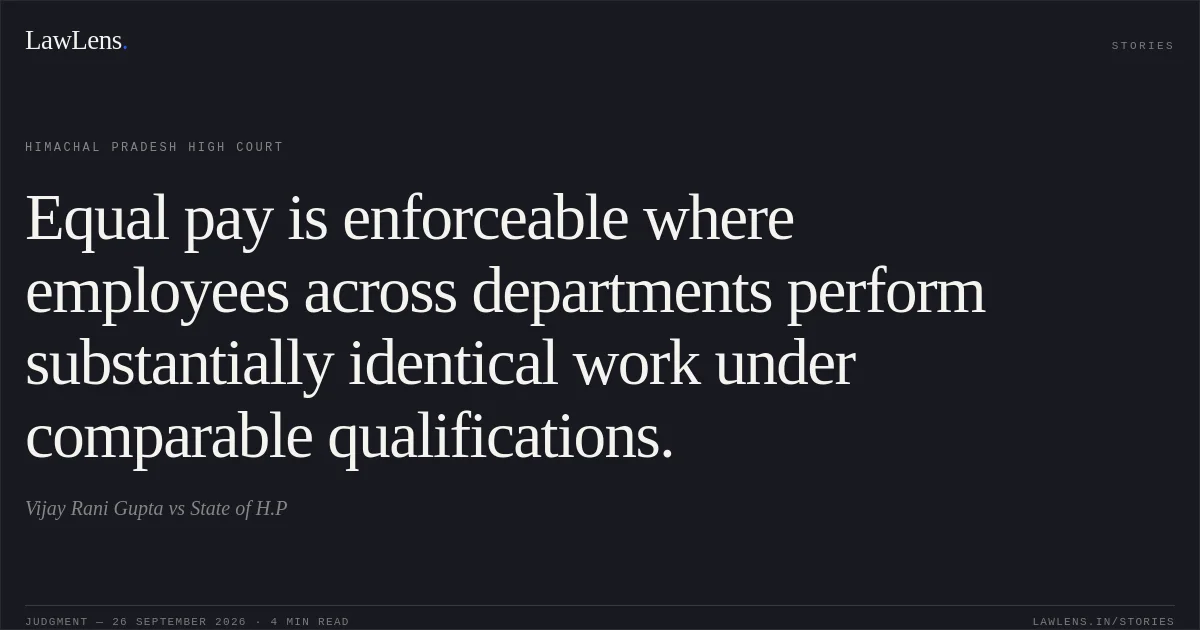
1. Whether the petitioner, despite being appointed as an Art/Craft Teacher in the Agriculture Department in the pay scale of Rs. 950–1800, was entitled to parity with Junior Tailoring Mistresses/Craft Teachers in the Rural Development Department on the principle of equal pay for equal work.
Source reference: paras. 16, 20, 232. Whether the respondents’ rejection of the petitioner’s claim on the basis that she had accepted the original pay scale and that pay fixation fell within the executive domain was legally sustainable.
Source reference: paras. 17, 21–253. Whether the petitioner was entitled to arrears for the entire period or only for a limited period preceding institution of the petition.
Source reference: para. 26Law Applied
The Court applied the constitutional principle of equal pay for equal work, read with Articles 14 and 16 of the Constitution, as articulated in Randhir Singh v. Union of India, (1982) 1 SCC 618.
Source reference: paras. 18–19It relied on Union of India v. Dineshan K.K., (2008) 1 SCC 586, and Union of India v. D.G.O.F. Employees Association, 2023 (15) Scale 293, for the proposition that although equation of posts and pay scales ordinarily lies within the executive and expert bodies’ domain, judicial intervention is permissible where employees possessing identical qualifications and performing substantially identical duties and responsibilities are treated differently on an irrational, arbitrary or unjust basis.
Source reference: paras. 22–24The Court also considered P.U. Joshi v. Accountant General, Ahmedabad, (2003) 2 SCC 632, while recognising the general limits on judicial determination of service conditions.
Source reference: para. 24For arrears, it applied Union of India v. Tarsem Singh, (2008) 8 SCC 648, under which a continuing pay-fixation wrong may be corrected despite delay, but arrears are ordinarily restricted to three years before institution of the writ petition.
Source reference: para. 26Reasoning
The Court found that the petitioner possessed qualifications comparable to those prescribed for the corresponding posts in the Rural Development and Education Departments and that the respondents had not specifically disputed her assertion that she performed substantially similar duties, functions and responsibilities.
Source reference: paras. 14, 20–21, 23The relevant Recruitment and Promotion Rules were also found to prescribe substantially identical qualifications across the Departments.
Source reference: paras. 21, 23Consequently, the difference in pay could not be justified merely by the petitioner’s departmental placement or her acceptance of the initial appointment order.
Source reference: paras. 20–21The Court held that acceptance of the appointment did not waive a continuing constitutional grievance arising from discriminatory pay treatment.
Source reference: paras. 20–21Although pay-scale determination ordinarily belongs to the executive, the admitted similarity of qualifications, duties and responsibilities, coupled with the absence of a rational justification for the differential treatment, brought the case within the recognised exception permitting judicial correction of an arbitrary pay anomaly.
Source reference: paras. 22–25However, applying Tarsem Singh, the Court limited recovery of arrears to three years preceding institution of the petition, while granting notional entitlement from the date of appointment.
Source reference: para. 26Holding
The Court allowed the petition and quashed the orders dated 10 April 2008 and 6 May 2009 rejecting the petitioner’s claim.
It directed the respondents to grant her the pay scale of Rs. 1350–2400 from the date of her appointment as Art/Craft Teacher, together with corresponding revisions with effect from 1 January 1996 and 1 January 2006 and all consequential benefits.
Source reference: para. 28Arrears were restricted to the three years preceding institution of the petition.
Source reference: para. 28If the arrears were not paid within six months, the respondents were directed to pay interest at 6% per annum from the date of judgment until actual payment.
Source reference: para. 28No order as to costs was made.
Source reference: para. 29Original Court PDF
Vijay Rani GuptavsState of H.P
Click to open original judgment
Original judgment, available to read, download and summarize on LawLens.in