Facts
The eviction petition under Section 14(1)(e) read with Section 25-B of the Delhi Rent Control Act, 1958 (“DRC Act”) was instituted in respect of shop No. IX/214, Ghas Mandi, Gandhi Nagar, Delhi.
Source reference: p.1, para. 1Notice was refused on 13 October 2016, and the tenant subsequently appeared before the Rent Controller on 17 February 2017, but did not file an application for leave to defend within fifteen days.
Source reference: pp.6–8, paras. 17–20The eviction petition was dismissed for non-prosecution on 26 October 2017 and was restored on 27 February 2020. The application for leave to defend was filed only on 11 February 2021.
Source reference: pp.6–8, paras. 17, 21–22The learned ARC rejected the application as time-barred and passed an eviction order under Section 25-B(4) of the DRC Act.
Source reference: p.7, para. 17The tenant challenged that order in revision under the proviso to Section 25-B(8), contending that restoration revived the statutory period and that the Supreme Court’s COVID-19 limitation orders extended the time for filing the application.
Source reference: pp.2–3, paras. 2–6Issues
1. Whether restoration of the eviction petition on 27 February 2020 revived or commenced a fresh period of fifteen days for filing an application for leave to defend under Section 25-B of the DRC Act.
Source reference: pp.12–13, paras. 28–312. Whether the Supreme Court’s orders in In Re: Cognizance for Extension of Limitation extended the period for filing the application for leave to defend in the circumstances of the case.
Source reference: pp.12–13, paras. 28–293. Whether the High Court, in exercising revisional jurisdiction under the proviso to Section 25-B(8), could interfere with the eviction order despite the belated application for leave to defend, on the ground that the tenant had raised triable issues.
Source reference: pp.14–17, paras. 33–364. Whether the learned ARC’s failure to examine the merits of the proposed defence constituted a jurisdictional error, material irregularity, or absence of adjudication.
Source reference: pp.19–20, paras. 39–42Law Applied
Section 25-B of the DRC Act prescribes a mandatory period of fifteen days for filing an application for leave to defend after due service of summons; under Section 25-B(4), failure to obtain leave results in the landlord’s statements being deemed admitted and ordinarily entitles the landlord to an eviction order.
Source reference: p.18, para. 38In Prithipal Singh v. Satpal Singh (Dead) through LRs, (2010) 2 SCC 15, the Supreme Court held that the fifteen-day period is mandatory and cannot be extended by resort to the Limitation Act or the CPC.
Source reference: pp.8–9, para. 23This principle was followed in M/s HIM Traders (P) Ltd. v. S.K. Gupta, 2014 SCC OnLine Del 4052, and Faridabad Manufacturing (Engineering Products) Pvt. Ltd. v. Yashpal Arora, 2014 SCC OnLine Del 3735, which held that even a one-day delay prevents consideration of the application.
Source reference: pp.9–11, paras. 24–25The revisional jurisdiction under the proviso to Section 25-B(8) is supervisory, not appellate, and permits interference only for jurisdictional error, manifest illegality, material irregularity, perversity, or an error apparent on the face of the record, as recognised in Sarla Ahuja v. United India Insurance Co. Ltd., (1998) 8 SCC 119; Hindustan Petroleum Corporation Ltd. v. Dilbahar Singh, (2014) 9 SCC 78; and Abid-Ul-Islam v. Inder Sain Dua, (2022) 6 SCC 30.
Source reference: pp.4–6, paras. 11–16Under Director, Directorate of Education v. Mohd. Shamim, 2019 SCC OnLine Del 11490, however, the High Court may exceptionally interfere where the tenant was prevented by reasons beyond control from filing the application in time and also demonstrates a substantial defence against the eviction claim.
Source reference: pp.14–17, paras. 34–35The Supreme Court’s COVID-19 orders excluded the limitation period from 15 March 2020 onwards but did not revive a statutory opportunity already lost before that date.
Source reference: pp.12–13, paras. 28–29Reasoning
The Court held that the tenant’s right to seek leave to defend had already been lost before the COVID-19 limitation exclusion commenced. Service had been refused on 13 October 2016, and, even giving the tenant the benefit of computing time from the date of personal appearance on 17 February 2017, no application was filed within fifteen days.
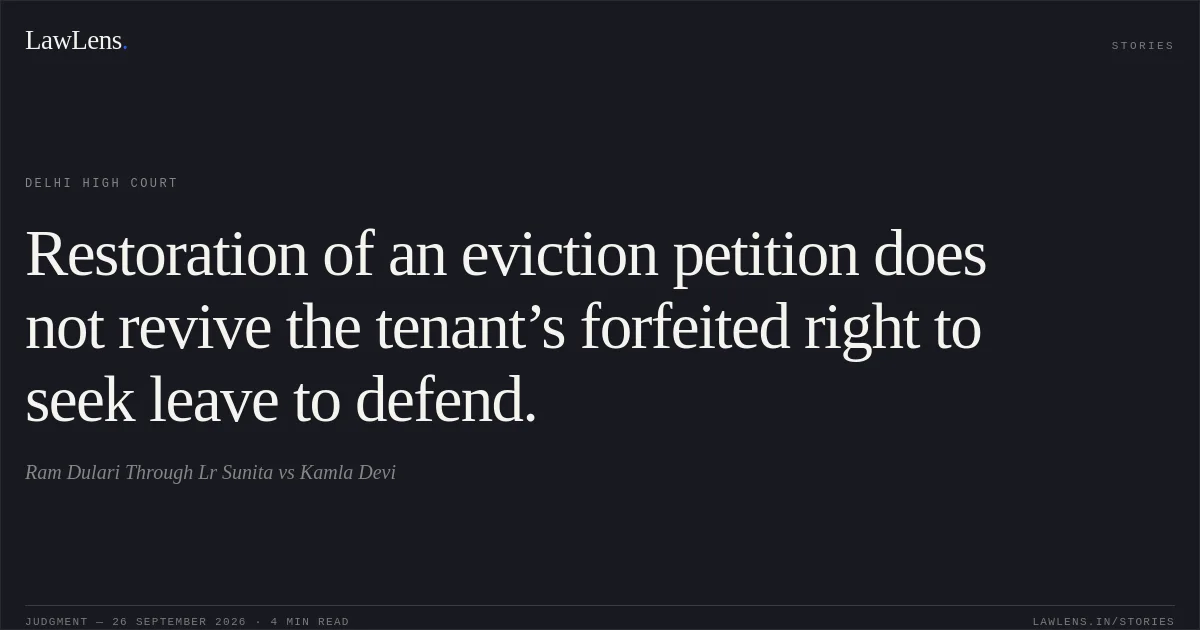
Source reference: pp.7–8, paras. 19–20, 26Restoration of the eviction petition did not erase the earlier proceedings or create a fresh statutory opportunity; otherwise, every restoration would restart the mandatory period under Section 25-B.
Source reference: pp.12–13, paras. 28–31Further, even after restoration on 27 February 2020, the tenant did not file the application within fifteen days. The Supreme Court’s limitation orders, which operated from 15 March 2020, therefore could not revive an opportunity already neglected.
Source reference: p.13, paras. 28–29Although the High Court could, in an exceptional case, examine whether the tenant was prevented by circumstances beyond control and whether a substantial defence existed, the tenant demonstrated no such preventing circumstance.
Source reference: pp.17–18, paras. 35–37Since the application was legally non-entertainable, the ARC was not required to examine the proposed triable issues. Its consideration of the procedural chronology and application of the mandatory statutory scheme disclosed no jurisdictional or material error warranting revision.
Source reference: pp.19–20, paras. 39–43Holding
The Court answered the issues against the tenant. Restoration of the eviction petition did not revive the fifteen-day period for filing leave to defend, and the COVID-19 limitation orders did not cure the tenant’s earlier defaults.
The belated application filed on 11 February 2021 was not legally entertainable, and the ARC was justified in passing an eviction order on the basis of the deemed admission under Section 25-B(4).
Source reference: p.18, para. 38Finding no jurisdictional error, manifest illegality, material irregularity, or perversity in the impugned order, the High Court dismissed the revision petition and disposed of all pending applications.
Source reference: p.20, paras. 43–45Acts & Sections Cited
5 provisions across 3 statutes referred to in this judgment. Each provision opens on LawLens.
delhi rent control act, 19583
Code of Civil Procedure, 19081
Limitation Act, 19631
Original Court PDF
Ram Dulari Through Lr SunitavsKamla Devi
Click to open original judgment
Original judgment, available to read, download and summarize on LawLens.in