Facts
On 11 March 2021, Hirma Sodi was returning to Motguda when a trailer bearing registration no. AP 16 TE-3757, allegedly driven rashly and negligently by Respondent No. 5, struck him. He sustained grievous injuries and died during treatment; a criminal case was registered following the incident
Source reference: para. 6His wife and three sons filed a claim under the Motor Vehicles Act, 1988, seeking compensation of ₹28,80,000. The Additional Motor Accident Claims Tribunal, South Bastar Dantewada, awarded ₹23,14,672 with interest at 6% per annum from the date of application until realization and held the Insurance Company liable.
Source reference: para. 7The Insurance Company filed an appeal under Section 173 of the Motor Vehicles Act, challenging only the quantum of compensation. Its objections concerned the assessment of the deceased’s monthly income at ₹15,000 and the deduction of only one-fourth towards personal and living expenses.
Source reference: paras. 5, 8Notice to the driver and owner was dispensed with because liability was admitted to rest upon the Insurance Company.
Source reference: paras. 2–4Issues
Whether the Claims Tribunal erred in assessing the deceased’s monthly income at ₹15,000 instead of ₹10,390 based on the applicable minimum wages notification?
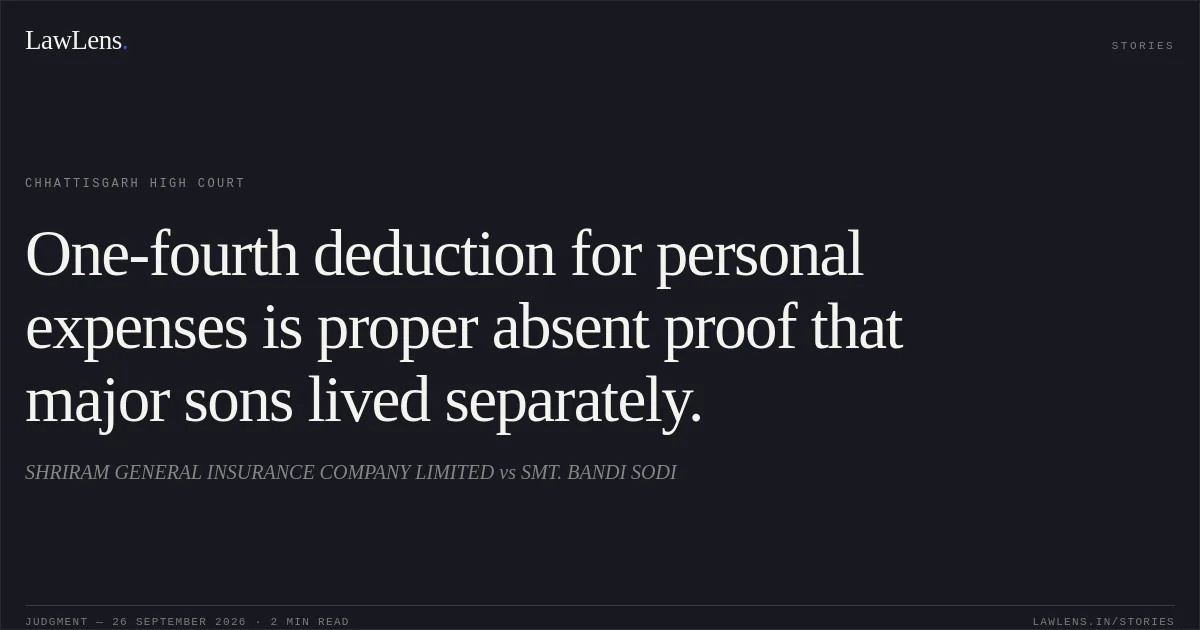
Source reference: paras. 8, 11Whether the deduction towards the deceased’s personal and living expenses ought to have been one-third, rather than one-fourth, because the three claimant-sons were major?
Source reference: paras. 8, 12Law Applied
The appeal was governed by Section 173 of the Motor Vehicles Act, 1988, which permits an aggrieved party to challenge an award of the Motor Accident Claims Tribunal.
Source reference: para. 5Compensation must be assessed on the basis of the evidence establishing the deceased’s income, and an evidentiary finding that was not challenged before the Tribunal may be accepted as just and proper.
Source reference: para. 11The deduction for personal and living expenses depends upon the number of established dependants and the evidence regarding their dependency and residence; the presence of major sons does not automatically require a one-third deduction where there is no pleading or evidence that they were living separately or were not dependants.
Source reference: para. 12Reasoning
The High Court upheld the Tribunal’s assessment of monthly income at ₹15,000 because the claimants had led evidence regarding the deceased’s agricultural and carpentry work, and the Insurance Company had not challenged that evidence before the Tribunal. The Court therefore rejected the proposed substitution of ₹10,390 based on minimum wages.
Source reference: para. 11It also upheld the one-fourth deduction. Although the three sons were major, the Insurance Company neither pleaded nor established that they were married, residing separately, or otherwise not dependent on the deceased. On the evidence before the Tribunal, the four claimants were properly treated as dependants, making the one-fourth deduction justified.
Source reference: para. 12Consequently, no error in the computation of compensation was demonstrated.
Source reference: no citationHolding
The Court answered both issues against the Insurance Company. It held that the monthly income of ₹15,000 and the one-fourth deduction towards personal and living expenses were properly determined by the Tribunal.
Finding no merit in the appeal, the High Court dismissed the Insurance Company’s appeal and left undisturbed the award of ₹23,14,672 with interest at 6% per annum, for which the Insurance Company remained liable.
Source reference: para. 13Acts & Sections Cited
1 provisions across 1 statute referred to in this judgment. Each provision opens on LawLens.
Motor Vehicles Act, 19881
Original Court PDF
SHRIRAM GENERAL INSURANCE COMPANY LIMITEDvsSMT. BANDI SODI
Click to open original judgment
Original judgment, available to read, download and summarize on LawLens.in