Facts
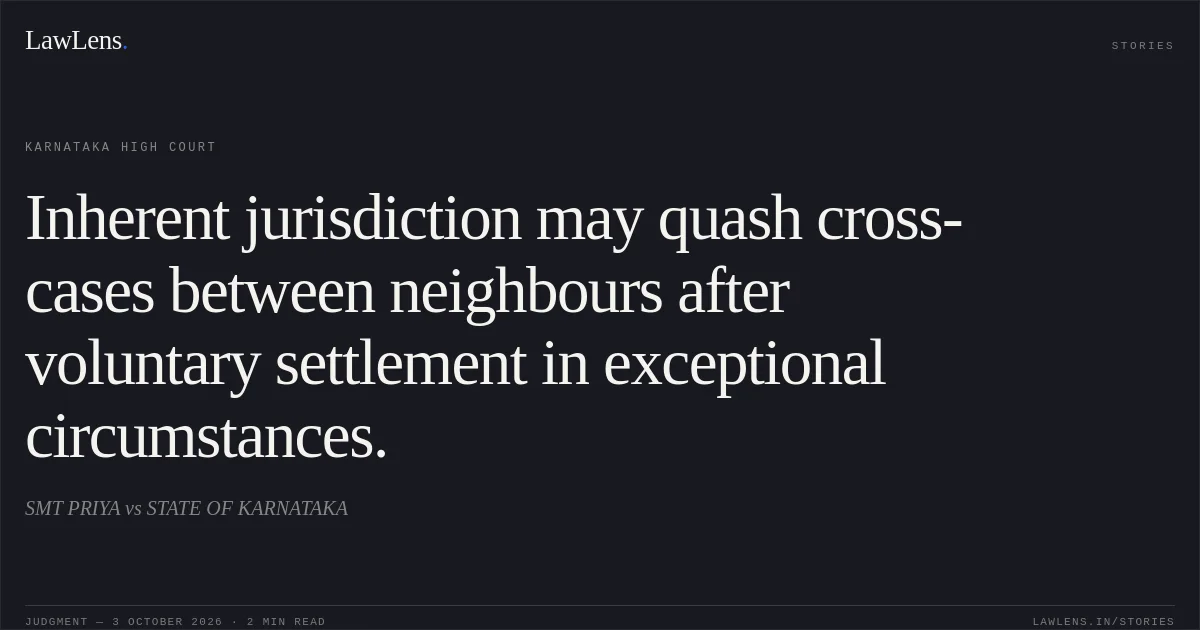
The petitions concerned cross-cases arising from a confrontation between neighbouring families on 8 February 2025. Priya alleged that Shivraj abused and threatened her; Namanashree alleged that Priya assaulted her and used caste-related abusive words.
Source reference: pp. 5–6, paras 4–5The cases proceeded as S.C. No. 72/2025, involving offences under the Bharatiya Nyaya Sanhita, 2023, and Spl.C. No. 30/2025, involving BNS offences and offences under the Scheduled Castes and the Scheduled Tribes (Prevention of Atrocities) Act, 1989.
Source reference: pp. 5–6, paras 4–5After charge sheets were filed, the parties settled, stated that they had no surviving grievance, and undertook to live peacefully as neighbours. They sought quashing of the respective proceedings under the High Court’s inherent jurisdiction.
Source reference: pp. 6–7, paras 6–9Issues
1. Whether the High Court should exercise its inherent jurisdiction to quash the proceedings in both cross-cases on the basis of the parties’ settlement, notwithstanding the seriousness and nature of the alleged offences.
Source reference: pp. 6–7, paras 7–82. Whether, in the particular circumstances—including the common neighbourhood dispute, cross-cases, and the parties’ continuing proximity—the settlement made continuation of the proceedings unnecessary to serve the ends of justice.
Source reference: pp. 7–10, paras 9–16Law Applied
The Court exercised its inherent jurisdiction under Section 482 of the Code of Criminal Procedure, 1973 / Section 528 of the Bharatiya Nagarik Suraksha Sanhita, 2023, to consider whether continuation of criminal proceedings would serve the ends of justice.
Source reference: pp. 4–5, paras 1–2; p. 7, para 8The Court observed that the jurisdiction is not confined to whether the offences are compoundable, but that settlement does not, by itself, justify quashing—particularly where serious offences are alleged, including offences under the SC/ST (Prevention of Atrocities) Act.
Source reference: pp. 6–7, paras 7–8No judicial precedents were cited in the order.
Source reference: no citationReasoning
The Court treated the cases as cross-proceedings arising from the same neighbourhood dispute, rather than unrelated transactions, and noted that both sides had voluntarily resolved their differences and expressed a clear intention to live peacefully as neighbours.
Source reference: pp. 5–8, paras 5–10Although the allegations—including those under the SC/ST Act—were serious and settlement alone would not ordinarily warrant termination, the Court found the combination of cross-cases, a shared factual origin, no indicated continuing dispute, and the parties’ ongoing proximity to be exceptional.
Source reference: pp. 6–10, paras 7–15It concluded that continuation would serve little purpose and risk perpetuating the very conflict the parties had resolved.
Source reference: pp. 8–11, paras 12–16Holding
The Court allowed both petitions and quashed the proceedings in S.C. No. 72/2025 and Spl.C. No. 30/2025, arising from Crime No. 19/2025.
It confined the decision to the peculiar facts of the case, clarified that it did not establish a general rule permitting quashing of such offences on settlement, and cautioned that the indulgence was one-off and would not be extended if similar conduct recurred.
Source reference: pp. 11–12, paras 17–19(v)Acts & Sections Cited
11 provisions across 4 statutes referred to in this judgment. Each provision opens on LawLens.
Code of Criminal Procedure, 19731
Bharatiya Nagarik Suraksha Sanhita, 20231
Bharatiya Nyaya Sanhita, 20238
Scheduled Castes and the Scheduled Tribes (Prevention of Atrocities) Act, 19891
Original Court PDF
SMT PRIYAvsSTATE OF KARNATAKA
Click to open original judgment
Original judgment, available to read, download and summarize on LawLens.in