Facts
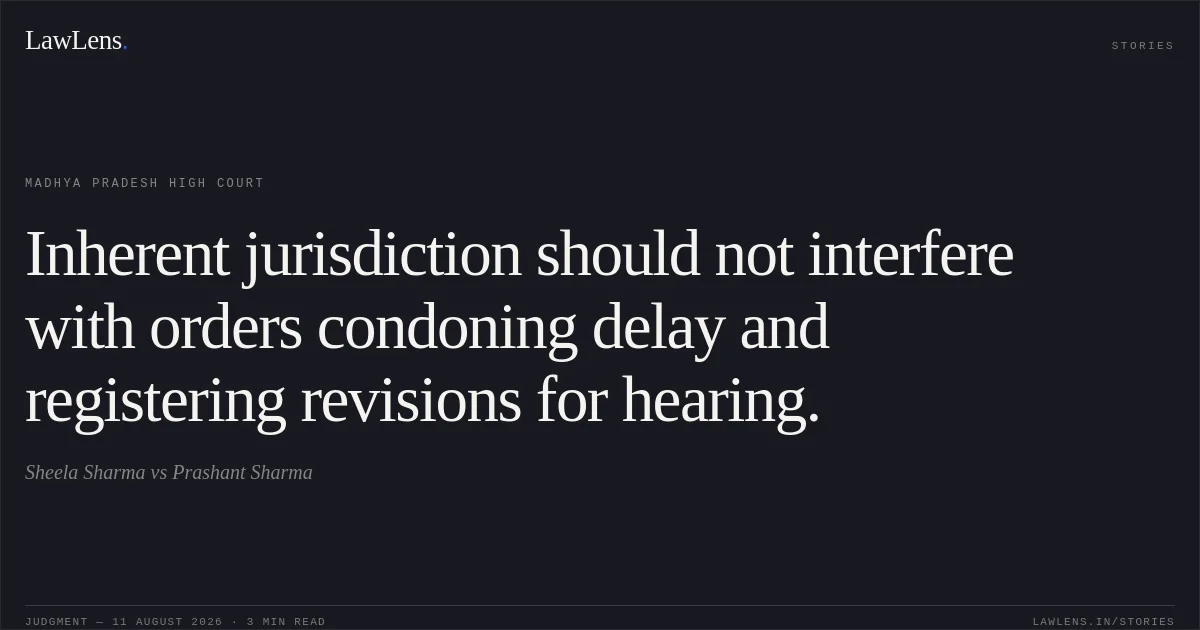
Proceedings under Section 152 of the Bharatiya Nagarik Suraksha Sanhita, 2023 (“BNSS”) were pending before the S.D.M., Sohagpur, District Shahdol. On 07.08.2024, the S.D.M. passed an interim order restraining interference with the repair work of a school building claimed by the applicant.
Source reference: p.1, para. 2The respondent challenged that order in Criminal Revision No. UNCR 230/2024, which was dismissed at the preliminary stage on 07.12.2024 as not maintainable against an interlocutory order.
Source reference: p.1, para. 2The respondent subsequently challenged another order dated 10.09.2024 passed in the same proceedings and filed an application under Section 5 of the Limitation Act for condonation of delay.
Source reference: p.1–2, para. 3Despite the applicant’s objections regarding limitation and maintainability, the First Additional Sessions Judge, Shahdol, condoned the delay and directed registration of Criminal Revision No. 12/2025 for hearing on merits by order dated 29.01.2025.
Source reference: p.1–2, para. 3The applicant invoked the High Court’s inherent jurisdiction under Section 528 BNSS to quash that order and the consequential proceedings.
Source reference: p.1, para. 1Issues
Whether the High Court should interfere under Section 528 BNSS with the order condoning delay and directing registration of the criminal revision for hearing on merits?
Source reference: p.1, para. 1; p.3–4, paras. 6–10Whether the Revisional Court was required to decide the maintainability of the criminal revision, including whether the order dated 10.09.2024 was interlocutory, before condoning the delay and registering the revision?
Source reference: p.2–3, paras. 4–8Whether the earlier dismissal of another revision as non-maintainable and the respondent’s alleged knowledge of the order constituted grounds for quashing the impugned order?
Source reference: p.2–3, paras. 4, 8–9Law Applied
The Court applied Section 528 BNSS, which preserves the High Court’s inherent jurisdiction to make orders necessary to give effect to the BNSS, prevent abuse of process, or secure the ends of justice.
Source reference: p.1, para. 1It also considered Section 5 of the Limitation Act, under which delay may be condoned upon sufficient cause being shown.
Source reference: p.1–2, para. 3The Court followed the principle that an order merely condoning delay and directing registration of a revision, without adjudicating the revision on merits or finally determining substantive rights, ordinarily does not warrant exercise of inherent jurisdiction.
Source reference: p.3–4, paras. 6–10The question whether the challenged order is interlocutory and whether the revision is maintainable was held to be one for consideration by the Revisional Court at the appropriate stage.
Source reference: p.3, para. 7Reasoning
The High Court confined its examination to the order dated 29.01.2025, which only condoned the delay and directed that the revision be registered for hearing.
Source reference: p.3, para. 6Since the Revisional Court had neither decided the revision on merits nor finally affected the parties’ substantive rights, the High Court found no illegality, perversity, or jurisdictional error justifying intervention under Section 528 BNSS.
Source reference: p.3–4, paras. 7, 9The applicant’s objection that the challenged order was interlocutory, as well as reliance on the earlier dismissal of another revision, were matters that could be urged before the Revisional Court itself.
Source reference: p.2–3, paras. 4, 8The respondent’s alleged knowledge of the order and the sufficiency of the cause for delay did not demonstrate prejudice of such magnitude as to require exercise of inherent powers at that stage.
Source reference: p.2–3, paras. 4, 8Holding
The Court answered the issues against the applicant and declined to interfere with the order dated 29.01.2025.
It held that the Revisional Court could consider the objections regarding limitation, maintainability, and the interlocutory character of the challenged order at the appropriate stage.
Source reference: p.4, para. 10The petition under Section 528 BNSS was dismissed as devoid of merit, while liberty was granted to the applicant to raise all available objections before the Revisional Court.
Source reference: p.4, para. 10Acts & Sections Cited
3 provisions across 2 statutes referred to in this judgment. Each provision opens on LawLens.
Bharatiya Nagarik Suraksha Sanhita, 20232
Limitation Act, 19631
Original Court PDF
Sheela SharmavsPrashant Sharma
Click to open original judgment
Original judgment, available to read, download and summarize on LawLens.in