Facts
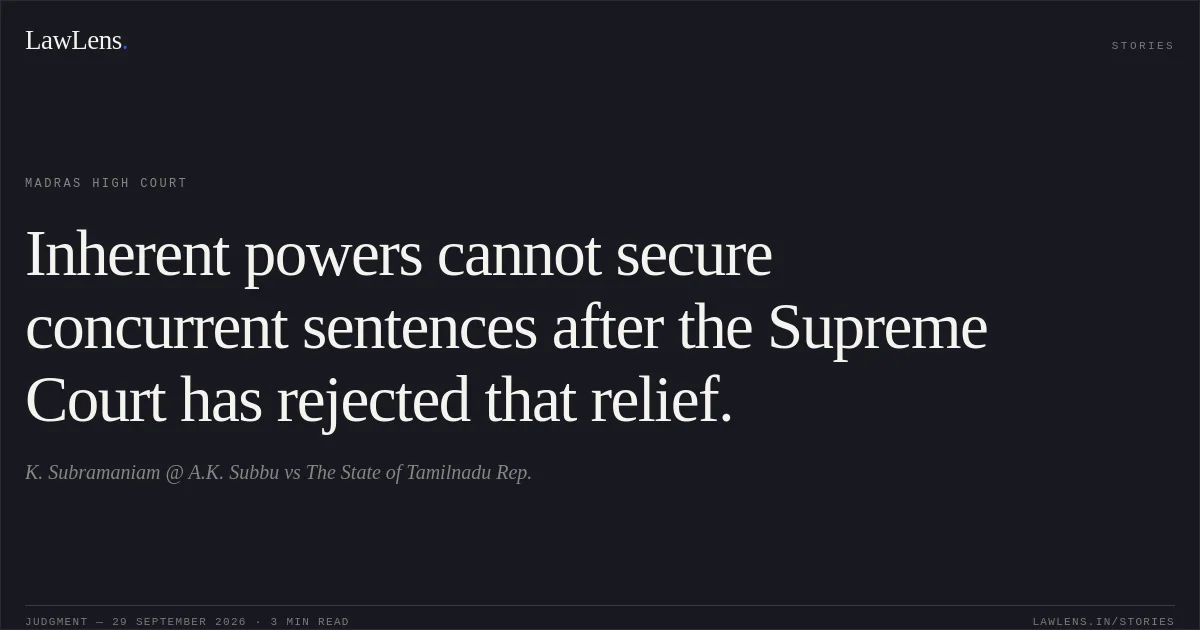
The petitioner had been convicted in five cases arising from alleged conspiracies to create forged insurance documents and obtain compensation awards.
Source reference: para. 2In the first four cases, he received sentences of up to two years; in the fifth, he was initially sentenced to five years, later reduced in revision. The sentences in each case were ordered to run concurrently internally, but no court directed that the sentences across the five cases run concurrently.
Source reference: para. 2, 5The convictions were upheld on appeal and revision; the Supreme Court dismissed the petitioner’s request for concurrent sentences under Section 427(1) of the Code of Criminal Procedure, 1973 (CrPC), and later dismissed his review petition.
Source reference: para. 2, 7He then sought relief under Section 528 of the Bharatiya Nagarik Suraksha Sanhita, 2023 (BNSS), relying also on his age and medical conditions.
Source reference: para. 3, 8Issues
Whether the High Court could use its inherent power under Section 528 BNSS to direct the sentences in the five cases to run concurrently after the Supreme Court had rejected the petitioner’s request for that relief under Section 427(1) CrPC
Source reference: para. 7, 16Whether the petitioner’s medical conditions justified directing the sentences to run concurrently
Source reference: para. 8, 31Law Applied
Section 427(1) CrPC establishes the general rule that a subsequent sentence commences after the expiry of the earlier sentence, while empowering the court to direct concurrent service in an appropriate case; that discretion must be exercised judicially, considering the offences and the circumstances, rather than mechanically.
Source reference: para. 20–24, 26–27The Court referred to Benson v. State of Kerala, (2016) 10 SCC 307; Anil Kumar v. State of Punjab, (2017) 5 SCC 53; P.N. Mohanan Nair v. State of Kerala, (2017) 14 SCC 719; Vicky @ Vikas v. State (NCT of Delhi), (2020) 11 SCC 540; and Iqram v. State of Uttar Pradesh, (2023) 3 SCC 184, among other authorities, for the discretionary nature of concurrency and the relevance of the facts of each case.
Source reference: para. 20–28Section 528 BNSS preserves the High Court’s inherent jurisdiction, but the Court treated that jurisdiction as unavailable to grant the requested relief in the circumstances of this case, particularly given the Supreme Court’s prior rejection of the same request.
Source reference: para. 7, 10, 30Reasoning
The Court considered that the five convictions arose from separate cases involving alleged forgery, conspiracy and attempted cheating, and that the petitioner’s convictions had been affirmed through the appellate process.
Source reference: para. 17–19It held that concurrency is discretionary, not automatic, and found no basis to exercise inherent jurisdiction in the petitioner’s favour: the trial courts had not ordered concurrency, no request had been made before them, and the Supreme Court had already rejected the petitioner’s request under Section 427(1) CrPC.
Source reference: para. 29–30The Court also noted that the prayer was framed incorrectly, as it sought to make the sentences in the earlier cases concurrent with the sentence in the later case.
Source reference: para. 30It declined to treat the petitioner’s reported illnesses as grounds for concurrency, noting that he had received medical treatment and could be treated in prison or at a nearby government hospital.
Source reference: para. 31–32Holding
The High Court dismissed the petition and refused to direct that the sentences in the five cases run concurrently.
It requested the Superintendent of Central Prison, Trichy, to ensure that the petitioner received appropriate medical treatment, either in the prison hospital or at a nearby government hospital.
Source reference: para. 32Acts & Sections Cited
14 provisions across 5 statutes referred to in this judgment. Each provision opens on LawLens.
Bharatiya Nagarik Suraksha Sanhita, 20232
Indian Penal Code, 18607
Code of Criminal Procedure, 19732
Narcotic Drugs and Psychotropic Substances Act, 19851
Drugs and Cosmetics Act, 19402
Original Court PDF
K. Subramaniam @ A.K. SubbuvsThe State of Tamilnadu Rep.
Click to open original judgment
Original judgment, available to read, download and summarize on LawLens.in