Facts
The applicants sought to quash FIR C.R. No. 11210050211310 of 2021 registered at Rander Police Station, Surat, and the resulting Sessions Case No. 150 of 2022.
Source reference: p. 1-2The FIR alleged offences including extortion, wrongful confinement, criminal intimidation, and conspiracy under Sections 387, 342, 323, 504, 506(2), 120B, and 201 of the IPC, alongside Sections 25(1)(A) and 27 of the Arms Act.
Source reference: p. 1-2The complainant alleged that members of the "Vipul Gajipara Gang" intercepted him at midnight, held him at gunpoint, and demanded Rs. 4 crore as "protection money".
Source reference: p. 4-5The applicants moved for quashing on the grounds that the matter was amicably settled, supported by a compromise affidavit from the complainant dated 11.01.2026.
Source reference: p. 2The record revealed that Applicant No. 1 was the kingpin of an organized crime syndicate with 11 serious pending offences, and Applicant No. 2 had 12 serious offences across Gujarat and Maharashtra.
Source reference: p. 3-4Issues
1. Whether the High Court should exercise its inherent powers to quash an FIR involving serious organized crime and extortion solely on the basis of a settlement between the parties.
Source reference: p. 1, 82. Whether the criminal antecedents of the accused and the gravity of the offence override a private compromise in the interest of justice and public order.
Source reference: p. 8-9Law Applied
The Court exercised its inherent powers under Section 528 of the Bharatiya Nagarik Suraksha Sanhita (BNSS), 2023.
Source reference: p. 1It relied on the guidelines established in State of Haryana and others v. Bhajan Lal and others (1992 (Supp.1) SCC 335) regarding the quashing of criminal proceedings.
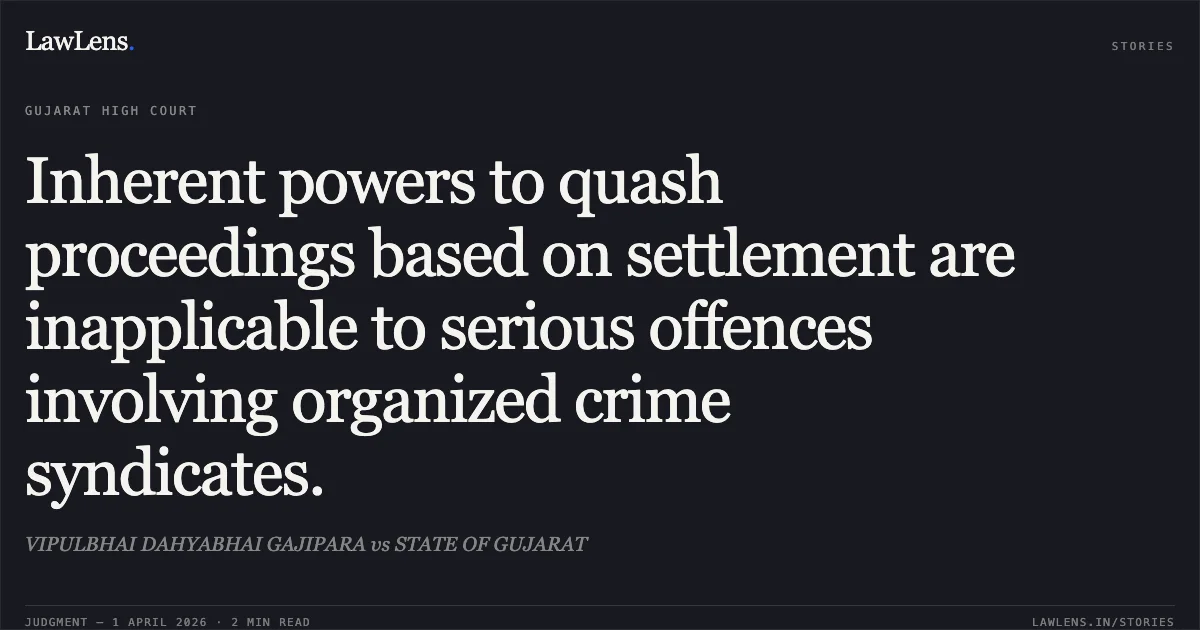
Source reference: p. 9The Court applied the principle that in cases involving "grave offences" or organized crime, public interest overrides private settlements, and inherent powers cannot be used to foster a "culture of impunity".
Source reference: p. 8-9Reasoning
The Court scrutinized the gravity of the allegations, noting that the victims were subjected to wrongful confinement and threatened with death to extort Rs. 4 crore.
Source reference: p. 5It observed that the applicants are headstrong individuals leading a criminal syndicate with interstate links.
Source reference: p. 7-8Investigating materials, including CCTV footage and the recovery of a weapon disposed of in the Tapi River, established a prima facie case.
Source reference: p. 6-7The Court highlighted a systemic pattern where such syndicates use "witness intimidation and victim coercion" to obtain compromise affidavits and withdraw prosecutions.
Source reference: p. 8It reasoned that mechanically quashing the FIR due to a settlement in such "egregious" circumstances would send a pernicious message to society and undermine the rule of law.
Source reference: p. 8-9Applying the Bhajan Lal criteria, the Court found that the proceedings were not an abuse of process but a necessary prosecution for serious criminal conduct.
Source reference: p. 9-10Holding
The Court dismissed the application in limine, refusing to quash the FIR or the Sessions Case.
It held that the inherent discretion of the Court cannot be invoked for headstrong offenders with significant criminal antecedents when the crime affects society at large.
Source reference: p. 9The Court concluded that the prosecution must be afforded the opportunity to prove its case through cogent evidence at trial.
Source reference: p. 10Acts & Sections Cited
10 provisions across 4 statutes referred to in this judgment. Each provision opens on LawLens.
Bharatiya Nagarik Suraksha Sanhita, 20231
Indian Penal Code, 18606
Arms Act, 19592
Code of Criminal Procedure, 19731
Original Court PDF
VIPULBHAI DAHYABHAI GAJIPARAvsSTATE OF GUJARAT
Click to open original judgment
Original judgment, available to read, download and summarize on LawLens.in


