Facts
The applicant (complainant) filed an FIR against the respondents for offences under Sections 294, 323, and 506/34 of the IPC.
Source reference: para 2The Trial Court (JMFC, Ashta) acquitted the respondents of Sections 294 and 506 but convicted them under Section 323 IPC, imposing a fine of ₹500 each.
Source reference: para 2The applicant challenged this via revision, arguing that a fracture injury was sustained, but due to the prosecution's failure to examine the radiologist, the accused were not charged/convicted under the more severe Section 325 IPC (Grievous Hurt).
Source reference: para 3The Revisional Court dismissed the plea, affirming the trial court's judgment. The applicant then moved the High Court under Section 482 of the CrPC seeking a remand for additional evidence.
Source reference: para 1, 3Issues
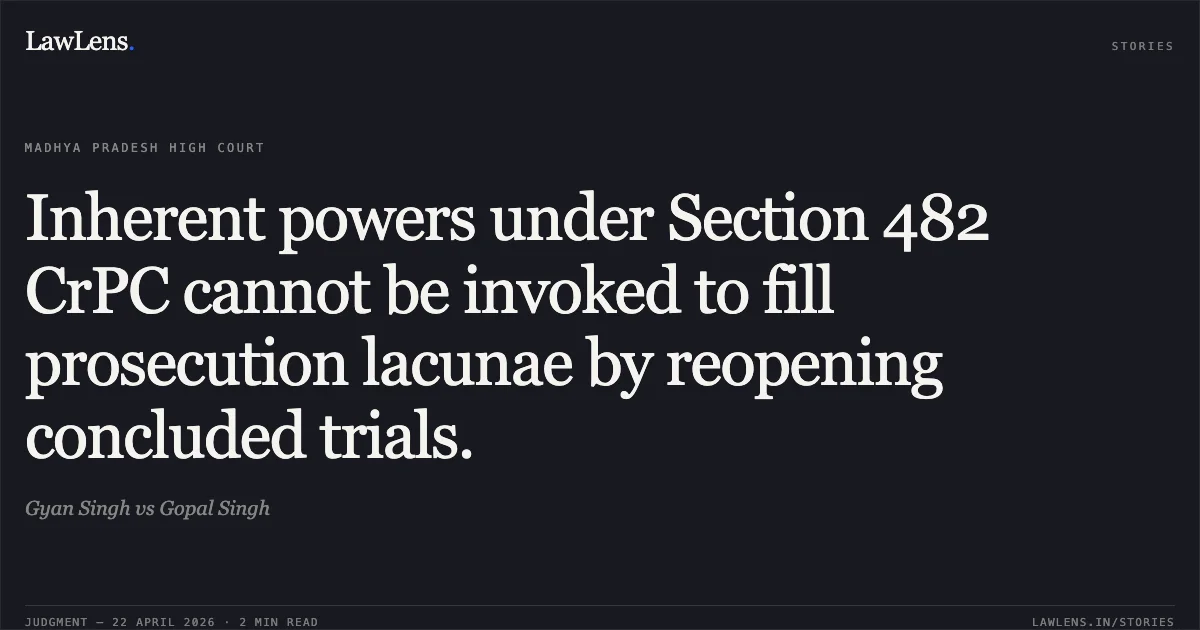
1. Whether the inherent powers of the High Court under Section 482 CrPC can be invoked to remand a matter for recording additional evidence to fill lacunae in the prosecution's case after the conclusion of trial and revision.
Source reference: para 7-92. Whether the non-examination of a material witness (radiologist) by the prosecution constitutes an "exceptional circumstance" justifying the reopening of a concluded trial.
Source reference: para 11Law Applied
The court applied Section 482 of the Code of Criminal Procedure, noting that inherent powers are limited and cannot be used to re-appreciate evidence or substitute findings of fact.
Source reference: para 7The court relied on the principle that prosecution must "stand or fall on the evidence adduced by it" and that inherent jurisdiction cannot cure negligence or deliberate lapses in examining witnesses.
Source reference: para 9, 10The court reinforced that additional evidence/remand is reserved for "exceptional circumstances" where such evidence is essential for a just decision and not to rectify a party's omission.
Source reference: para 10Reasoning
The Court observed that the trial had concluded and the conviction under Section 323 IPC was based on the evidence available, specifically noting that Section 325 IPC could not be proved because the radiologist was never examined.
Source reference: para 8The Court reasoned that the applicant had a full opportunity during the trial to ensure all material witnesses were summoned.
Source reference: para 11It held that the failure to examine the doctor was a prosecution lapse rather than a miscarriage of justice requiring judicial intervention.
Source reference: para 11Furthermore, since two subordinate courts had concurrently evaluated the facts, the High Court declined to act as a court of appeal to re-evaluate those findings, concluding that the petition was merely an attempt to "fill up lacunae".
Source reference: para 11-12Holding
The Court answered both issues in the negative, holding that Section 482 CrPC is not a tool to remedy prosecution negligence at a belated stage.
The High Court found no exceptional circumstances or illegality in the lower courts' orders. Consequently, the petition was dismissed, and the concurrent findings of the Trial Court and Revisional Court were upheld.
Source reference: para 11, 12Acts & Sections Cited
5 provisions across 1 statute referred to in this judgment. Each provision opens on LawLens.
Indian Penal Code, 18605
Original Court PDF
Gyan SinghvsGopal Singh
Click to open original judgment
Original judgment, available to read, download and summarize on LawLens.in