01Facts
The deceased, Sanjay, committed suicide on October 6, 2021, leaving a suicide note in his vehicle naming five accused persons and alleging they instigated him by filing false cases
p. 2Prior to the suicide, the deceased and his family were arraigned in an FIR (No. 11216009210509) dated September 3, 2021, for allegedly cheating villagers of Rs. 3,81,50,000/- under the pretext of developing an industrial park
p. 3The deceased had been arrested, suspended from service, and was on temporary bail at the time of his death
pp. 3, 6-7The impugned FIR (No. 11213022211360) was filed by the respondent on October 7, 2021, under Sections 306 and 114 of the IPC
p. 2Accused No. 2 expired during the pendency of the application, resulting in the abatement of proceedings against him
p. 202Issues
i.1. Whether the act of initiating legal proceedings (filing an FIR and issuing a notice under Section 138 of the Negotiable Instruments Act) constitutes "instigation" or "abetment" of suicide under Section 306 of the IPC.
pp. 3-4, 9ii.2. Whether the continuation of criminal proceedings against the applicants constitutes an abuse of the process of law warranting quashment under Section 482 of the CrPC.
p. 4, 1203Law Applied
The Court primarily applied Section 306 (Abetment of suicide) and Section 107 (Definition of abetment) of the IPC, which require proof of instigation, conspiracy, or intentional aid
pp. 7-8It relied on the Supreme Court’s guidelines in State of Haryana v. Bhajan Lal (1992) regarding the exercise of inherent powers under Section 482 of the CrPC to quash proceedings that do not prima facie constitute an offence
pp. 10-12The Court further referenced Abhinav Mohan Delkar vs. State of Maharashtra (2025) and Mohit Singhal vs. State of Uttarakhand, establishing that pressure from creditors or legal recourse for debt recovery does not amount to intentional instigation
p. 4Provisions in the judgment · 7 · Linked ones open on LawLens
Indian Penal Code, 1860 Section 306Section 114Section 406Section 420Section 107Section 409
Negotiable Instruments Act, 1881 Section 138
04Reasoning
The Court observed that the essential ingredients of Section 306—specifically the mens rea to instigate or abet suicide—were absent
p. 8It noted that a "live-link" or proximate connection between the accused’s actions and the suicide is mandatory
p. 9Upon examining the roles, the Court found that Accused No. 1 and 3 had filed a legitimate FIR for cheating, Accused No. 4 had issued a statutory notice for a dishonored cheque of Rs. 45 lakhs, and Accused No. 5, an advocate, had merely provided legal assistance
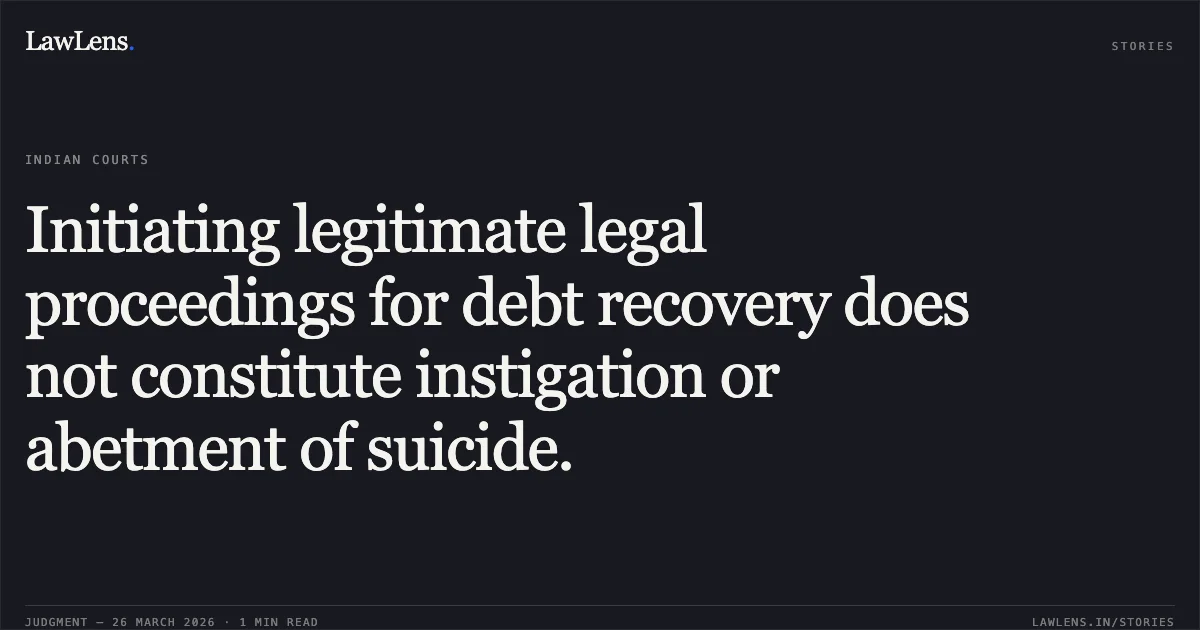
p. 9The Court reasoned that taking legal recourse to recover money or report a crime cannot be construed as creating circumstances where the deceased had "no other option" but suicide
p. 9It concluded that the suicide was likely a reaction to the deceased’s arrest and suspension in the cheating case rather than any positive act of instigation by the applicants
p. 4, 1005Holding
The High Court allowed the applications and quashed the impugned FIR (No. 11213022211360) and all consequential proceedings
p. 12The Court held that there was no iota of evidence suggesting the applicants instigated the suicide, and continuing the proceedings would amount to an abuse of the process of law
p. 12Rule was made absolute
p. 12Original Court PDF
HARDIKBHAI HASHMUKHBHAI BAROTvsSTATE OF GUJARAT
Click to open original judgment
Original judgment, available to read, download and summarize on LawLens.in