01Facts
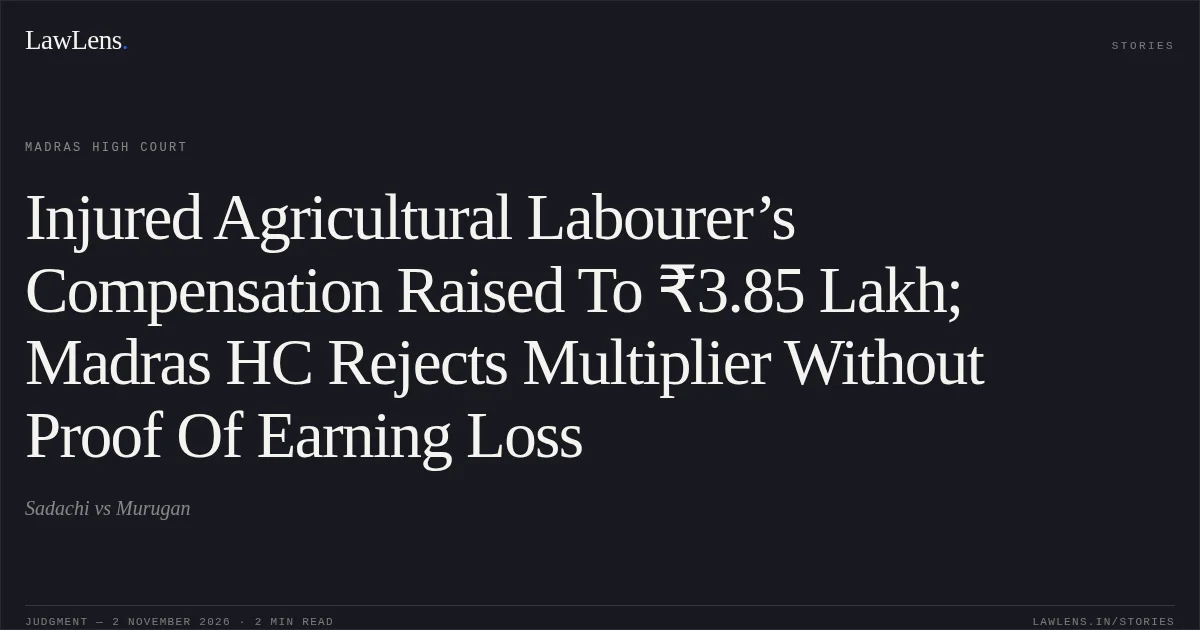
Sadachi, injured in a road accident on 10 December 2016, sought compensation under Section 166 of the Motor Vehicles Act, 1988.
p. 2The Tribunal found the accident was caused by the offending vehicle’s rider and awarded ₹2,85,000, including ₹1,50,000 for 50% permanent disability assessed by the Medical Board at ₹3,000 per percentage; it also ordered pay and recovery because the rider lacked a valid driving licence.
pp. 2–4Sadachi appealed, seeking enhancement and contending that the Tribunal should have assessed loss of earning capacity and applied the multiplier method.
pp. 4–5The appeal concerned quantum; the negligence finding was not disputed.
p. 602Issues
i.1. Whether the claimant’s 50% medical disability warranted compensation for loss of future earning capacity using the multiplier method, rather than the percentage method, in the absence of evidence of functional disability or loss of earning capacity?
pp. 7–8ii.2. Whether the amount awarded per percentage of disability should be increased, and the total compensation enhanced?
p. 903Law Applied
Section 166 of the Motor Vehicles Act, 1988 provides the basis for a claim for compensation arising from a motor accident, while Section 173 provides for an appeal to the High Court.
pp. 1–2Under the principles discussed in Raj Kumar v. Ajay Kumar, assessment of medical disability does not by itself determine loss of earning capacity: the Tribunal must consider whether the disability affects the claimant’s earning capacity.
p. 5The Court also applied M. Chinnathambi v. S. Deepa and National Insurance Company, which it relied on for awarding ₹5,000 per percentage of disability for accidents occurring from 2016 onwards.
p. 8The claimant cited C. Karunakaran v. SRM Transport India Pvt. Ltd. in support of assessing the effect of disability on work and earnings.
p. 5Provisions in the judgment · 2 · Linked ones open on LawLens
Motor Vehicles Act, 1988 Section 173Section 166
04Reasoning
The Medical Board assessed the claimant’s permanent disability at 50%, but the certificate did not address functional disability, and the evidence did not establish that she was prevented from performing her prior agricultural work or had suffered a resulting loss of earning capacity.
pp. 7–8The Court therefore upheld the Tribunal’s use of the percentage method rather than applying a multiplier.
p. 8However, applying M. Chinnathambi, it increased the rate from ₹3,000 to ₹5,000 per percentage, resulting in ₹2,50,000 for disability; it left the other compensation heads unchanged.
p. 905Holding
The appeal was partly allowed.
pp. 9–10The total compensation was enhanced from ₹2,85,000 to ₹3,85,000, with interest at 7.5% per annum from the date of the claim petition until deposit.
pp. 9–10The insurer was directed to deposit the amount, less any sum already withdrawn, within six weeks; no interest was payable on the enhanced compensation for the default period.
pp. 9–10Original Court PDF
SadachivsMurugan
Click to open original judgment
Original judgment, available to read, download and summarize on LawLens.in