01Facts
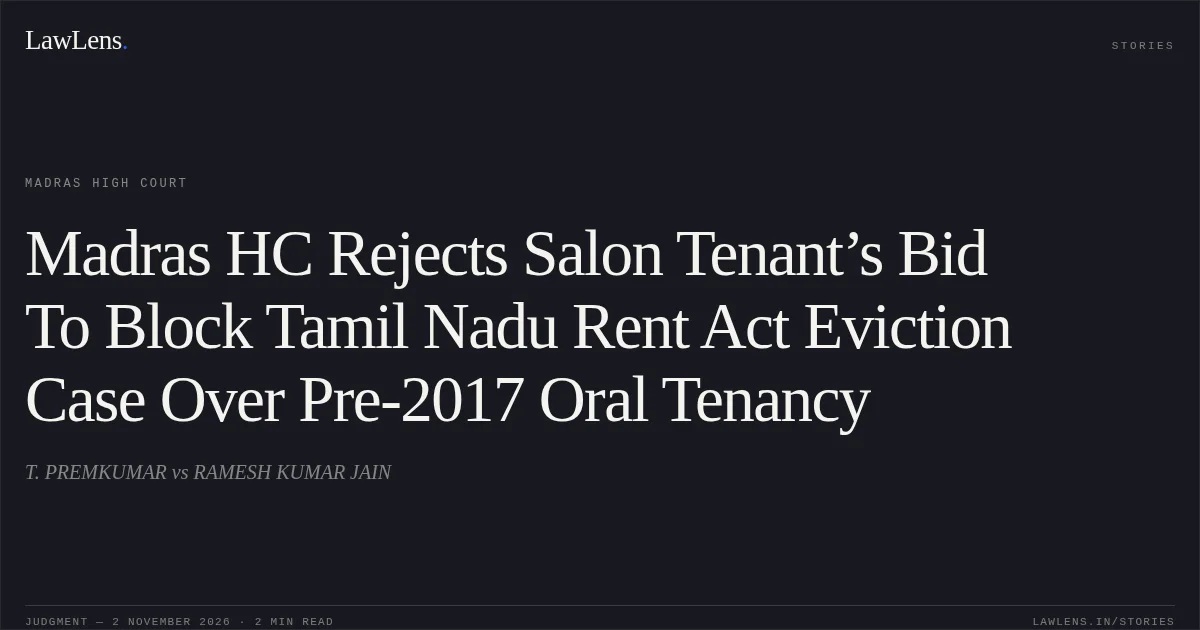
The petitioner’s grandfather became a tenant of the shop premises under an oral tenancy predating the Tamil Nadu Regulation of Rights and Responsibilities of Landlords and Tenants Act, 2017.
pp. 2–4 · ¶ 3–4After his grandfather’s death, the petitioner continued the tenancy.
pp. 2–4 · ¶ 3–4The respondent purchased the property in 2016, and the petitioner later paid rent to him, but no written tenancy agreement was executed.
pp. 2–4 · ¶ 3–4Following alleged non-payment of rent and the petitioner’s failure to execute a written agreement, the respondent sought eviction under Section 21(2)(a) of the Act.
pp. 2–4 · ¶ 3–4The petitioner challenged the maintainability of the eviction proceeding and sought to have it struck off, relying on S. Muruganandam v. J. Joseph [2022 SCC OnLine Mad 958].
pp. 2–4, 8–9 · ¶ 3–4, 11–1202Issues
i.1. Whether the eviction proceeding was liable to be struck off as not maintainable because the tenancy was oral and no written agreement had been executed
p. 4 · ¶ 6ii.2. Whether the tenancy fell within categories 5 or 6, rather than category 2, in S. Muruganandam, thereby requiring the landlord to seek eviction under the general law
pp. 4–5, 7–9 · ¶ 8–1103Law Applied
Section 4(2) of the Tamil Nadu Regulation of Rights and Responsibilities of Landlords and Tenants Act, 2017, and its proviso, as considered in S. Muruganandam v. J. Joseph, permit a landlord to invoke Section 21(2)(a) where a tenancy predating the Act continued without a written agreement; category 2 of S. Muruganandam concerns such pre-Act oral tenancies.
pp. 5–9 · ¶ 9, 11By contrast, categories 5 and 6 concern tenancies created after commencement of the Act—respectively, agreements that expired before the eviction petition and oral tenancies—and the decision states that landlords in those categories must pursue remedies under the Transfer of Property Act.
pp. 5–9 · ¶ 9, 11Provisions in the judgment · 3
Tamil Nadu Regulation of Rights and Responsibilities of Landlords and Tenants Act, 2017 Section 21Section 4Section 5
04Reasoning
The Court found that the tenancy originated orally before the 2017 Act and continued after the respondent purchased the property, without any written agreement being executed before or after the Act commenced.
pp. 8–9 · ¶ 11–12It therefore held that the case did not fall within categories 5 or 6, which concern post-Act tenancies, but squarely within category 2 of S. Muruganandam.
pp. 8–9 · ¶ 11–12Under that category, Section 21(2)(a), read with Section 4(2) and its proviso, was available to the landlord.
pp. 8–9 · ¶ 11–12The Court also noted that the petitioner had relied on category 2 before the Rent Court but advanced a different position in the revision.
pp. 8–9 · ¶ 11–1205Holding
The Court held that the respondent’s eviction petition under Section 21(2)(a) was maintainable and that the petitioner had shown no basis to strike it off.
p. 10 · ¶ 13The Civil Revision Petition was dismissed, with no order as to costs; the connected miscellaneous petition was closed.
p. 10 · ¶ 13Original Court PDF
T. PREMKUMARvsRAMESH KUMAR JAIN
Click to open original judgment
Original judgment, available to read, download and summarize on LawLens.in