01Facts
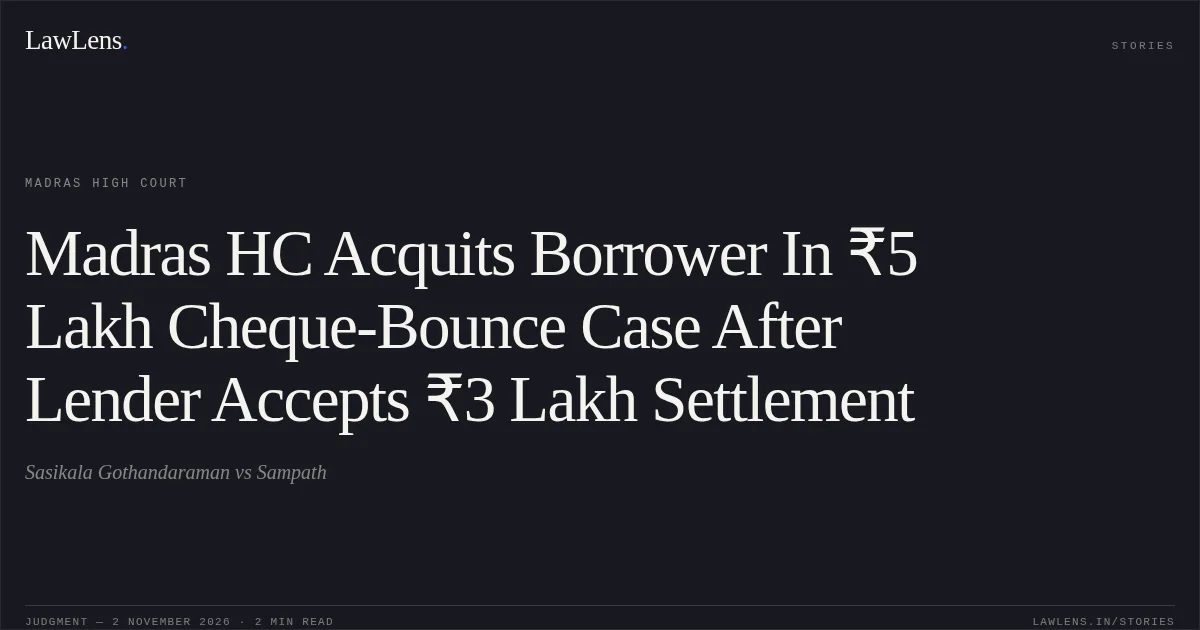
The petitioner was convicted under Section 138 of the Negotiable Instruments Act, 1881, for dishonour of two cheques issued towards a ₹5,00,000 loan. The Trial Court sentenced her to ten months’ simple imprisonment and directed her to pay ₹4,00,000 as compensation; the appellate court affirmed the conviction and sentence
pp. 2–3During the revision, the parties entered into a settlement for ₹3,00,000: the petitioner paid ₹2,00,000 directly to the respondent, and the respondent agreed to withdraw ₹1,00,000 deposited with the Trial Court as the balance. The respondent consented to compounding and had no further claim
pp. 4–602Issues
i.Whether the High Court could permit compounding of a Section 138 offence and set aside the conviction affirmed on appeal, on the basis of a subsequent settlement between the parties
p. 11 · ¶ 17ii.Whether the respondent was entitled to withdraw the ₹1,00,000 deposited by the petitioner with the Trial Court under the settlement
p. 16 · ¶ 2803Law Applied
Section 147 of the Negotiable Instruments Act makes every offence under that Act compoundable.
p. 13 · ¶ 18Section 359(6) of the Bharatiya Nagarik Suraksha Sanhita, 2023 empowers a High Court or Court of Session exercising revisional jurisdiction to permit compounding of an offence compoundable under that section; under Section 359(8), composition results in acquittal.
pp. 12–13 · ¶ 18The Court also referred to Damodar S. Prabhu v. Sayed Babalal H., which sets out a graded costs framework for delayed compounding, and to authorities recognising the compensatory purpose of Section 138 proceedings and permitting settlement-based resolution, including Meters and Instruments Private Limited v. Kanchan Mehta and Vinay Devanna Nayak v. Ryot Seva Sahkari Bank Limited
pp. 6–10 · ¶ 9–12Provisions in the judgment · 13 · Linked ones open on LawLens
Negotiable Instruments Act, 1881 Section 138Section 139Section 143Section 147
Code of Criminal Procedure, 1973 Section 258Section 357Section 431Section 264Section 482
Indian Penal Code, 1860 Section 64
Bharatiya Nagarik Suraksha Sanhita, 2023 Section 359
Bharatiya Nyaya Sanhita, 2023 Section 3Section 190
04Reasoning
The Court accepted that the appeal had already been dismissed and the conviction and sentence affirmed, but considered the parties’ subsequent settlement and the complainant’s voluntary consent to compound the offence. It held that Section 147 permitted compounding and, relying also on its prior decision in K. Balachenniappan v. Jeyakrishnan, concluded that the settlement justified allowing compounding in the interests of justice
pp. 13–15 · ¶ 19–24As the respondent had accepted the agreed settlement and had no further claim, the Court directed that the ₹1,00,000 deposited with the Trial Court be released to him upon application
p. 16 · ¶ 2805Holding
The conviction and sentence under Section 138 were set aside, and the petitioner was treated as acquitted on account of compounding
p. 15 · ¶ 25 · p. 16 · ¶ 26–27The revision was disposed of in terms of the settlement. The respondent was permitted to apply to the Trial Court to withdraw the ₹1,00,000 deposit, which the Trial Court was directed to release within three weeks of the application
p. 16 · ¶ 28Original Court PDF
Sasikala GothandaramanvsSampath
Click to open original judgment
Original judgment, available to read, download and summarize on LawLens.in