Facts
On June 9, 1996, an altercation occurred at a TSR stand in Sagarpur between Raj Kishore (PW-8) and the appellant Surinder Singh over taking passengers out of turn
Source reference: p. 2Surinder Singh left and returned with his parents and the appellant ASI Mohan Singh, armed with a knife, hockey stick, and iron strips
Source reference: p. 2During the assault, Surinder Singh inflicted fatal knife blows on Ram Kishore (deceased) and injured PW-8, while ASI Mohan Singh allegedly exhorted the attack and caught hold of the victims
Source reference: p. 2-3Ram Kishore succumbed to his injuries shortly after
Source reference: p. 3The trial court convicted Surinder Singh under Section 302 IPC and Mohan Singh under Section 324/34 IPC
Source reference: p. 4Surinder Singh appealed his conviction, while Mohan Singh restricted his appeal to the quantum of sentence, citing his age (80 years) and the 24-year duration of the proceedings
Source reference: p. 5, 28Issues
1. Whether the prosecution proved the guilt of Surinder Singh under Section 302 IPC beyond a reasonable doubt despite the absence of independent public witnesses and alleged contradictions in testimonies
Source reference: p. 5-72. Whether the mitigating circumstances, including the age of the appellant and the reformative theory of punishment, justify a reduction in the sentence of Mohan Singh
Source reference: p. 26-28Law Applied
The Court primarily applied Section 302 (Murder) and Section 324 (Voluntarily causing hurt by dangerous weapons) of the Indian Penal Code
Source reference: p. 4It relied on Section 134 of the Indian Evidence Act, 1872, establishing that the quality of evidence outweighs the quantity of witnesses
Source reference: p. 19-20The Court applied principles from Appabhai v. State of Gujarat regarding the reliability of prosecution cases in the absence of public witnesses
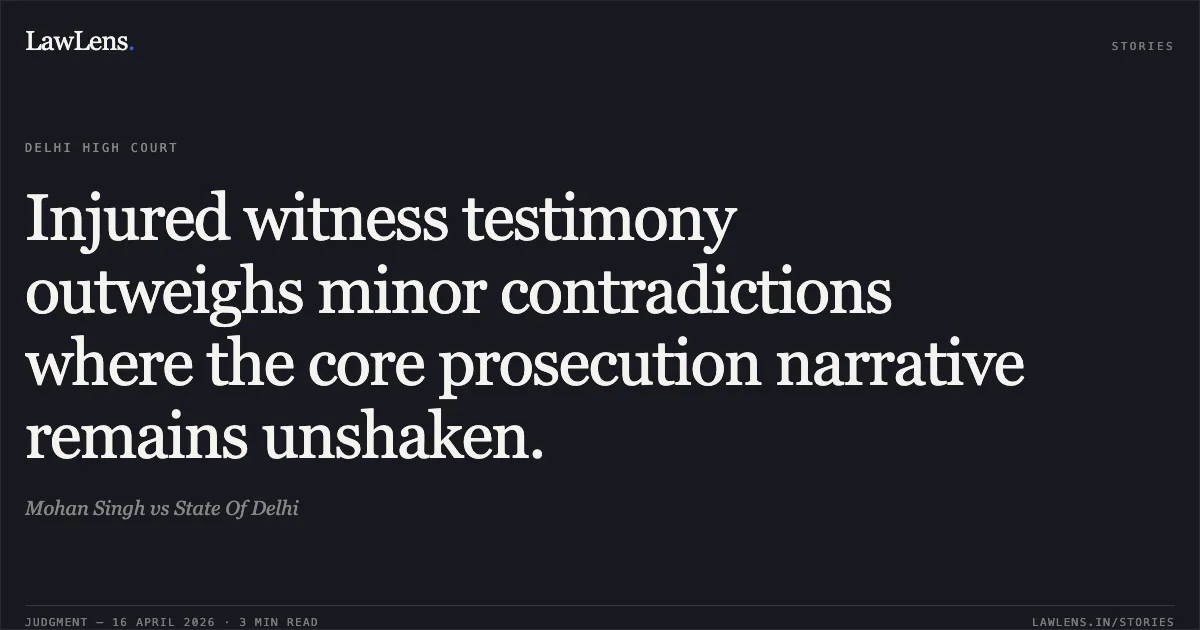
Source reference: p. 20The Court applied principles from Abdul Sayeed v. State of Madhya Pradesh concerning the high evidentiary value of injured witnesses
Source reference: p. 21-22Furthermore, it invoked the "Reformative Theory of Punishment" as articulated in Mohammad Giasuddin v. State of Andhra Pradesh and Pramod Kumar Mishra v. State of Uttar Pradesh
Source reference: p. 26-27Reasoning
The Court found that the presence of PW-8 at the scene was indisputable as he was an injured witness, and his testimony carried a "built-in guarantee" of truthfulness regarding the identity of the assailant
Source reference: p. 21-22It dismissed the defense's argument regarding minor contradictions, attributing them to the lapse of three years between the incident and the testimony
Source reference: p. 12-13The Court held that the non-examination of independent public witnesses was not fatal, noting societal apathy in criminal matters
Source reference: p. 20Regarding Surinder Singh, the Court determined that inflicting multiple stabs on vital parts established the requisite mens rea for murder under Section 302 IPC
Source reference: p. 23, 25For Mohan Singh, the Court noted he did not strike the fatal blow and had already undergone approximately one year of his one-and-a-half-year sentence
Source reference: p. 26, 28Given his advanced age of 80 years and the two-decade-long "ordeal of trial," the Court found him a fit candidate for a reduction in sentence under the reformative theory
Source reference: p. 28-29Holding
The Court dismissed CRL.A. 704/2002, upholding the conviction and life imprisonment sentence of Surinder Singh, and directed him to surrender immediately
The Court partly allowed CRL.A. 555/2002, maintaining Mohan Singh’s conviction but reducing his sentence to the period already undergone (approximately one year) in light of mitigating factors
Source reference: p. 28-29All other terms of the trial court's order remained unchanged
Source reference: p. 29Acts & Sections Cited
8 provisions across 3 statutes referred to in this judgment. Each provision opens on LawLens.
Indian Penal Code, 18605
Arms Act, 19592
Code of Criminal Procedure, 19731
Original Court PDF
Mohan SinghvsState Of Delhi
Click to open original judgment
Original judgment, available to read, download and summarize on LawLens.in