01Facts
The deceased, Sh. Madan Singh, was employed as a driver with Sh. Devinder Singh and sustained spinal injuries (D9 vertebra) in a motor accident on January 13, 2012, during the course of his employment
p. 2He underwent extensive treatment at Lok Nayak Hospital and Sir Ganga Ram Hospital but remained incapacitated and wheelchair-bound until his death on September 3, 2012
p. 2The respondents (widow and mother) filed a claim under the Employees’ Compensation Act, 1923. The widow subsequently remarried, leaving the mother as the sole pursuing claimant
p. 2The Commissioner, Employees’ Compensation, allowed the claim via order dated June 13, 2016, fastening liability on the appellant-insurer
p. 2The appellant challenged this order, arguing there was no proof of a causal nexus between the injuries and the death, nor was a formal disability certificate produced
p. 302Issues
i.1. Whether a claim for compensation survives for the benefit of legal heirs if a direct causal nexus between the injury and the eventual death is not established
p. 3, 4ii.2. Whether the Commissioner can determine the loss of earning capacity in the absence of a formal disability certificate or expert medical testimony
pp. 3-4iii.3. Whether the High Court can re-appreciate findings of fact regarding employer-employee relationships and injury severity under Section 30 of the Act
pp. 5-603Law Applied
The court primarily applied Section 3 and Section 30 of the Employees’ Compensation Act, 1923
p. 2, 5It relied on New India Assurance Co. Ltd. v. Sushila, which establishes that the right to compensation crystallizes on the date of the accident and forms part of the employee's estate
p. 4It further applied Kalavati Sakharam Ingular vs. Mahindra Ugine Steel Co. Ltd., holding that an injury contributing to the acceleration of death satisfies Section 3 requirements
p. 5Regarding the scope of appeal, the court cited North East Karnataka Road Transport Corporation v. Sujatha, which restricts High Court interference under Section 30 to substantial questions of law, barring re-appreciation of evidence unless findings are perverse
p. 6Provisions in the judgment · 2
Employee Section 3Section 30
04Reasoning
The court observed that while a direct causal nexus between the 2012 injury and the employee's death might be absent, the entitlement to compensation for injuries sustained during his lifetime remains valid
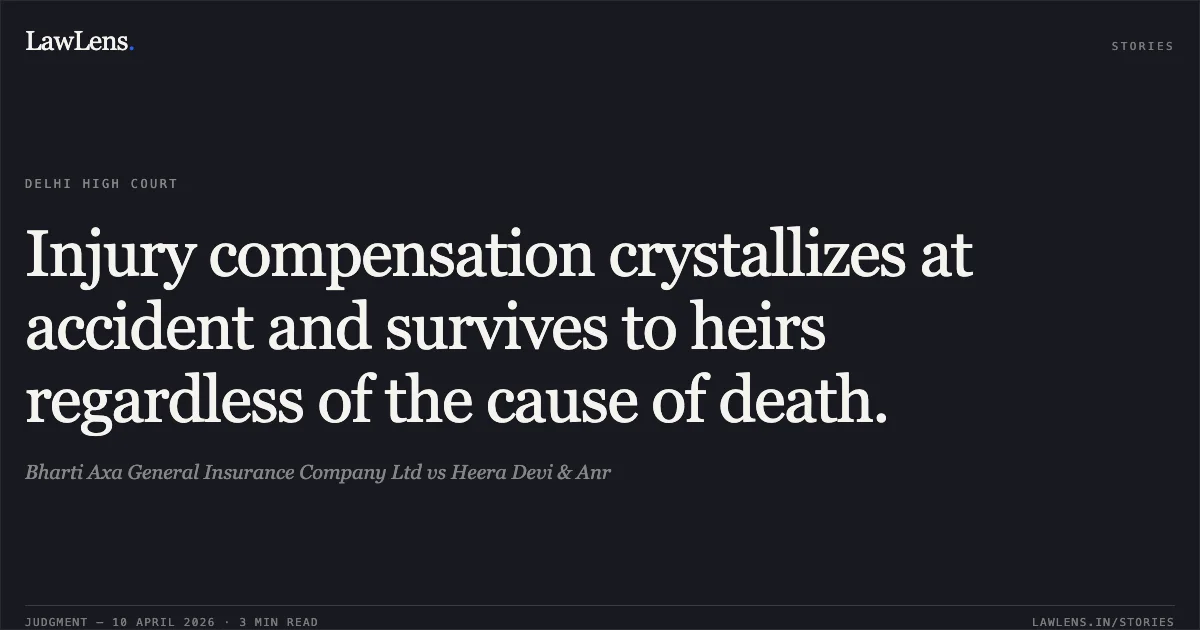
p. 3It reasoned that since the right to compensation crystallizes at the moment of the accident, it becomes a vested right that the legal heirs can pursue even if the death was not a direct result of the injury
pp. 4-5Regarding the lack of a disability certificate, the court held that the Commissioner is entitled to draw inferences of "functional disability" from the material on record, such as the nature of spinal injuries and the deceased’s dependence on a wheelchair, which rendered him totally unfit for his duties as a driver
p. 4The court found that the employer-employee relationship was sufficiently proven through investigation reports and the employer's failure to contest the proceedings (ex-parte)
p. 3Finally, the court determined that the appellant’s arguments sought a re-appreciation of facts, which is impermissible under Section 30 as no substantial question of law was raised
pp. 5-605Holding
The High Court dismissed the appeal, holding that the absence of a causal connection between injury and death does not defeat a claim for compensation for loss of earning capacity accrued during the employee's lifetime
p. 5The court affirmed the Commissioner's finding of total loss of earning capacity based on functional disability despite the absence of a formal certificate
p. 4, 6The impugned order awarding compensation was upheld, and all pending applications were disposed of
p. 6Original Court PDF
Bharti Axa General Insurance Company LtdvsHeera Devi & Anr
Click to open original judgment
Original judgment, available to read, download and summarize on LawLens.in