Facts
On 1 April 1990, the appellant, an auto-rickshaw driver, was injured when a car insured by respondent No. 2 collided with his rickshaw.
Source reference: para. 5, p. 2He claimed that before the accident he earned Rs. 200 per day driving the rickshaw and, afterward, could work only as a hawker earning Rs. 1,500 per month.
Source reference: para. 6, p. 3An injury certificate recorded a tibial fracture and assessed 22% partial permanent disability; the doctor who issued it was not examined.
Source reference: paras. 5, 13(c), pp. 2, 6The Tribunal awarded Rs. 34,000 as a lump sum for disability and pain and suffering, and Rs. 4,000 for treatment, conveyance and special diet.
Source reference: paras. 8, 17, pp. 4, 8The claimant appealed, challenging the assessment of compensation.
Source reference: paras. 1, 4, pp. 1–2Issues
1. Whether the Tribunal properly assessed the injured claimant’s income and compensation for disability.
Source reference: para. 1, p. 12. Whether compensation should be reassessed by determining functional disability and its effect on earning capacity, and by applying a multiplier and future-prospects enhancement.
Source reference: paras. 2–3, pp. 1–2Law Applied
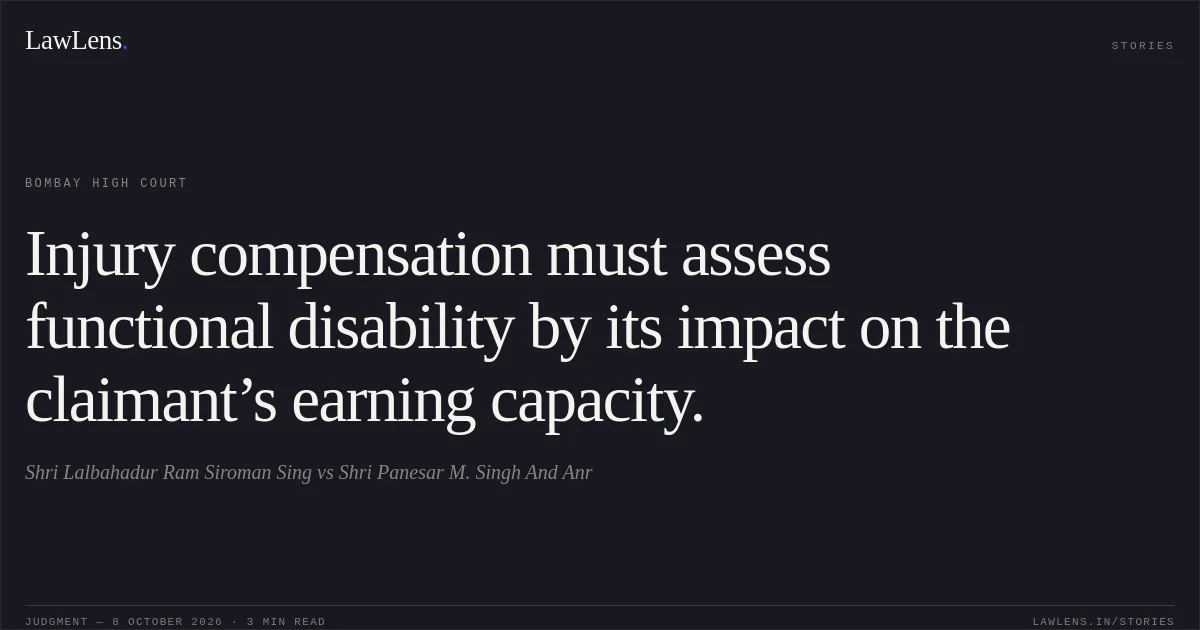
Under the Motor Vehicles Act, 1988, compensation for an injury-related disability requires assessment of the claimant’s income, physical disability, and functional disability—the effect of the disability on earning capacity—before calculating loss of future earnings.
Source reference: para. 13(c), p. 6In Raj Kumar v. Ajay Kumar, (2011) 1 SCC 343, the Supreme Court explained that functional disability depends on the affected body part, the claimant’s occupation, and the use of that body part in performing the occupation; where loss of future earning capacity is less than total, compensation may also be awarded for loss of amenities or expectation of life.
Source reference: para. 13(c), p. 6; para. 16, p. 7The Court distinguished Indra Bai v. Oriental Insurance Co. Ltd. & Anr., which concerned the codified assessment of disability under the Workmen’s Compensation Act, 1923, rather than a claim under the Motor Vehicles Act.
Source reference: para. 13(b), p. 6The Court also considered the principle that future prospects should be taken into account in assessing compensation for injury-related loss of earnings.
Source reference: paras. 2(d), 17, pp. 1, 8Reasoning
The Court held that the Tribunal’s lump-sum approach did not properly distinguish physical disability from its occupational impact.
Source reference: paras. 8, 13(a), pp. 4, 6Although the doctor was not examined and the claimant’s evidence did not establish total incapacity, the claimant’s unchallenged evidence showed that his earnings fell from Rs. 6,000 per month as a rickshaw driver to Rs. 1,500 per month as a hawker.
Source reference: paras. 7, 14–16, pp. 3, 7Considering the knee injury and fracture, but also the absence of amputation and the claimant’s ability to work as a hawker, the Court assessed functional disability at 10%, rather than 22% physical disability or 100% loss of earning capacity.
Source reference: paras. 14–15, p. 7It applied a monthly income of Rs. 6,000, a multiplier of 18, and a 40% future-prospects enhancement, and separately assessed pain and suffering, loss of amenities, special diet, conveyance, and medical treatment.
Source reference: paras. 16–18, pp. 7–9In response to the insurer’s objection concerning delay in prosecuting the claim, the Court reduced the quantum across heads rather than excluding interest for the period in question.
Source reference: paras. 9, 18, pp. 5, 9Holding
The appeal was partly allowed.
The Court assessed total compensation at Rs. 2,50,440 and, after deducting the Tribunal’s Rs. 34,000 award, directed the insured and insurer jointly and severally to pay the enhanced amount of Rs. 2,16,440 within eight weeks.
Source reference: paras. 17, 19(a)–(b), pp. 8–9The enhanced amount carries interest at 6% per annum from the date of the claim petition until payment, subject to payment of deficit court fees.
Source reference: para. 19(c)–(d), p. 9Original Court PDF
Shri Lalbahadur Ram Siroman SingvsShri Panesar M. Singh And Anr
Click to open original judgment
Original judgment, available to read, download and summarize on LawLens.in