Facts
On 2 August 2011, the claimant was travelling in a tempo that collided with an ST bus while the tempo was allegedly driven rashly and negligently.
Source reference: paras. 1–5; pp. 1–3He suffered multiple fractures, including fractures of both legs, the left hand and the left pubic rami, and underwent four surgeries.
Source reference: paras. 1–5; pp. 1–3The Motor Accident Claims Tribunal, Anand, partly allowed MACP No. 677 of 2011 and awarded ₹2,19,000 with interest at 9% per annum.
Source reference: paras. 1–5; pp. 1–3The claimant appealed solely on the ground that the compensation was inadequate, particularly regarding income, future prospects, functional disability, loss of income, pain and suffering, and attendant-related expenses.
Source reference: paras. 1–5; pp. 1–3The claimant’s income was not proved through cogent evidence; the Tribunal had assessed it at ₹3,000 per month, determined functional disability at 25%, and granted compensation under the other relevant heads.
Source reference: paras. 7–9, 13–18; pp. 2–7Issues
Whether, in the absence of proved income, the claimant’s income should be assessed on the basis of the minimum wages applicable to a skilled worker at the time of the accident.
Source reference: para. 13; p. 4Whether the claimant, aged about 22 years, was entitled to an addition of 40% towards future prospects.
Source reference: para. 13; p. 4Whether the Tribunal’s assessment of functional disability at 25% required enhancement in view of the claimant’s injuries and avocation.
Source reference: para. 14; pp. 5–6Whether the compensation awarded for actual loss of income, pain and suffering, and special diet, attendant charges and transportation required enhancement.
Source reference: paras. 15–18; pp. 6–7Law Applied
In motor accident compensation proceedings, where the claimant’s actual income is not established by cogent evidence, the court may assess income by applying the applicable minimum wages.
Source reference: para. 13; p. 4For a claimant aged below 40 years, an addition of 40% towards future prospects is permissible in accordance with National Insurance Company Ltd. v. Pranay Sethi, 2017 (16) SCC 680, and Sidram v. The Divisional Manager, United India Insurance Company Ltd., 2022 INSC 1202.
Source reference: para. 13; p. 4Loss of future earning capacity is assessed by applying the percentage of functional disability to the income, adding future prospects where applicable, and applying the multiplier corresponding to the claimant’s age.
Source reference: para. 14; pp. 5–6Functional disability must be assessed with reference not merely to medical disability but also to the effect of the injuries on the claimant’s actual avocation.
Source reference: para. 14; pp. 5–6Compensation must further be just and reasonable under the heads of actual loss of income, medical expenses, pain and suffering, and special diet, attendant charges and transportation.
Source reference: paras. 15–18; pp. 6–7Reasoning
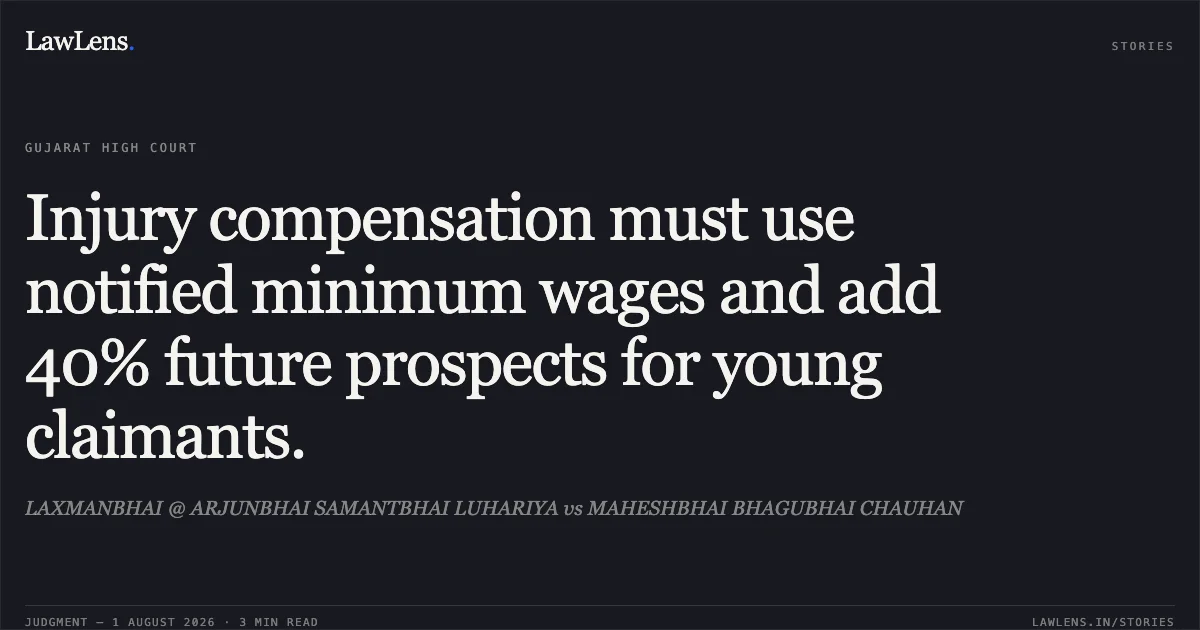
The High Court found that the Tribunal’s assessment of ₹3,000 per month was below the Gujarat minimum wage for a skilled worker, which was ₹4,660 per month in August 2011; accordingly, it reassessed the claimant’s income at ₹4,660.
Source reference: para. 13; p. 4Since the claimant was approximately 22 years old, the Court added 40% for future prospects, resulting in a monthly income of ₹6,524.
Source reference: para. 13; p. 4Although the medical evidence assessed whole-body disability at 48%, the Court examined its functional impact on the claimant’s work as a conductor.
Source reference: para. 14; pp. 5–6The claimant had difficulty standing for long periods, walking long distances, running and performing heavy work.
Source reference: para. 14; pp. 5–6In view of these restrictions and his avocation, the Court enhanced functional disability from 25% to 35% and applied the multiplier of 18, calculating future loss of income at ₹4,93,214.
Source reference: para. 14; pp. 5–6Considering the multiple fractures, four surgeries, prolonged hospitalisation and subsequent outdoor treatment, the Court enhanced pain and suffering from ₹15,000 to ₹75,000, awarded six months’ actual loss of income amounting to ₹27,960, and increased special diet, attendant charges and transportation from ₹15,000 to ₹30,000.
Source reference: paras. 15–18; pp. 6–7Medical expenses of ₹15,000 were maintained.
Source reference: paras. 15–18; pp. 6–7Holding
The appeal was partly allowed.
The total compensation was enhanced from ₹2,19,000 to ₹6,41,174, comprising ₹4,93,214 for future loss of income, ₹27,960 for actual loss of income, ₹15,000 for medical expenses, ₹75,000 for pain, shock and suffering, and ₹30,000 for special diet, attendant charges and transportation.
Source reference: para. 19; p. 7The claimant was consequently awarded additional compensation of ₹4,22,174, carrying interest at 9% per annum from the date of filing of the claim petition until realisation.
Source reference: para. 20; p. 7The respondent no. 3 insurance company was directed to deposit the additional amount with interest within six weeks.
Source reference: paras. 21–23; pp. 7–8The Tribunal was directed to disburse the compensation after due verification and deduction of any deficit court fee, if applicable.
Source reference: paras. 21–23; pp. 7–8Original Court PDF
LAXMANBHAI @ ARJUNBHAI SAMANTBHAI LUHARIYAvsMAHESHBHAI BHAGUBHAI CHAUHAN
Click to open original judgment
Original judgment, available to read, download and summarize on LawLens.in


