Facts
On March 10, 2001, at approximately 2:00 p.m., the deceased (Ramesh) was playing Holi when he was allegedly stabbed in the left thigh by the appellant, Tarun @ Rocky
Source reference: para. 3The incident was reportedly witnessed by the deceased’s mother (PW-6) and father (PW-3)
Source reference: para. 8, 27-28A PCR officer (PW-9) transported the victim to AIIMS, during which the victim purportedly made a dying declaration naming "Rocky" as the assailant
Source reference: para. 3, 30The victim succumbed to injuries at 2:00 a.m. the following day
Source reference: para. 4Following the appellant's arrest, a knife and blood-stained clothes were recovered, with FSL reports confirming the blood group matched the deceased's
Source reference: para. 5-6The Trial Court convicted the appellant under Section 302 of the IPC, sentencing him to life imprisonment
Source reference: para. 1-2, 10The appellant challenged the conviction, citing contradictions in witness testimonies and questioning the intent to murder
Source reference: para. 12-20Issues
Whether the prosecution proved the identity of the appellant as the assailant beyond a reasonable doubt given the alleged contradictions in witness testimony
Source reference: para. 12, 38Whether the act of stabbing the deceased twice in the thigh constitutes "Murder" under Section 302 or "Culpable Homicide not amounting to murder" under Section 304 of the IPC
Source reference: para. 20, 39Law Applied
The court applied Section 299 of the IPC (Culpable Homicide) and Section 300 of the IPC (Murder), distinguishing between the two based on "intention" and "knowledge"
Source reference: para. 39-41It relied on the landmark precedent Rampal Singh v. State of U.P. (2012) to delineate the degrees of culpable homicide and the "principle of exclusion" to determine if an act falls under Section 302 or 304
Source reference: para. 42The court further referenced State of A.P. v. Rayavarapu Punnayya regarding the genus-species relationship between culpable homicide and murder
Source reference: para. 42The court further referenced Mukesh & Anr. v. State (NCT of Delhi) regarding the reliability of police witnesses in the absence of public witnesses
Source reference: para. 22Reasoning
The Court upheld the finding that the appellant was the assailant, noting that the parents (PW-3 and PW-6) had no reason to falsely implicate him and their testimonies were corroborated by the prompt DD entry (recorded 10 minutes post-incident) naming "Rocky"
Source reference: para. 29, 31Minor discrepancies regarding the deceased’s clothes or the clerical error in the name (Arun vs. Tarun) did not vitiate the prosecution's case
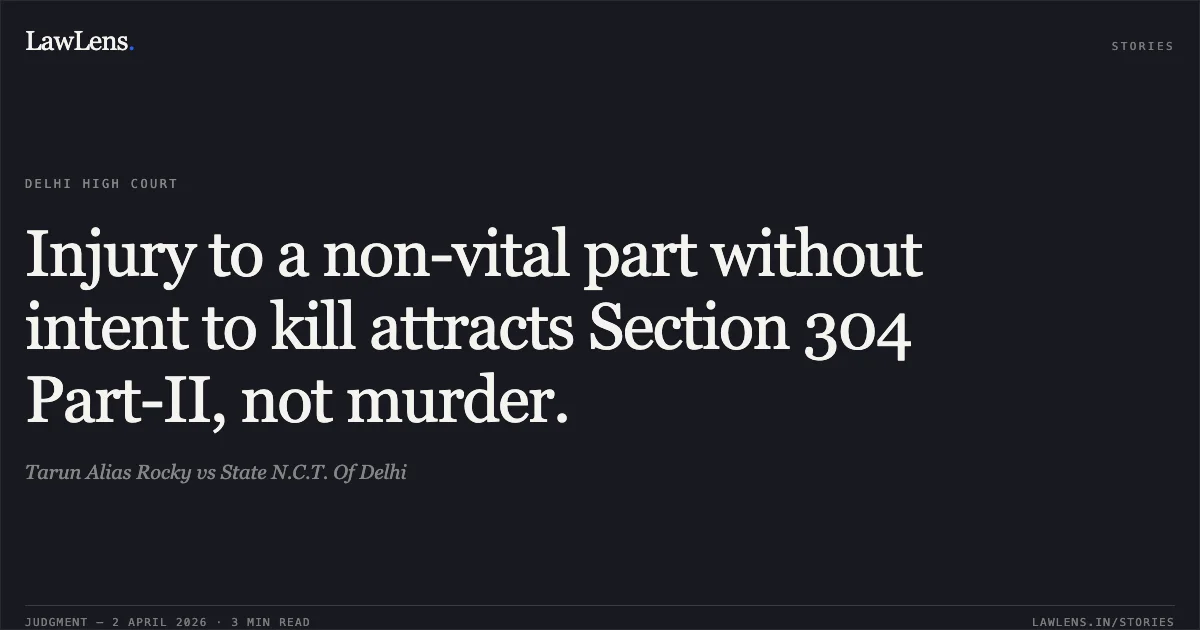
Source reference: para. 32, 37However, regarding the nature of the offense, the Court observed that the deceased and appellant were playing Holi together, and the deceased was under the influence of liquor, suggesting a sudden fight
Source reference: para. 43Crucially, the appellant inflicted injuries on the thigh—a non-vital part of the body—and the case was initially registered under Section 324 IPC
Source reference: para. 43Applying the Virsa Singh principles as discussed in Rampal Singh, the Court found that while the appellant had the "knowledge" that the injury was likely to cause death, the evidence failed to prove a "premeditated intention" to kill
Source reference: para. 43-44Holding
The Court partly allowed the appeal, setting aside the conviction under Section 302 IPC and instead finding the appellant guilty under Section 304 Part-II IPC (Culpable homicide not amounting to murder committed with knowledge but without intent)
The sentence of life imprisonment was reduced to seven years of rigorous imprisonment
Source reference: para. 46As the appellant had already undergone over five years of actual imprisonment plus remissions, he was directed to surrender within two weeks to serve the remaining period of the modified sentence
Source reference: para. 47-48Acts & Sections Cited
6 provisions across 2 statutes referred to in this judgment. Each provision opens on LawLens.
Indian Penal Code, 18605
Code of Criminal Procedure, 19731
Original Court PDF
Tarun Alias RockyvsState N.C.T. Of Delhi
Click to open original judgment
Original judgment, available to read, download and summarize on LawLens.in