Facts
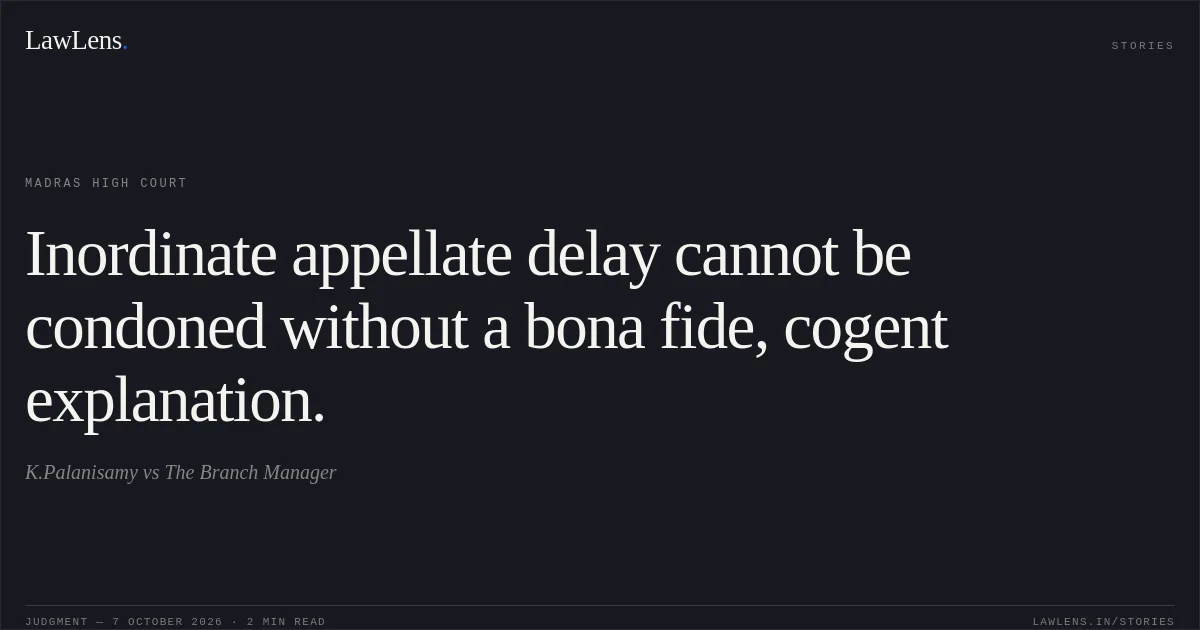
The appellant sought condonation under Section 5 of the Limitation Act of an 811-day delay in filing a writ appeal against the order dated 25 April 2024 in W.P. No. 22065 of 2021.
Source reference: p. 1–2He attributed the delay to age-related ailments, a road accident resulting in a leg fracture and a year-long recovery, followed by eye surgery; he stated that he consulted counsel in August 2026 to pursue the appeal.
Source reference: p. 1–2The Court considered the condonation application and dismissed it, with the appeal rejected at the SR stage.
Source reference: p. 2, 6Issues
1. Whether the appellant established sufficient cause under Section 5 of the Limitation Act to condone the 811-day delay in filing the writ appeal
Source reference: p. 2, 62. Whether the explanations in the appellant’s affidavit were bona fide and sufficiently valid and cogent to justify condonation of the delay
Source reference: p. 2, 6Law Applied
Section 5 of the Limitation Act permits condonation only where sufficient cause is established.
Source reference: no citationIn Karnataka Power Corporation Ltd. v. K. Thangappan, (2006) 4 SCC 322, the Supreme Court held that delay and laches may justify refusal of discretionary relief, with discretion exercised judicially and reasonably.
Source reference: p. 3Shivamma v. Karnataka Housing Board, 2025 INSC 1104, establishes that the length of delay is relevant, the court must first assess the bona fides of the explanation, and substantial justice does not automatically override inaction.
Source reference: p. 4Thirunagalingam v. Lingeswaran, 2025 INSC 672, reiterates that delay should not be condoned as an act of generosity and that the applicant must demonstrate reasonable grounds for the delay.
Source reference: p. 5Reasoning
Applying those principles, the Court assessed the appellant’s explanation before considering the merits of the proposed appeal.
Source reference: p. 2, 6It found that the affidavit’s assertions concerning his ailments, accident, recovery and eye surgery did not amount to sufficient cause for the inordinate delay; no valid and cogent reasons had been assigned to justify the full delay.
Source reference: p. 2, 6The Court therefore found no ground to exercise its discretion in the appellant’s favour.
Source reference: p. 6Holding
The Court held that the appellant had not established sufficient cause to condone the 811-day delay.
It dismissed C.M.P. No. 23237 of 2026 and consequently rejected W.A. SR No. 141431 of 2026 at the SR stage.
Source reference: p. 6Acts & Sections Cited
1 provisions across 1 statute referred to in this judgment. Each provision opens on LawLens.
Limitation Act, 19631
Original Court PDF
K.PalanisamyvsThe Branch Manager
Click to open original judgment
Original judgment, available to read, download and summarize on LawLens.in