Facts
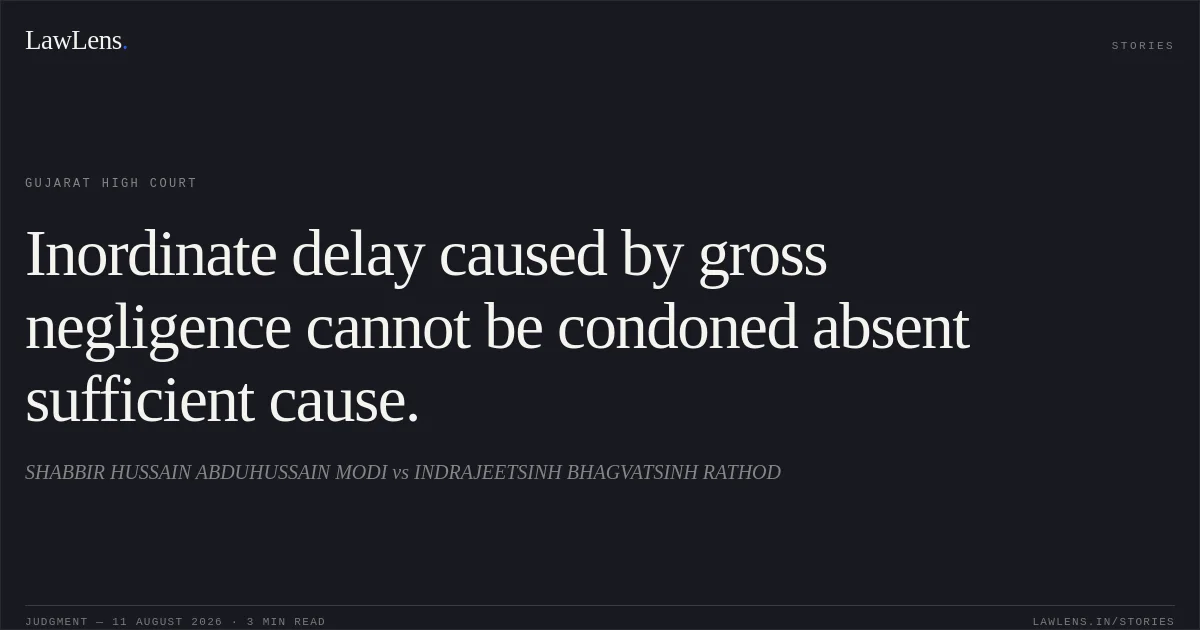
The petitioner challenged, under Article 227 of the Constitution, the order dated 21.04.2025 passed by the Sixth Additional District Judge, Bhuj-Kachchh in CMA No. 23 of 2025, whereby his application for condonation of delay was rejected.
Source reference: para. 2; p.1The Trial Court had rejected the petitioner’s plaint under Order VII Rule 11 of the Code of Civil Procedure by order/decree dated 01.10.2019.
Source reference: para. 4; p.3Although the petitioner was informed of the order by his advocate in 2020, he filed the first appeal only on 27.02.2025, resulting in a delay of approximately 1,900 days.
Source reference: paras. 4–5; pp.3–4He attributed the delay to his advanced age of about 69 years, residence at Rajkot while the suit was filed at Bhuj, dependence on family members, and restrictions during the COVID-19 period.
Source reference: paras. 3.1–3.2; p.2The delay application also disclosed that he had travelled abroad in 2023 and undertaken Hajj.
Source reference: para. 5.1; p.4Issues
Whether the petitioner had established sufficient cause under Section 5 of the Limitation Act, 1963 for condoning the approximately 1,900-day delay in filing the first appeal?
Source reference: paras. 4–6; pp.3–4Whether the Appellate Court committed a jurisdictional or legal error warranting interference by the High Court under Article 227 of the Constitution?
Source reference: paras. 7, 9–10; pp.4, 9–10Whether the delay could be condoned by imposing reasonable costs despite the petitioner’s prolonged inaction and negligence?
Source reference: paras. 3, 8.2, 10; pp.2, 8–10Law Applied
The Court applied Section 5 of the Limitation Act, 1963, under which delay may be condoned only when “sufficient cause” is established; although the provision receives a liberal and justice-oriented interpretation, such discretion is unavailable where the litigant’s conduct demonstrates gross negligence, inaction, lack of bona fides, or want of due diligence.
Source reference: para. 8; pp.4–6The Court relied on K.B. Lal (Krishna Bahadur Lal) v. Gyanendra Pratap & Ors., 2024 (4) Scale 759, Basawaraj v. Special Land Acquisition Officer, (2013) 14 SCC 81, and Esha Bhattacharjee v. Managing Committee of Raghunathpur Nafar Academy, (2013) 12 SCC 649, which require a balanced, pragmatic approach but distinguish between bona fide delay and gross negligence.
Source reference: para. 8; pp.4–6, 8It also relied on Pathapati Subba Reddy v. Special Deputy Collector (LA), 2024 INSC 286, holding that limitation is founded on public policy, that condonation is discretionary even where some explanation exists, and that merits ordinarily should not be examined while deciding delay.
Source reference: para. 8.1; pp.6–7Rajneesh Kumar v. Ved Prakash, 2024 LiveLaw (SC) 912, and Shivamma (Dead) by LRs v. Karnataka Housing Board, 2025 INSC 1104, were relied upon for the principles that inordinate delay and prolonged inaction require a strict approach and that the Court must first assess the bona fides of the explanation.
Source reference: paras. 7, 8.3; pp.4, 8–9The Court further applied the limited supervisory scope of Article 227 of the Constitution and held that conditions or costs cannot substitute for the statutory requirement of sufficient cause.
Source reference: paras. 8.2, 10; pp.8, 9–10Reasoning
The High Court held that the explanation was insufficient to account for the entire period of delay.
Source reference: para. 5; p.3It was prepared to accept that the petitioner’s age, distance between Rajkot and Bhuj, and the COVID-19 restrictions could explain some inaction during the relevant period; however, the COVID-19 situation had substantially ended by the second half of 2022.
Source reference: para. 5; p.3The petitioner thereafter took no effective steps to contact his advocate or file the appeal between 2022 and 2025, despite having been aware of the Trial Court’s order since 2020.
Source reference: paras. 5–6; pp.3–4His ability to travel abroad and undertake Hajj in 2023 further weakened the assertion that he was unable to travel approximately 250 kilometres to Bhuj for pursuing the appeal.
Source reference: para. 5.1; p.4The Court therefore characterized the conduct as gross negligence and lackadaisical prosecution of the remedy, rather than bona fide delay.
Source reference: paras. 6, 9; pp.4, 9In light of the governing precedents, the Court held that the petitioner’s offer to pay costs, or the asserted merits of the proposed appeal, could not cure the absence of sufficient cause.
Source reference: paras. 3.3, 8.1–8.2; pp.2, 6–8Since the Appellate Court had correctly applied the law and committed no gross error, Article 227 jurisdiction was not attracted.
Source reference: paras. 7, 10; pp.4, 9–10Holding
The High Court answered the issues against the petitioner.
It held that the petitioner failed to establish sufficient cause for the approximately 1,900-day delay and that the delay resulted from gross negligence and prolonged inaction.
Source reference: paras. 6, 9; pp.4, 9The order dated 21.04.2025 rejecting the condonation application was found to be legally sound, and no ground for interference under Article 227 was made out.
Source reference: para. 10; p.10The Special Civil Application was accordingly dismissed, with no order as to costs.
Source reference: para. 11; p.10Acts & Sections Cited
2 provisions across 1 statute referred to in this judgment. Each provision opens on LawLens.
Original Court PDF
SHABBIR HUSSAIN ABDUHUSSAIN MODIvsINDRAJEETSINH BHAGVATSINH RATHOD
Click to open original judgment
Original judgment, available to read, download and summarize on LawLens.in