Facts
The petitioners are the legal heirs of Jantuben (original plaintiff No. 3), who filed Regular Civil Suit No. 272 of 2011.
Source reference: p. 1-2Jantuben died on January 26, 2014, while the suit was pending.
Source reference: p. 2The petitioners filed an application (Exhibit 48) to be brought on record as legal heirs only on September 5, 2023—a delay of over nine years.
Source reference: p. 4-5They attributed the delay to illiteracy, lockdowns, and the failure of their Power of Attorney (PoA) holders to take action.
Source reference: p. 3On April 7, 2025, the Trial Court rejected the delay condonation application, finding a lack of "sufficient cause."
Source reference: p. 2, 5The petitioners challenged this under Article 227 of the Constitution.
Source reference: p. 1Issues
1. Whether the petitioners demonstrated "sufficient cause" under Section 5 of the Limitation Act to condone a nine-year delay in bringing legal heirs on record.
Source reference: p. 5, 152. Whether the negligence or inaction of a Power of Attorney holder constitutes a valid ground for condoning inordinate delay by the principal.
Source reference: p. 7, 10Law Applied
Section 5 of the Limitation Act, 1963, regarding "sufficient cause" for delay condonation.
Source reference: p. 8, 15Order XXII Rule 9 of the CPC regarding setting aside abatement.
Source reference: p. 8, 15The maxim vigilantibus non dormientibus jura subveniunt (the law assists the vigilant, not those who sleep over their rights).
Source reference: p. 10Suresh Chandra (Deceased) v. Parasram (2025) on the failure to substitute close relatives.
Source reference: p. 8Rajneesh Kumar v. Ved Prakash (2024) on the duty of litigants to be vigilant despite lawyer negligence.
Source reference: p. 10K.B. Lal v. Gyanendra Pratap (2024) and Esha Bhattacharjee (2013) on the parameters for "sufficient cause".
Source reference: p. 11-12Pathapati Subba Reddy v. Special Deputy Collector (2024) establishing that discretionary power cannot defeat the substantive law of limitation in cases of gross negligence.
Source reference: p. 13Reasoning
The Court observed that the petitioners were grossly negligent and "indolent" in pursuing their rights.
Source reference: p. 7-8It noted that the petitioners were aware of the death since 2014 and had even executed a new Power of Attorney in 2018, yet failed to inquire about the suit's progress for years.
Source reference: p. 6-7The Court rejected the argument of "illiteracy" and "lockdown," noting the delay began years before the pandemic.
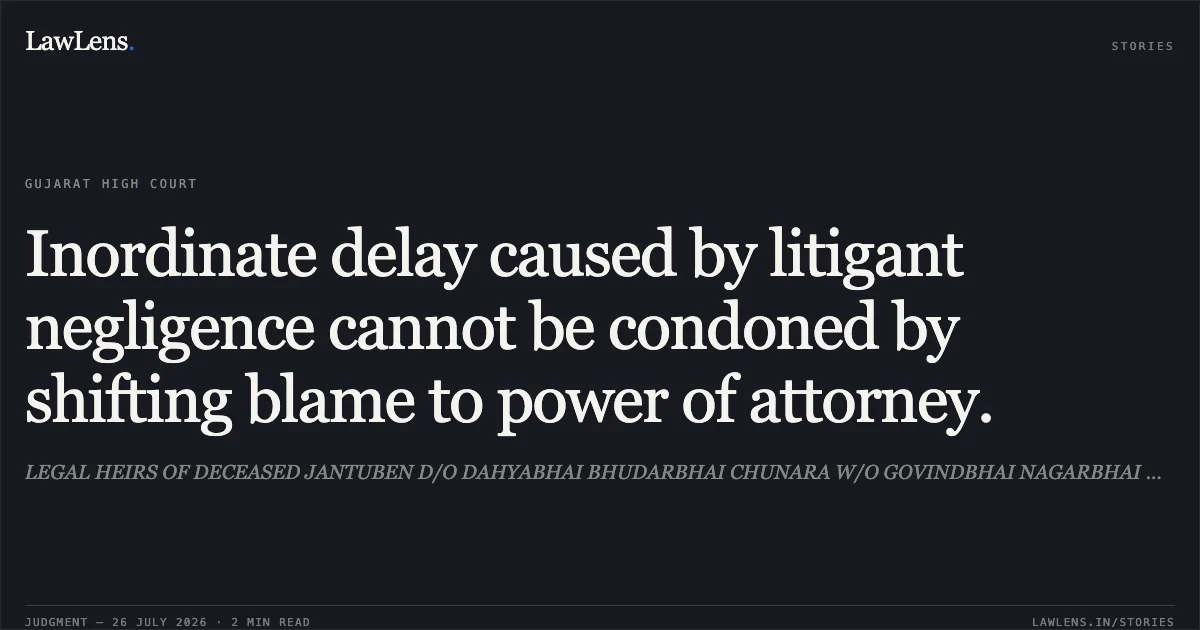
Source reference: p. 8It held that a Power of Attorney is an agent, and the principal cannot shift the blame for inaction onto the agent to revive a stale claim.
Source reference: p. 7, 10Applying Esha Bhattacharjee, the Court reasoned that while a liberal approach is preferred for short delays, inordinate delays (9 years) require a strict approach to prevent prejudice to the other side and ensure the finality of litigation.
Source reference: p. 12-13Holding
The High Court held that the petitioners miserably failed to show "sufficient cause" and that their conduct was marked by gross negligence and a lack of bona fides.
The High Court dismissed the petition, upholding the Trial Court’s order, with no order as to costs.
Source reference: p. 16Acts & Sections Cited
4 provisions across 1 statute referred to in this judgment. Each provision opens on LawLens.
Limitation Act, 19634
Original Court PDF
LEGAL HEIRS OF DECEASED JANTUBEN D/O DAHYABHAI BHUDARBHAI CHUNARA W/O GOVINDBHAI NAGARBHAI DANTANIvsVASTUPAL FAKIRCHAND SHIKARI
Click to open original judgment
Original judgment, available to read, download and summarize on LawLens.in