Facts
The petitioner had been in custody since 2 August 2025 in FIR No. 137/2025, registered at Police Station Dharampur, District Solan, under Sections 62, 65(1), 76, 115(2), 45, 132(2) and 127 of the Bharatiya Nyaya Sanhita, 2023, and Sections 4, 12, 17 and 18 of the Protection of Children from Sexual Offences Act, 2012 (“POCSO Act”).
Source reference: para. 1The 14-year-and-9-month-old prosecutrix alleged that co-accused Golu alias Kushal brought her to the petitioner’s room, where the petitioner allegedly attempted to remove her clothes and sexually assault her; she escaped by locking herself in a toilet and was rescued after raising an alarm.
Source reference: paras. 4, 8Co-accused Kushal, a juvenile, had already been granted bail.
Source reference: para. 4The police filed the challan on 29 August 2025, and charges were framed on 5 June 2026.
Source reference: para. 8Although the petitioner had remained incarcerated for more than one year, the prosecution had examined only two formal witnesses, and the statement of the prosecutrix had not been recorded despite repeated notices.
Source reference: paras. 7–8, 11–12The petitioner therefore sought regular bail under Section 483 of the Bharatiya Nagarik Suraksha Sanhita, 2023.
Source reference: no citationIssues
Whether the petitioner was entitled to regular bail under Section 483 BNSS, 2023, notwithstanding the serious nature of the offences alleged under the BNS and POCSO Act.
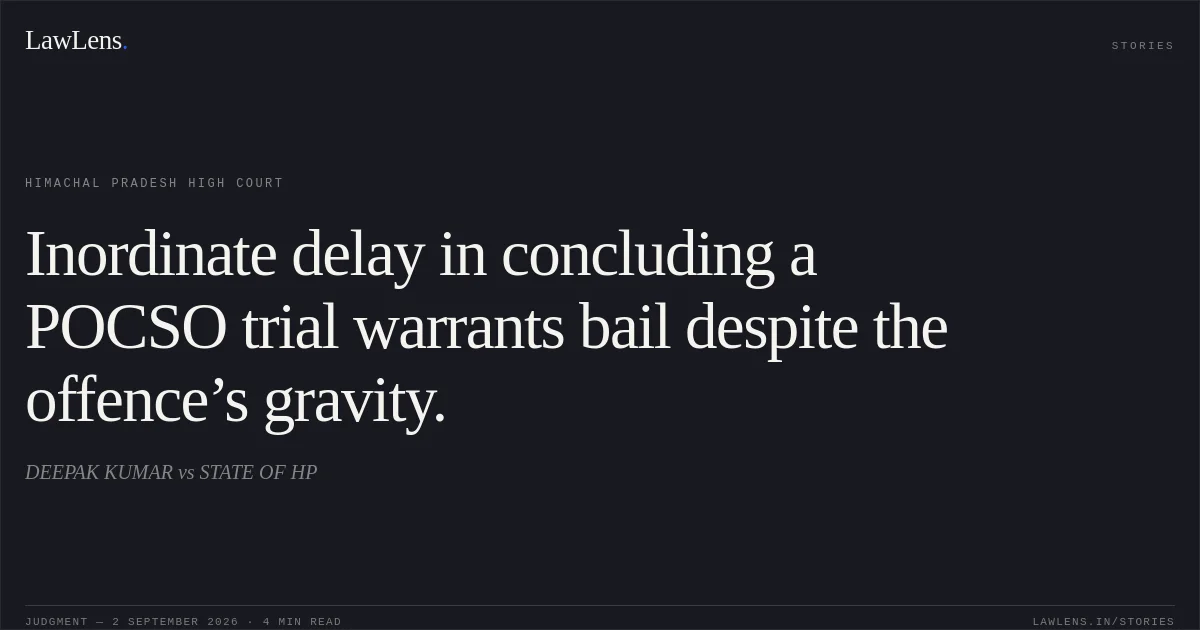
Source reference: paras. 1, 7–9Whether the prolonged failure to conclude the POCSO trial, particularly the non-recording of the prosecutrix’s evidence, violated the petitioner’s constitutional right to speedy trial under Article 21 and justified release on bail.
Source reference: paras. 8–12, 14–23Whether the statutory timelines under Section 35 of the POCSO Act had been substantially breached so as to warrant judicial intervention.
Source reference: paras. 10–12Law Applied
The Court applied Section 483 BNSS, 2023, governing the High Court’s power to grant bail, along with Section 35(1) and (2) of the POCSO Act, which require the evidence of the child to be recorded within thirty days of cognizance and the trial to be completed, as far as possible, within one year.
Source reference: paras. 10–12The Court relied on Article 21 of the Constitution, under which speedy trial is an essential component of the right to life and personal liberty.
Source reference: no citationIt relied on Alakh Alok Srivastava v. Union of India, (2018) 17 SCC 291, for expeditious POCSO trials.
Source reference: para. 13Mohd. Muslim v. State (NCT of Delhi), 2023 SCC OnLine SC 352, for the principle that stringent bail provisions cannot justify indefinite pre-trial incarceration.
Source reference: paras. 15–16Shaheen Welfare Association v. Union of India, (1996) 2 SCC 616, and Jagjeet Singh v. Ashish Mishra, (2022) 9 SCC 321, for the rule that prolonged detention without a reasonable prospect of an early trial is impermissible.
Source reference: paras. 17–18Javed Gulam Nabi Shaikh v. State of Maharashtra, Criminal Appeal No. 2787 of 2024, decided on 3 July 2024, along with subsequent decisions, for the proposition that inordinate delay in trial may entitle an accused to bail notwithstanding the seriousness of the offence.
Source reference: paras. 19–23Reasoning
The Court acknowledged the seriousness of the allegations and the minority of the prosecutrix but noted that the petitioner had remained in custody for more than one year without being convicted.
Source reference: para. 8The challan had already been filed and nothing remained to be recovered from him.
Source reference: paras. 5, 9Despite the statutory requirement under Section 35 of the POCSO Act, the prosecutrix’s evidence had not been recorded, and only two formal witnesses had been examined even after charges were framed.
Source reference: paras. 8, 11–12The Court found that the trial was unlikely to conclude in the near future and that continued detention would effectively amount to pre-trial punishment, contrary to the presumption of innocence and Article 21.
Source reference: paras. 9, 11, 14, 22–23The prosecutrix’s failure to appear before the trial court despite notice, although she appeared before the High Court, further demonstrated that the delay could not justify the petitioner’s indefinite incarceration.
Source reference: para. 9Balancing the gravity of the allegations against the constitutional requirement of a speedy trial, the Court held that the petitioner had established a case for bail.
Source reference: no citationHolding
The High Court allowed the petition and ordered the petitioner’s release on regular bail upon furnishing bail bonds of ₹1,00,000 with one surety in the like amount to the satisfaction of the trial court.
The bail was subject to conditions requiring him to attend the trial, cooperate with interrogation, refrain from tampering with evidence or influencing witnesses, and not leave India without prior permission of the court.
Source reference: para. 24The Court clarified that misuse or violation of the bail conditions would entitle the investigating agency to seek cancellation of bail, and that the observations made were not findings on the merits of the prosecution case.
Source reference: paras. 25–26Acts & Sections Cited
15 provisions across 4 statutes referred to in this judgment. Each provision opens on LawLens.
Bharatiya Nagarik Suraksha Sanhita, 20232
Bharatiya Nyaya Sanhita, 20237
Protection of Children from Sexual Offences Act, 20125
Narcotic Drugs and Psychotropic Substances Act, 19851
Original Court PDF
DEEPAK KUMARvsSTATE OF HP
Click to open original judgment
Original judgment, available to read, download and summarize on LawLens.in