Facts
The Appellants challenged their conviction dated 28.04.2023 for offences under Sections 376 and 120B of the IPC, Section 5 of the Immoral Traffic (Prevention) Act, and Section 4 of the POCSO Act.
Source reference: para. 2, 5The prosecution alleged that on 30.09.2012, the accused kidnapped the victim ('X'), aged 15-16, and sold her into a Mumbai brothel.
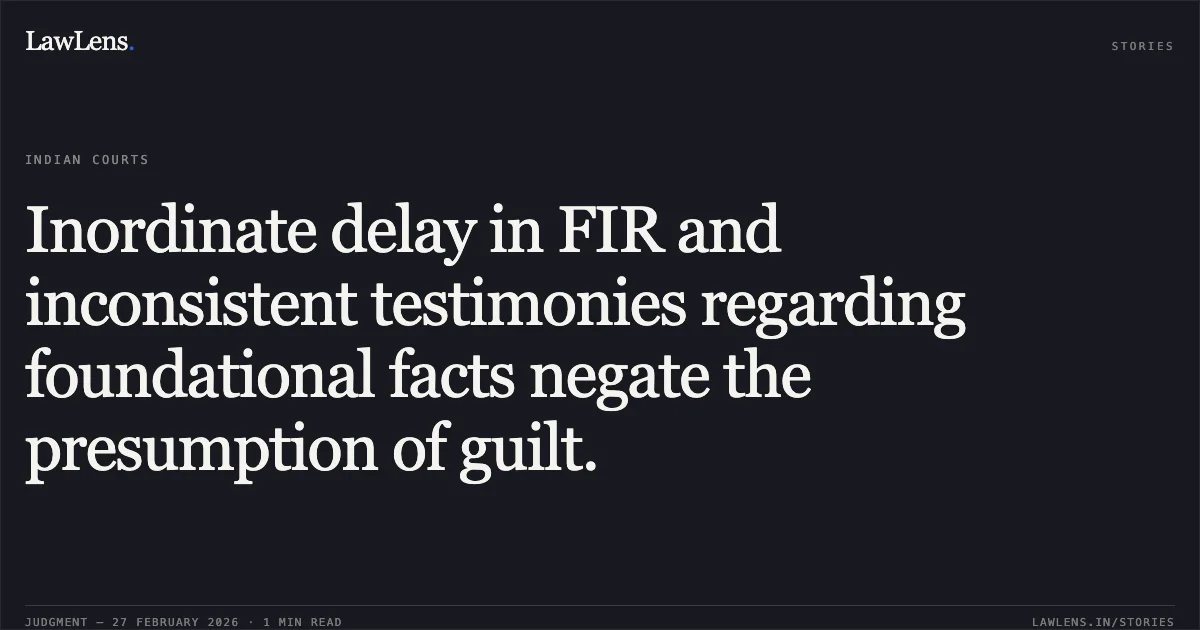
Source reference: para. 3The victim allegedly escaped and returned after three months, yet the FIR was lodged only on 12.02.2014—a delay of over a year.
Source reference: para. 18, 20The Trial Court convicted the appellants primarily based on the victim's testimony and the presumption of guilt under Sections 29 and 30 of the POCSO Act.
Source reference: para. 9-10Issues
1. Whether the conviction under the POCSO Act was legally sustainable given that the Act came into force on 14.11.2012, while the alleged offence occurred on 30.09.2012.
Source reference: para. 122. Whether the "reverse burden of proof" under Sections 29 and 30 of the POCSO Act can be invoked without the prosecution first proving foundational facts.
Source reference: para. 243. Whether the inordinate and unexplained delay in lodging the FIR, coupled with material contradictions, vitiates the prosecution's case.
Source reference: para. 18, 23Law Applied
The Court applied the principle that the POCSO Act, 2012, cannot be applied retrospectively to offences occurring before its commencement on 14.11.2012.
Source reference: para. 12It relied on Mehraj Singh (L/Nk.) v. State of U.P. regarding the loss of sanctity of an FIR in cases of inordinate, unexplained delay.
Source reference: para. 23Furthermore, citing Ramanand v. State of U.P., the Court held that the presumption of innocence is a human right and the "reverse burden" under Sections 29 and 30 of the POCSO Act only triggers after the prosecution proves "foundational facts" beyond reasonable doubt.
Source reference: para. 24It also considered the margin of error (plus/minus two years) in bone ossification tests for age determination per Rajak Mohammad v. State of H.P.
Source reference: para. 13Reasoning
The Court found the prosecution's case fundamentally flawed due to the retrospective application of the POCSO Act to a September 2012 incident.
Source reference: para. 12Critically, the FIR was filed over a year after the victim's return, and no police assistance was sought during her three-month disappearance, which severely undermined the credibility of the story.
Source reference: para. 20The Investigating Officer (PW-6) admitted that he did not verify the Mumbai/Varanasi locations and disclosed that the informant had a history of filing and compromising similar cases for money.
Source reference: para. 21-22The Court reasoned that because the "foundational facts" regarding the kidnapping and sale were not proved, the statutory presumption of guilt could not be used to bypass the requirement of a fair trial.
Source reference: para. 24The discrepancies between the testimonies of the victim (PW-1) and her mother (PW-2) regarding how they met in Mumbai further rendered the evidence untrustworthy.
Source reference: para. 16-17Holding
The High Court allowed the appeal, setting aside the judgment of conviction and the order of sentence.
The Court held that the evidence of PW-1 and PW-2 was not trustworthy and the prosecution failed to prove the charges beyond reasonable doubt.
Source reference: para. 25The Appellants (Pappu Dalal Banarsi and Munna Darjee) were ordered to be released forthwith, and Sahina Khatoon was discharged from her bail bonds.
Source reference: para. 27Acts & Sections Cited
9 provisions across 4 statutes referred to in this judgment. Each provision opens on LawLens.
Indian Penal Code, 18601
Immoral Traffic (Prevention) Act, 19561
Protection of Children from Sexual Offences Act, 20124
Code of Criminal Procedure, 19733
Original Court PDF
Sahina Khatoon & Ors. v. The State of Bihar & Anr., Criminal Appeal (DB) No. 552 of 2023
Click to open original judgment
Original judgment, available to read, download and summarize on LawLens.in