Facts
The Petitioner, a Junior Engineer (JE), was implicated in Cuttack Vigilance P.S. Case No. 05 of 1993 for alleged misappropriation of government subsidies (totaling ₹1.47 lakh) in the installation of Shallow Point Tube Wells
Source reference: pp. 2-3The FIR was registered on 02.02.1993, and the chargesheet against 56 individuals was filed on 30.06.1997
Source reference: p. 4Cognizance was taken in 2001, and the case was transferred to the Special Judge (Vigilance), Cuttack, in 2007
Source reference: p. 4By 2024, nearly 31 years had elapsed without the trial commencing or charges being framed
Source reference: p. 15During the pendency, 24 of the 56 accused persons passed away
Source reference: p. 26The Petitioner sought to quash the proceedings under Section 528 of the BNSS (inherent jurisdiction) on the grounds of inordinate delay
Source reference: p. 1Issues
1. Whether the continuation of criminal proceedings after a delay of over 32 years since the FIR violates the Petitioner's fundamental right to a speedy trial under Article 21 of the Constitution
Source reference: p. 52. Whether the delay in the commencement of the trial is attributable to the accused or the State/Prosecution
Source reference: p. 93. Whether the gravity of the offences under the Prevention of Corruption Act and the subsequent framing of charges during the pendency of this petition bar the quashing of proceedings
Source reference: p. 14Law Applied
The court primarily applied Article 21 of the Constitution, interpreting the right to life and liberty to include the right to a "fair, just, and reasonable" procedure, encompassing a speedy trial
Source reference: pp. 5, 17Section 528 of the BNSS (corresponding to Section 482 of the CrPC) regarding inherent powers to prevent abuse of the process
Source reference: p. 1A.R. Antulay v. R.S. Nayak, which established that while no rigid time limit exists, inordinate delay can warrant quassing
Source reference: pp. 5, 17Vakil Prasad Singh v. State of Bihar, affirming that excessive delay compromises trial fairness
Source reference: pp. 5, 18Pankaj Kumar v. State of Maharashtra, where proceedings were quashed due to an eight-year delay attributable to the prosecution
Source reference: p. 20State of Haryana v. Bhajan Lal regarding the sparing use of quashing powers
Source reference: p. 15Reasoning
The Court rejected the Vigilance Department’s argument that the delay was solely due to the non-appearance of 56 accused persons. It held that the State’s judicial and prosecutorial machinery bears the primary duty to ensure timely trials through measures like splitting trials or enforcing attendance
Source reference: pp. 24-25The Court observed that 31 years passed before charges were framed (only after the filing of this petition in 2025)
Source reference: p. 23Applying the balancing test from Antulay, the court found that the "cloud of a criminal investigation" hanging over the Petitioner for three decades was oppressive
Source reference: p. 22The evidentiary foundation had "crumbled" because 24 co-accused and several witnesses had died, making a fair trial impossible
Source reference: pp. 26-27The court distinguished the Petitioner's case from co-accused Nanda Kishore Pal (whose case was quashed on lack of sanction) but found them on equal footing regarding the constitutional grievance of delay
Source reference: p. 26Holding
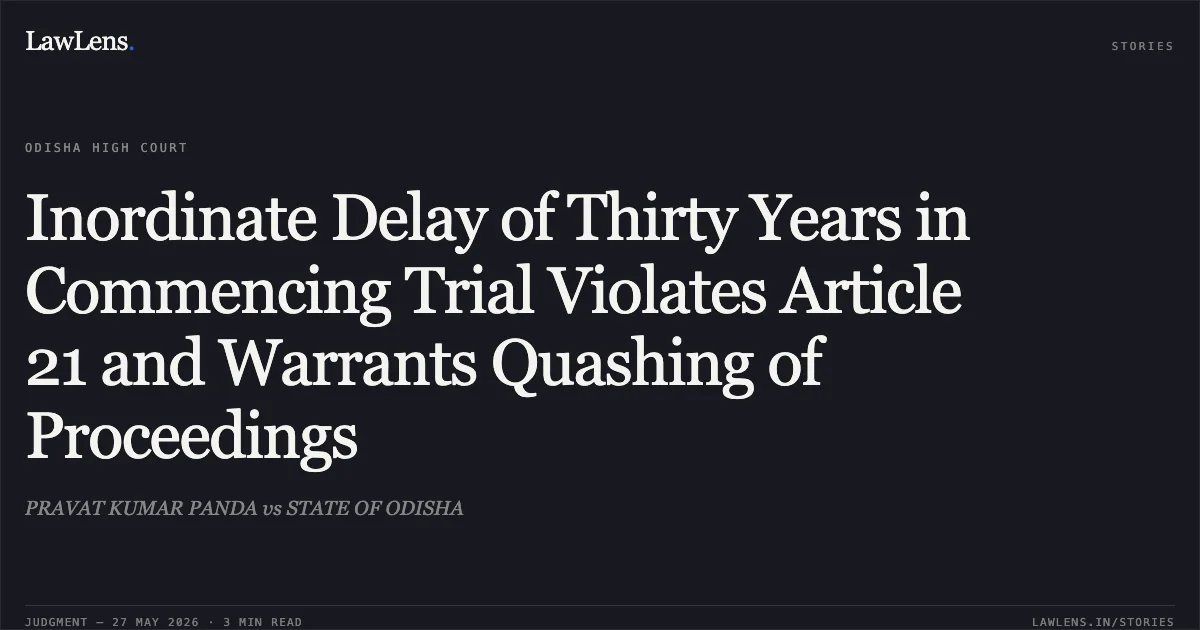
The Court answered the first issue in the affirmative, holding that the "inordinate and unexplained" delay of 32 years violated the Petitioner's fundamental right to a speedy trial under Article 21
The Court allowed the CRLMC application and quashed T.R. Case No. 213 of 2007 insofar as it related to the Petitioner, holding that continuing a trial where the evidentiary landscape had fundamentally changed due to time would be a manifest abuse of process
Source reference: pp. 27, 28Acts & Sections Cited
8 provisions across 4 statutes referred to in this judgment. Each provision opens on LawLens.
Bharatiya Nagarik Suraksha Sanhita, 20231
Prevention of Corruption Act, 19881
Indian Penal Code, 18605
Code of Criminal Procedure, 19731
Original Court PDF
PRAVAT KUMAR PANDAvsSTATE OF ODISHA
Click to open original judgment
Original judgment, available to read, download and summarize on LawLens.in