Facts
The appellant’s original appeal was dismissed for non-prosecution on January 22, 2008
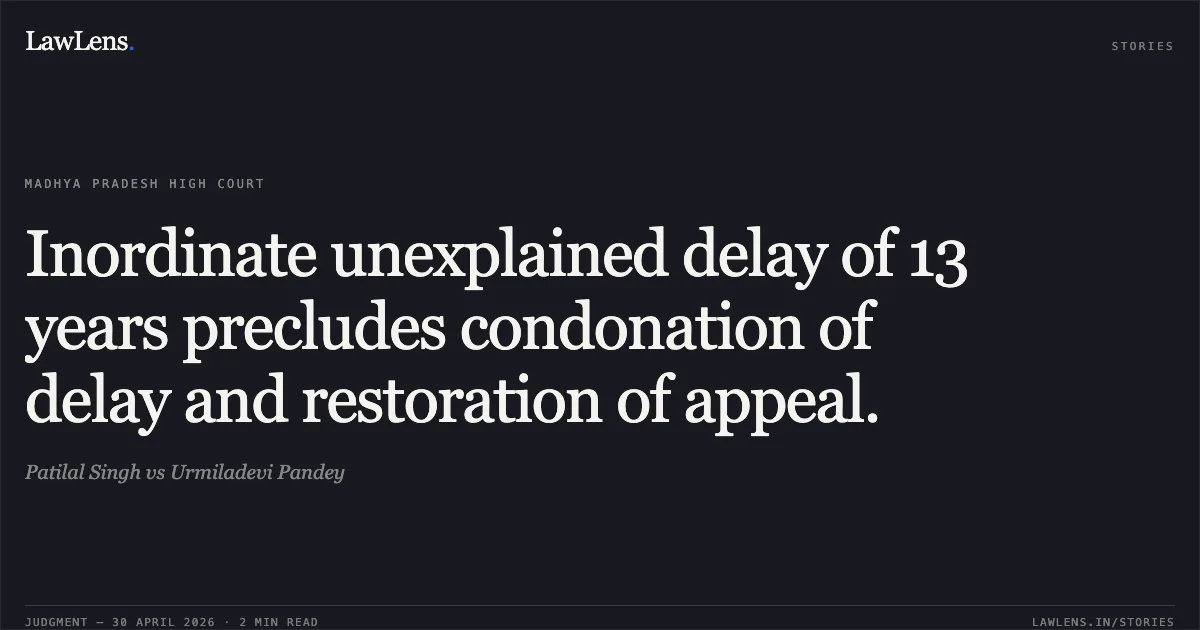
Source reference: para. 2After a delay of approximately 13 years, the appellant filed an application for restoration under Order 9 Rule 9 of the Code of Civil Procedure (CPC) along with an application under Section 5 of the Limitation Act for condonation of delay
Source reference: para. 1, 5The appellant contended that as an uneducated agriculturist, he was unaware of the dismissal due to a lack of communication from his counsel and only learned of it during execution proceedings
Source reference: para. 2The Principal District Judge, Singrauli, rejected the application in MJC No. 100/2021 on July 4, 2023
Source reference: para. 1The appellant subsequently challenged this rejection in the High Court
Source reference: para. 1, 2Issues
1. Whether the learned trial court erred in law by refusing to condone the 13-year delay and rejecting the application for restoration under Order 9 Rule 9 CPC
Source reference: para. 22. Whether the lack of communication by counsel and the status of the appellant as an uneducated agriculturist constitute "sufficient cause" for condoning an inordinate delay of 13 years
Source reference: para. 5, 6Law Applied
The court applied Order 43 Rule 1(c) and Section 151 of the CPC regarding the maintainability of the appeal
Source reference: para. 1It further applied Section 5 of the Limitation Act, which requires the party seeking condonation to demonstrate "sufficient cause" for delay
Source reference: para. 5, 6The court relied on the principle that while a liberal approach is often preferred, limitation law is based on public policy to ensure finality in litigation and cannot assist a party who is "indolent" or shows "gross negligence"
Source reference: para. 3, 6Additionally, the court noted the precedent in Bhoj Raj Garg v. Goyal Education and Welfare Society (2025) 9 SCC 618, emphasizing the necessity for the expeditious disposal of execution proceedings
Source reference: para. 3Reasoning
The Court examined the appellant's justification for the 13-year delay, noting that the plea of ignorance and counsel negligence was unsubstantiated by any cogent material or evidence
Source reference: para. 5The Court reasoned that a litigant cannot remain completely inactive for over a decade without making any effort to ascertain the status of their case; such behavior reflects a lack of bona fides
Source reference: para. 3It was observed that the respondents had acquired valuable rights under the decree during the intervening years, and reopening the matter after such an inordinate period would cause serious prejudice and defeat the principles of legal certainty
Source reference: para. 3The Court concluded that delay cannot be condoned in a "routine manner" and the appellant failed to meet the threshold of "sufficient cause" required by law
Source reference: para. 6, 7Holding
The High Court answered the issues in the negative, holding that there was no illegality, perversity, or jurisdictional error in the lower court's order
The Court affirmed that the 13-year delay remained unexplained and dismissed the Miscellaneous Appeal
Source reference: para. 8The order of the Principal District Judge, Singrauli, dated July 4, 2023, was upheld
Source reference: para. 9Acts & Sections Cited
4 provisions across 2 statutes referred to in this judgment. Each provision opens on LawLens.
Code of Civil Procedure, 19083
Limitation Act, 19631
Original Court PDF
Patilal SinghvsUrmiladevi Pandey
Click to open original judgment
Original judgment, available to read, download and summarize on LawLens.in