Facts
The respondent, a railway servant appointed in 1979, was dismissed from service on 15.03.2002 following a departmental enquiry under Rule 9 of the Railway Servants (Discipline & Appeal) Rules, 1968.
Source reference: para. 2The charges arose from a vigilance raid where a decoy passenger alleged the respondent failed to return Rs. 10/- from a Rs. 100/- note.
Source reference: para. 10, 14Additional allegations included the possession of 13 used tickets for potential resale, excess cash at the counter, and failure to declare private cash.
Source reference: para. 15The Central Administrative Tribunal (CAT), Jabalpur, allowed the respondent’s Original Application (O.A. 630/2002) on 16.07.2004, setting aside the dismissal and appellate orders due to procedural lapses, including the failure to involve independent gazetted witnesses as required by Paragraph 705 of the Railway Vigilance Manual.
Source reference: para. 1, 3The Union of India challenged the CAT’s order via this petition under Article 227 of the Constitution.
Source reference: para. 1Issues
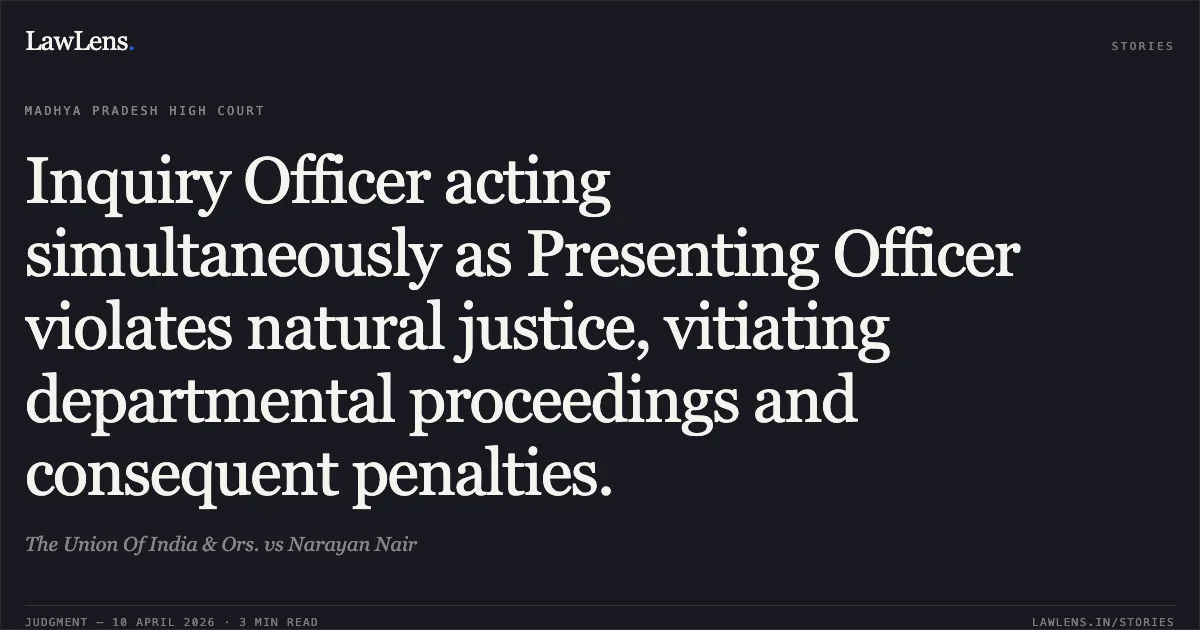
1. Whether the departmental enquiry was vitiated by the Inquiry Officer simultaneously acting as the Presenting Officer, thereby violating the principles of natural justice.
Source reference: para. 17, 312. Whether the failure to adhere to Paragraph 705 of the Railway Vigilance Manual regarding independent gazetted witnesses during a trap constitutes a fatal procedural irregularity.
Source reference: para. 4, 323. Whether the charges were proved based on the standard of preponderance of probabilities.
Source reference: para. 30Law Applied
Rule 9 of the Railway Servants (Discipline & Appeal) Rules, 1968 regarding the conduct of major penalty proceedings.
Source reference: para. 2Paragraphs 705 and 706 of the Railway Vigilance Manual, which mandate the use of independent witnesses during departmental traps.
Source reference: para. 4, 15Union of India v. Mohd. Naseem Siddiqui (2005), which establishes that an Inquiry Officer cannot act as a Presenting Officer.
Source reference: para. 6, 33Moni Shankar v. Union of India (2008), which held that violations of the Vigilance Manual and procedural safeguards warrant the quashing of penalties.
Source reference: para. 6, 33Union of India v. Gyan Chand Chattar (2009), requiring charges to be specific and supported by evidence rather than hearsay.
Source reference: para. 6, 33Reasoning
The court found the enquiry procedurally defective as the Inquiry Officer’s dual role as Presenting Officer compromised the impartiality required in quasi-judicial proceedings.
Source reference: para. 17, 33Regarding the trap, the court noted that the decoy passenger was a member of the vigilance team, and the absence of independent witnesses—despite the proximity of other stations where gazetted officers could have been sourced—vitiated the findings.
Source reference: para. 17, 32The court observed that no personal search was conducted on the decoy passenger before or after the trap to verify the cash, making the allegation of the "short Rs. 10/-" uncorroborated.
Source reference: para. 18, 24Furthermore, the court found the charge of "excess cash" unreliable, as the initial figure of Rs. 799/- was reduced to Rs. 7/- after accounting for clerical errors, which the department failed to rebut.
Source reference: para. 21, 26The used tickets were found in a non-exclusive area, and the respondent provided a plausible explanation for his private cash (buying medicine for his wife), which did not amount to grave misconduct.
Source reference: para. 20, 27, 28Holding
The High Court dismissed the petition and upheld the CAT's order quashing the disciplinary and appellate orders.
The court held that the charges were not established even on the standard of preponderance of probabilities due to significant investigative irregularities and violations of natural justice.
Source reference: para. 30, 34The respondent was exonerated of all charges.
Source reference: para. 30No order as to costs was issued.
Source reference: para. 34Original Court PDF
The Union Of India & Ors.vsNarayan Nair
Click to open original judgment
Original judgment, available to read, download and summarize on LawLens.in