Facts
The petitioner, a police constable posted at the Reserve Police Lines, Deoria, was assigned NCC-guard duty on 6 August 2010. He allegedly left duty without intimation, was found intoxicated in police uniform near a country-liquor shop, and remained absent for 12 days, 4 hours and 15 minutes before reporting on 18 August 2010.
Source reference: para. 3A charge-sheet dated 14 February 2011 was served upon him. Although he sought time to reply, he did not submit a reply within the extended period.
Source reference: para. 3He initially appeared in the disciplinary inquiry on 16 May 2011 but subsequently remained absent despite notices, resulting in an ex parte inquiry. The Inquiry Officer found the charges proved and separately recommended dismissal from service in the report dated 31 December 2011.
Source reference: paras. 3–4, 12–13A show-cause notice enclosing the inquiry report and proposing dismissal was issued to the petitioner. He sought further time but allegedly failed to submit his explanation within the extended period.
Source reference: para. 4The disciplinary authority dismissed him from service on 13 February 2012; his appeal and revision were rejected on 30 April 2012 and 31 August 2012, respectively.
Source reference: para. 5The petitioner challenged all three orders before the High Court.
Source reference: no citationIssues
Whether the disciplinary proceedings and dismissal order were vitiated for failure to provide the petitioner a sufficient opportunity to submit his reply and participate in the inquiry?
Source reference: paras. 6–10, 14–15Whether the disciplinary authority acted unlawfully by agreeing with the Inquiry Officer’s findings and proposing dismissal, when the Inquiry Officer had separately recommended the punishment?
Source reference: paras. 6, 11–16Whether the petitioner’s alleged reply to the show-cause notice, annexed with the writ petition, required consideration by the disciplinary authority?
Source reference: para. 14Law Applied
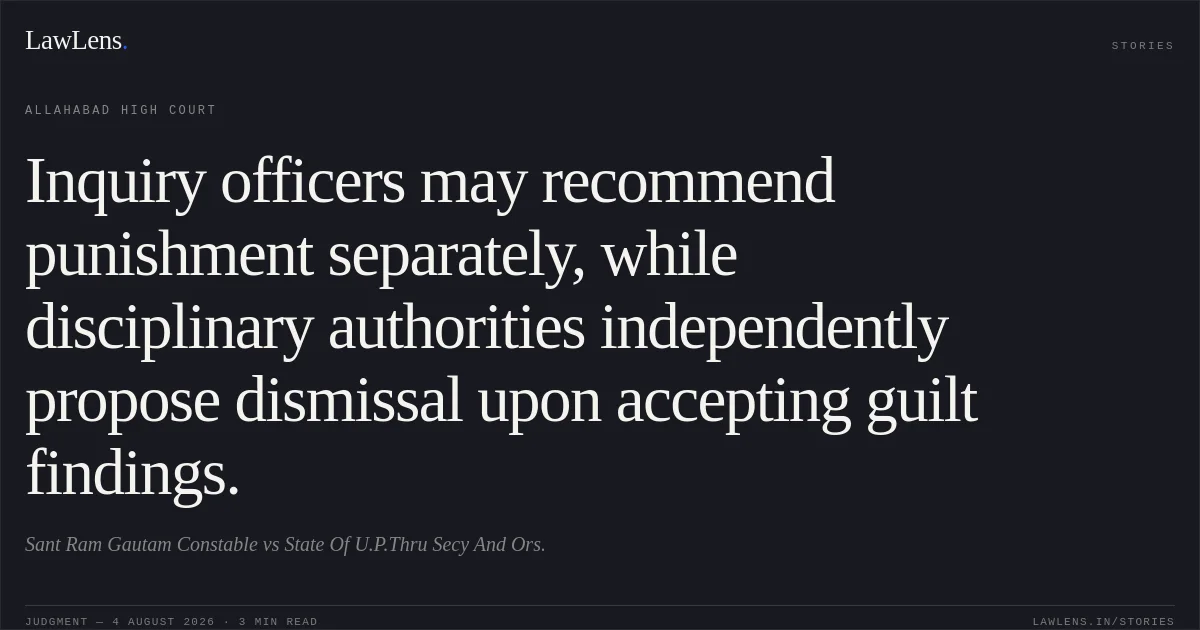
The Court applied Rule 14(1), Appendix I, of the U.P. Police Officers of Subordinate Ranks (Discipline and Appeal) Rules, 1991, under which the Inquiry Officer may separately recommend the proposed punishment after recording findings on guilt.
Source reference: para. 13The disciplinary authority must independently consider the inquiry findings, record agreement with the findings before issuing a show-cause notice, and may then propose an appropriate punishment under Rule 4(1)(a) of the 1991 Rules.
Source reference: paras. 11, 13, 15A disciplinary inquiry may proceed ex parte where the delinquent employee, despite due notice and opportunity, fails to participate.
Source reference: paras. 9–10The Court distinguished Jai Mangal Ram v. State of U.P., 2023 LawSuit (All) 1786; Neutral Citation 2023:AHC:232617, holding that the decision had not considered Appendix I to Rule 14(1), which expressly permits the Inquiry Officer to recommend punishment.
Source reference: para. 16The decisions in Krishna Kumar Mishra v. State of U.P., Writ-A No. 39792 of 2012, and Umesh Babu v. State of U.P., Writ-A No. 23660 of 2010, were held inapplicable on the facts.
Source reference: para. 16Reasoning
The Court found that the petitioner had repeatedly received opportunities to defend himself: he was served with the charge-sheet, sought and received extensions of time, appeared initially before the Inquiry Officer, and was thereafter notified of subsequent dates but failed to participate.
Source reference: paras. 3, 9The ex parte inquiry was therefore not contrary to natural justice.
Source reference: paras. 9–10The show-cause notice enclosed the inquiry report, recorded the disciplinary authority’s agreement with the Inquiry Officer’s findings of guilt, and proposed dismissal; it did not demonstrate that the disciplinary authority had improperly adopted the Inquiry Officer’s recommendation as its own punishment decision.
Source reference: paras. 11–13, 15Under Appendix I to Rule 14(1), the Inquiry Officer was permitted to make a separate punishment recommendation, and the disciplinary authority retained authority to decide the punishment.
Source reference: paras. 13–15The alleged reply annexed to the writ petition was undated and unsupported by any acknowledgment or proof that it had been submitted before dismissal. The disciplinary authority had specifically recorded that no reply had been received before the punishment order.
Source reference: para. 14Accordingly, the Court found no procedural or substantive illegality in the inquiry, show-cause process, or dismissal order.
Source reference: paras. 14–16Holding
The High Court held that the petitioner was afforded adequate opportunity to participate in the disciplinary proceedings and to respond to the inquiry report and proposed punishment.
The Inquiry Officer’s separate recommendation of dismissal was permissible under Appendix I to Rule 14(1) of the 1991 Rules, and the disciplinary authority lawfully agreed with the findings of guilt while independently proposing and imposing dismissal.
Source reference: paras. 13–15The writ petition was dismissed, and the dismissal order dated 13 February 2012, together with the appellate order dated 30 April 2012 and revisional order dated 31 August 2012, was left undisturbed.
Source reference: para. 17Original Court PDF
Sant Ram Gautam ConstablevsState Of U.P.Thru Secy And Ors.
Click to open original judgment
Original judgment, available to read, download and summarize on LawLens.in