Facts
M/s. Emerald Mineral Exim Pvt. Ltd. (Corporate Debtor/CD) entered into an agreement with a Builder to purchase a commercial unit in 2011
Source reference: para. 2(i)The Appellant Bank sanctioned a loan of Rs. 1.50 Crores to the CD, and a quadripartite agreement was executed between the Bank, CD, Builder, and WBHIDCL
Source reference: para. 2(ii-iii)Per the agreement, the Bank disbursed Rs. 1.34 Crores directly to the Builder
Source reference: para. 2(iv)Subsequently, the CD entered into a nomination agreement to transfer the property to a third party (JPL)
Source reference: para. 2(vi)The CD’s account was classified as an NPA in 2014
Source reference: para. 2(x)The Bank initiated recovery proceedings before the Debt Recovery Tribunal (DRT), where the Builder was directed to deposit Rs. 1.50 Crores as security
Source reference: para. 2(xiii-xiv)The Bank then filed a winding-up petition (later converted to a Section 7 petition under the IBC)
Source reference: para. 2(xv-xvi)Dealing with an appeal against the NCLT’s admission of the petition, the NCLAT set aside the order, holding that the Bank was not a "Financial Creditor" as the amount was not disbursed directly to the CD and the process was used for recovery
Source reference: para. 4Issues
1. Whether the nature of the transaction and the direct disbursement to the Builder disqualifies the Bank from initiating Corporate Insolvency Resolution Process (CIRP) under Section 7 of the IBC.
Source reference: para. 8-102. Whether the invocation of the IBC in a predominantly contractual dispute involving third-party obligations amounts to an abuse of process for debt recovery.
Source reference: para. 11-12Law Applied
The court applied Section 7 of the Insolvency and Bankruptcy Code, 2016 (IBC), emphasizing that the existence of a ‘financial debt’ and ‘default’ are conditions precedent for its invocation
Source reference: para. 8It relied on Innovative Industries Ltd. v. ICICI Bank, establishing that the IBC is a collective resolution mechanism, not a recovery forum
Source reference: para. 8, fn 1It further applied principles from Pioneer Urban Land and Infrastructure Ltd. v. Union of India and Glas Trust Company LLC v. BYJU Raveendran, which hold that using the Code as a tool for coercion or to compel payment in a genuine contractual dispute, rather than addressing financial distress, constitutes an abuse of process
Source reference: para. 8, fn 2 & 3Reasoning
The Court examined the quadripartite agreement and found that the Bank’s disbursement was "intrinsically linked" to the Builder’s performance of obligations, such as construction and transfer of property
Source reference: para. 10Although the CD was the borrower, the structure of the transaction—where the Builder was required to refund amounts to the Bank in case of cancellation—showed that the obligations were intertwined
Source reference: para. 9-10The Court reasoned that the dispute was predominantly contractual, involving competing claims regarding property transfer rather than a straightforward financial default
Source reference: para. 11Since the Bank had already sought relief via the DRT and the Builder had deposited security therein, the Court determined that the Bank was attempting to use the IBC as a coercive recovery mechanism rather than for insolvency resolution
Source reference: para. 12Holding
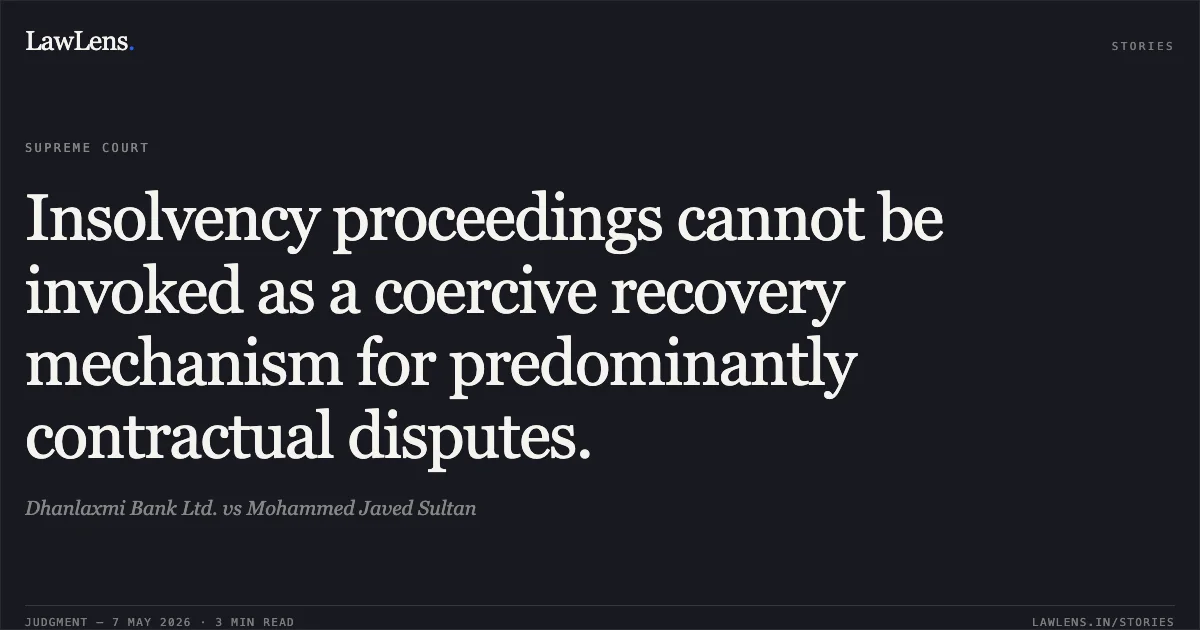
The Supreme Court dismissed the appeal and upheld the NCLAT’s decision to set aside the CIRP
The Court held that the IBC cannot be invoked in cases where the dispute is primarily contractual and is already being actively adjudicated in an appropriate forum like the DRT
Source reference: para. 12It concluded that converting insolvency proceedings into a coercive mechanism for debt recovery is impermissible under the scheme of the Code
Source reference: para. 12Acts & Sections Cited
1 provisions across 1 statute referred to in this judgment. Each provision opens on LawLens.
Insolvency and Bankruptcy Code, 2016.1
Original Court PDF
Dhanlaxmi Bank Ltd.vsMohammed Javed Sultan
Click to open original judgment
Original judgment, available to read, download and summarize on LawLens.in