01Facts
The respondent/plaintiff, Ram Pati Devi, sued her son, Amar Bahadur Singh, and daughter-in-law, Sitara Devi, for possession and permanent injunction concerning property bearing No. K-93A, Gali No. 52, Shahadatpur Extension, Karawal Nagar, Delhi.
¶ 2–5 · pp. 2–3She relied on a General Power of Attorney, Agreement to Sell, Will and Receipt, all dated 1 November 1996, under which the property had allegedly been purchased in her name by her husband from his earnings.
¶ 2–5 · pp. 2–3, 6–7The appellants claimed an independent ownership interest, asserting that Amar Bahadur had contributed ₹1,50,000 towards purchase of the property and ₹60,000 towards its construction.
¶ 14–19 · pp. 5–6The Trial Court held that although the unregistered documents did not constitute a completed transfer of title, they established the plaintiff’s possessory and superior rights under Section 53A of the Transfer of Property Act, 1882.
¶ 27–30 · pp. 7–8It further held that the appellants’ occupation was permissive and decreed possession and permanent injunction in favour of the plaintiff on 9 February 2026.
¶ 27–30 · pp. 7–8The appellants challenged that decree under Section 96 read with Order XLI CPC.
¶ 1 · p. 202Issues
i.Whether the plaintiff could maintain a suit for possession on the basis of an unregistered GPA, Agreement to Sell, Will and Receipt, despite those documents not conferring absolute title under Suraj Lamp & Industries (P) Ltd. v. State of Haryana?
¶ 39–42 · pp. 9–10ii.Whether the appellants established an independent ownership or beneficial interest in the suit property on the basis of their alleged financial contributions towards its purchase and construction?
¶ 45–50 · pp. 11–12iii.Whether the appellants’ long-standing occupation was independent or merely permissive, and whether a separate notice terminating such permission was necessary before seeking possession?
¶ 51–57 · pp. 12–13iv.Whether the Trial Court erred in decreeing possession and permanent injunction in favour of the plaintiff?
¶ 58–60 · pp. 13–1403Law Applied
The Court applied Section 96 read with Order XLI CPC governing a first appeal.
It relied on Suraj Lamp & Industries (P) Ltd. v. State of Haryana for the rule that a GPA, Agreement to Sell and Will transaction does not, by itself, convey absolute title in immovable property; however, such documents may establish possessory or superior rights for limited purposes.
¶ 27–28, 40–42 · pp. 7–10Section 53A of the Transfer of Property Act, 1882 was invoked as recognising the limited possessory protection arising from part performance.
¶ 28 · p. 8Section 2(9)(A)(iii) of the Prohibition of Benami Property Transactions Act, 1988 was relied upon for the exception concerning property held by a spouse where consideration is paid from the known sources of the other spouse.
¶ 44 · pp. 10–11The Court further applied the principle in M/s Nopany Investments (P) Ltd. v. Santokh Singh (HUF), (2008) 2 SCC 728, that institution of a possession or eviction suit may itself operate as notice terminating the occupant’s authority to remain in possession.
¶ 54–57 · p. 13Provisions in the judgment · 6 · Linked ones open on LawLens
Code of Civil Procedure, 1908 Section 96Section 151
Registration Act, 1908 Section 17
Code of Criminal Procedure, 1973 Section 200
Transfer of Property Act, 1882 Section 106
Prohibition of Benami Property Transactions Act, 1988 Section 2
04Reasoning
The Court held that the appellants could not rely on Suraj Lamp to defeat the plaintiff’s claim because they themselves claimed rights through the plaintiff and acknowledged that the property stood in her name.
¶ 38–42 · pp. 9–10The plaintiff’s case was not that she had personally paid the consideration, but that her husband had purchased the property in her name; this did not, by itself, create any right in favour of the son, particularly in view of the statutory spouse-related exception under the Benami Act.
¶ 43–44 · pp. 10–11The alleged contributions of ₹1,50,000 and ₹60,000 were unsupported by receipts, bank records or other documentary evidence.
¶ 46–49 · pp. 11–12Further, the appellant’s own testimony was inconsistent: he stated that the purchase contribution was made perhaps in November 1997, although the property documents were dated November 1996, and he could not specify when the construction contribution was made.
¶ 46–49 · pp. 11–12Mere contribution to household expenses or construction did not establish co-ownership, particularly when the appellant’s name was absent from all title-related documents.
¶ 50 · p. 12The appellants’ residence and possession, evidenced by Aadhaar cards and photographs, established occupation but not an independent legal right.
¶ 51–53 · pp. 12–13Their status as the plaintiff’s son and daughter-in-law supported the finding that their occupation was permissive.
¶ 51–53 · pp. 12–13The earlier order protecting them from dispossession except by due process did not confer any substantive right to remain in possession.
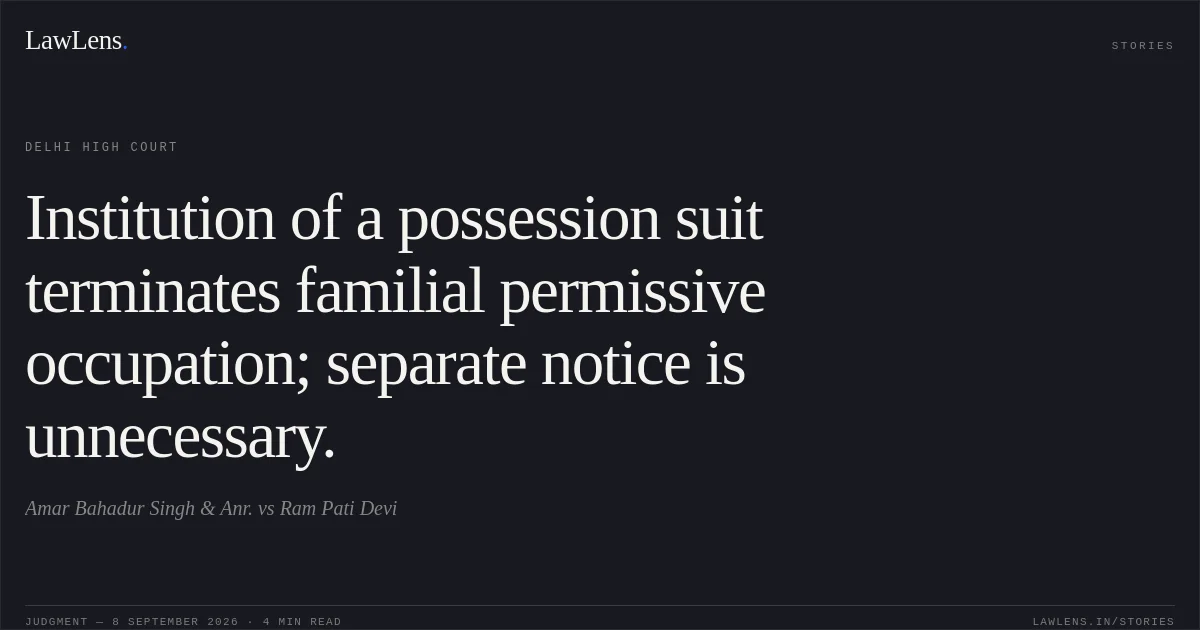
¶ 51–53 · pp. 12–13Finally, the filing of the possession suit unequivocally withdrew the permission to occupy, making a separate notice unnecessary.
¶ 54–57 · p. 1305Holding
The High Court dismissed the appeal and upheld the judgment and decree dated 9 February 2026.
¶ 58–60 · pp. 13–14It held that, notwithstanding the absence of a registered conveyance, the plaintiff’s documents established her superior possessory rights as against the appellants; the appellants failed to prove any independent title, co-ownership or beneficial interest; and their occupation was permissive and stood terminated by the institution of the possession suit.
¶ 58–60 · pp. 13–14The decree for possession and permanent injunction was consequently affirmed, and the pending applications were disposed of accordingly.
¶ 60 · p. 14Original Court PDF
Amar Bahadur Singh & Anr.vsRam Pati Devi
Click to open original judgment
Original judgment, available to read, download and summarize on LawLens.in