Facts
The Supreme Court of India took suo motu cognizance of the escalating menace of stray dog attacks and cattle intrusions on public roads and institutional premises.
Source reference: para. 1In an order dated 7th November 2025, the Court directed the removal of stray dogs from "institutional areas" (schools, hospitals, railway stations, etc.) and prohibited their re-release into those same locations.
Source reference: para. 4-5Various animal welfare organizations filed interlocutory applications seeking modification or recall of these directions, arguing they conflicted with the Animal Birth Control (ABC) Rules, 2023, which mandate releasing dogs back to their original locality.
Source reference: para. 6, 10-11Conversely, other applicants sought to expand these safety directions to residential colonies and parks.
Source reference: para. 35The Court also reviewed the Standard Operating Procedures (SOPs) issued by the Animal Welfare Board of India (AWBI) and the status of compliance by various States.
Source reference: para. 77, 86Issues
1. Whether stray dogs found within institutional and restricted-access premises qualify as “street dogs” entitled to re-release under Rule 11(19) of the ABC Rules, 2023.
Source reference: para. 392. Whether the Court’s directions for permanent relocation of dogs from institutional areas constitute an impermissible exercise of jurisdiction under Article 142 in derogation of statutory law.
Source reference: para. 503. Whether the SOPs issued by the AWBI exceeded the Court’s mandate by including additional public spaces like religious sites and parks.
Source reference: para. 79Law Applied
The Court applied the Animal Birth Control Rules, 2023, specifically Rule 7(2) regarding classification of street dogs and Rule 11(19) regarding their release back to the same locality.
Source reference: para. 40Section 2(i) of the Prevention of Cruelty to Animals (PCA) Act, 1960, which defines "street" as spaces to which the public has access.
Source reference: para. 40The Court also invoked its plenary powers under Article 142 of the Constitution of India to do "complete justice," relying on the "problem-solver" doctrine established in Union Carbide Corpn. v. Union of India and Shilpa Sailesh v. Varun Sreenivasan, which permits the Court to modulate statutory application in nebulous areas provided it does not violate fundamental public policy.
Source reference: para. 51, 52-53The Court prioritized the Right to Life and Safety under Article 21 of the Constitution over subordinate regulatory procedures.
Source reference: para. 101Reasoning
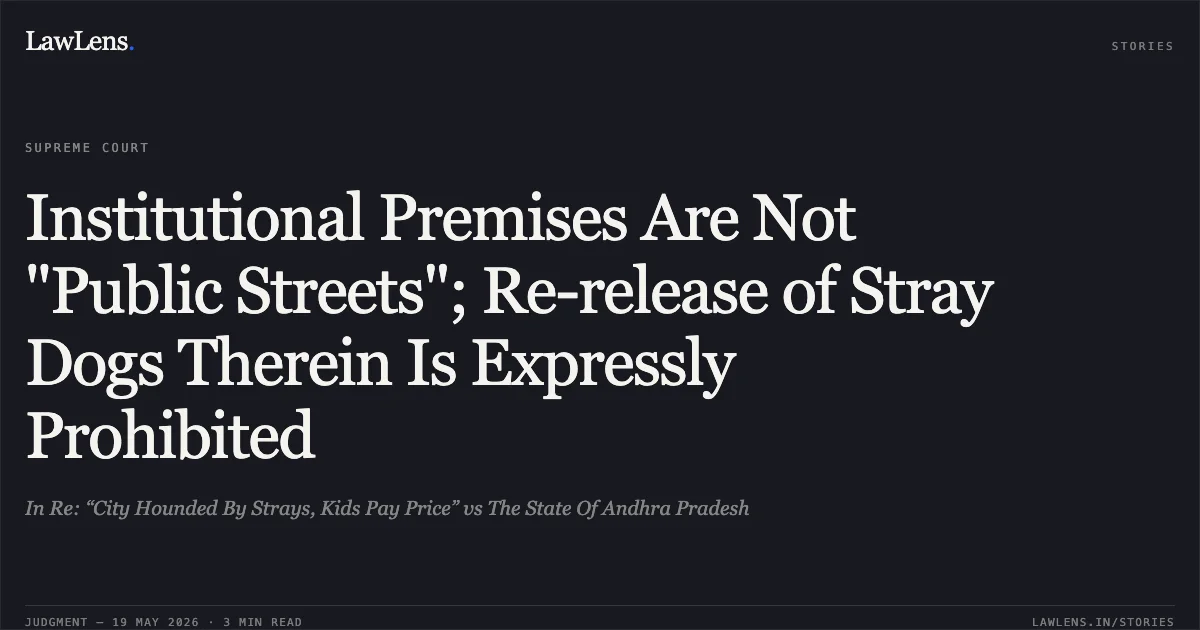
The Court performed a harmonious construction of the PCA Act and the ABC Rules, concluding that sensitive institutional premises (hospitals, schools, airports) are not "streets" or "localities" in the sense contemplated by Rule 11(19).
Source reference: para. 45-48The Court reasoned that the statutory classification in Rule 7(2) is merely descriptive and does not confer an absolute right for animals to inhabit spaces where they pose a grave risk to vulnerable human populations, such as sick patients or children.
Source reference: para. 42-43Regarding Article 142, the Court held that its directions do not "supplant" the law but "iron out the creases" by excluding restricted-access areas from the re-release protocol to prevent a "catch-22" situation where administrative safety duties conflict with animal welfare rules.
Source reference: para. 59-62The Court found the AWBI's SOPs valid, noting that the enumeration of institutional areas in the original order was illustrative, not exhaustive, and logically extended to high-footfall areas like parks and religious sites.
Source reference: para. 82-83Holding
The Court dismissed all applications seeking to modify or stay the removal of stray dogs from institutional areas and held that stray dogs in restricted-access premises do not fall under the re-release mandate of Rule 11(19).
The Court issued fresh directions: (A) States must establish at least one functional ABC Centre per district [para. 108(B)]; (B) NHAI must deploy specialized vehicles for cattle removal [para. 108(G)]; (C) Euthanasia is permitted for demonstrably dangerous/rabid dogs per statutory protocols [para. 108(H)]; and (D) Animal welfare groups in campuses must accept tortious liability for dog bites [para. 74].
Source reference: para. 108, 74The Court transferred the "continuing mandamus" to the respective High Courts to monitor local compliance, directing them to register suo motu petitions for this purpose, with the matter listed for review on 17th November 2026.
Source reference: para. 111, 114Acts & Sections Cited
1 provisions across 1 statute referred to in this judgment. Each provision opens on LawLens.
Prevention of Cruelty to Animals Act, 19601
Original Court PDF
In Re: “City Hounded By Strays, Kids Pay Price”vsThe State Of Andhra Pradesh
Click to open original judgment
Original judgment, available to read, download and summarize on LawLens.in