Facts
Madina Masjid filed Application No. 22/2026 before the Karnataka Waqf Tribunal challenging a Karnataka State Board of Auqaf resolution and a District Waqf Officer’s letter concerning three institutions: Masjid-e-Quba, Masjid-e-Arfath and Masjid-e-Mahmoodiya.
Source reference: pp. 6–7, 20–21It sought, among other reliefs, to preserve its authority to manage those institutions and to restrain interference with that management.
Source reference: pp. 6–7, 20–21The three institutions sought impleadment under Order I Rule 10(2) of the Code of Civil Procedure, contending that they were separate entities, independently managed, and not allied institutions of Madina Masjid.
Source reference: pp. 8–10The Tribunal rejected their applications, holding that they were neither necessary nor proper parties and should pursue an independent proceeding.
Source reference: p. 10They appealed under Section 83(9) of the Waqf Act, as described in the judgment.
Source reference: pp. 1–5Issues
1. Whether the Tribunal’s order rejecting the three institutions’ applications for impleadment called for interference
Source reference: p. 192. Whether the three institutions were necessary or proper parties to Madina Masjid’s application before the Tribunal
Source reference: pp. 21–25Law Applied
The Court considered Order I Rule 10(2) CPC, which permits a court to add a party whose presence is necessary for effective and complete adjudication.
Source reference: pp. 25–26Relying on Vidur Impex and Traders Pvt. Ltd. v. Tosh Apartments Pvt. Ltd., (2012) 8 SCC 384, it applied the principles that a necessary party is one in whose absence an effective decree cannot be passed, while a proper party is one whose presence enables complete, effective and proper adjudication, even if no decree is sought for or against that person.
Source reference: pp. 25–26The appeals were brought under Section 83(9) of the Waqf Act, as identified in the judgment.
Source reference: pp. 1–5Reasoning
Madina Masjid’s requested reliefs concerned the three institutions’ status and management: it sought to challenge the Board’s resolution, prevent action to register the institutions separately, and restore its own authority over their affairs.
Source reference: pp. 20–22The proposed parties, in contrast, claimed independent legal status and management, and denied that they fell under Madina Masjid’s authority.
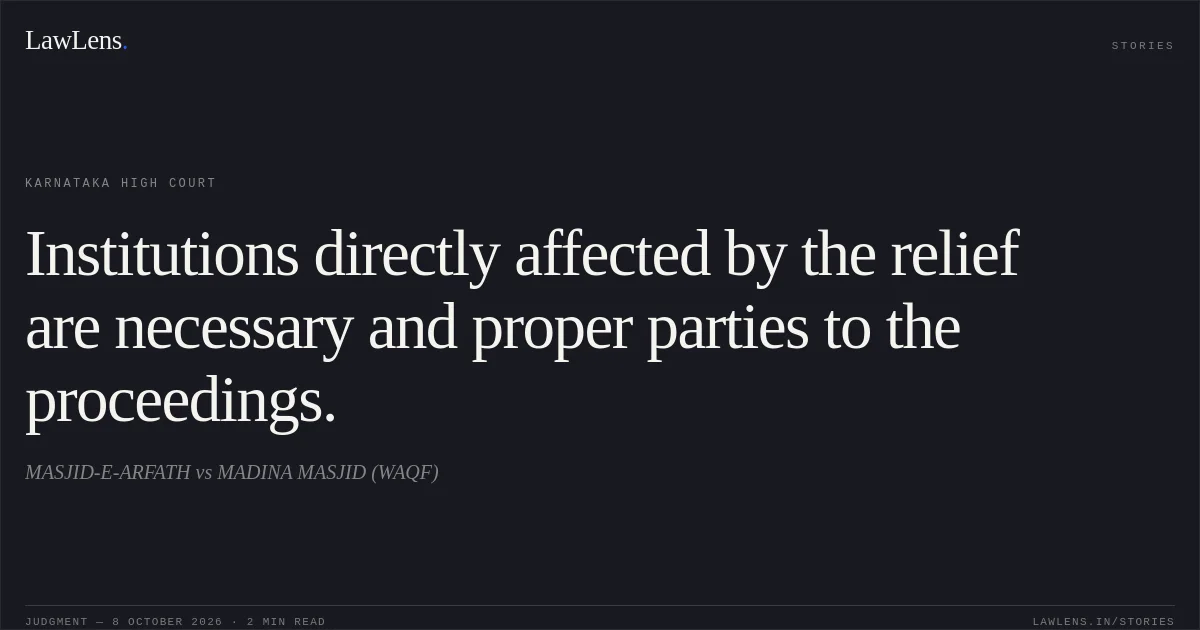
Source reference: pp. 22–23Because a decision on Madina Masjid’s claims could directly affect the institutions’ management and interests, their participation would assist the Tribunal in determining the central dispute.
Source reference: pp. 23–27The Court therefore held that they were proper and necessary parties, without deciding the merits of their competing claims.
Source reference: pp. 23–27Holding
The Court allowed all three appeals, set aside the Tribunal’s common order dated 3 June 2026, and allowed I.A. Nos. 4, 5 and 6.
It directed that the appellants be impleaded as respondent Nos. 4, 5 and 6 in the Tribunal proceedings.
Source reference: p. 27The Court expressed no opinion on the merits and left all contentions open.
Source reference: p. 27Acts & Sections Cited
2 provisions across 1 statute referred to in this judgment. Each provision opens on LawLens.
Technology Development Board Act, 19952
Original Court PDF
MASJID-E-ARFATHvsMADINA MASJID (WAQF)
Click to open original judgment
Original judgment, available to read, download and summarize on LawLens.in