Facts
The Respondent applied for the post of Assistant Tourist Officer Grade – II (2018-2019) following a recruitment notification by the Appellants
Source reference: p. 2After qualifying the written examination held on 29.09.2019, she was provisionally admitted for certificate verification
Source reference: p. 2The Appellants issued a press release on 22.10.2020 requiring candidates to upload scanned documents between 26.10.2020 and 05.11.2020
Source reference: p. 3The Respondent failed to upload the documents, citing travel to her native place and technical difficulties during the peak of the COVID-19 pandemic
Source reference: p. 3A Single Judge of the Writ Court allowed her petition (W.P. No. 17853 of 2020), directing the Commission to permit document uploading on humanitarian grounds
Source reference: p. 3The Appellants challenged this order via the present intra-court appeal.
Source reference: p. 3Issues
1. Whether personal difficulties or extraordinary circumstances like the COVID-19 pandemic justify a relaxation of mandatory timelines set by a recruiting agency for document verification
Source reference: p. 7 / para. 72. Whether the High Court, under Article 226, can exercise discretionary power to modify or relax mandatory instructions issued by a Public Service Commission
Source reference: p. 6 / para. 5Law Applied
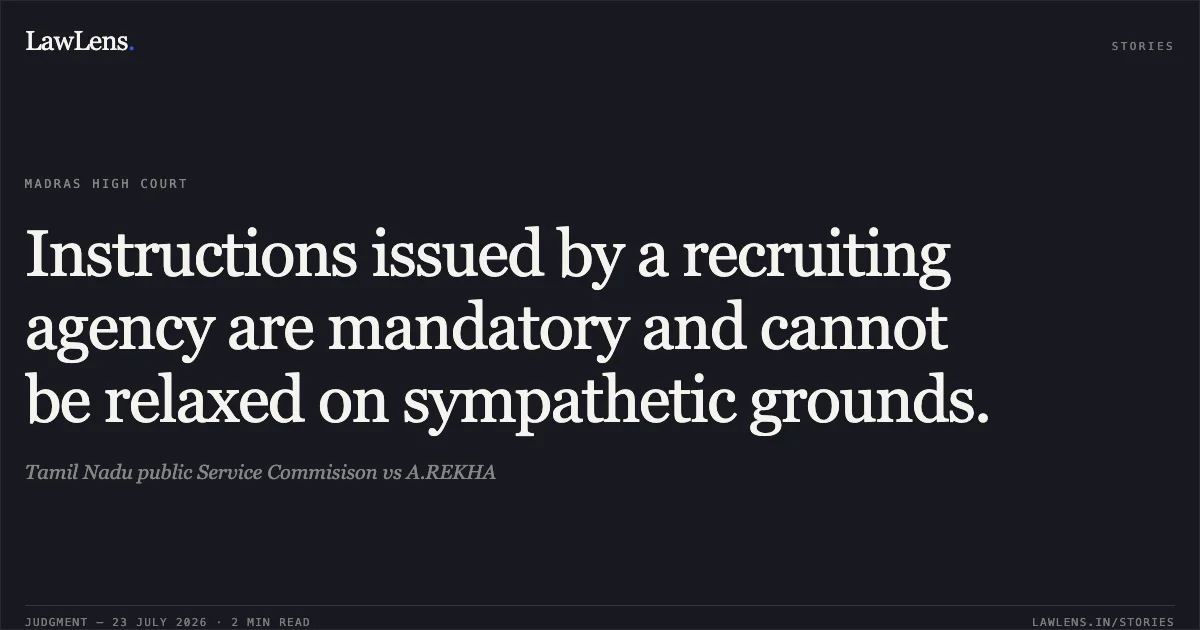
The Court applied the principle that instructions issued by a Public Service Commission are mandatory, carry the force of law, and must be strictly complied with
Source reference: p. 5, 6It relied on the Division Bench precedent in The Secretary, TNPSC v. The Additional Chief Secretary to Government (W.A. No. 567 of 2021), which held that mandatory instructions cannot be ignored even in cases where candidates suffered from COVID-19
Source reference: p. 4, 5Furthermore, it followed the Supreme Court ruling in State of Tamil Nadu v. G. Hemalathaa (2020) 19 SCC 430, which established that the High Court cannot modify or relax Commission instructions under Article 226, as such misplaced sympathy would result in "bad law"
Source reference: p. 6Reasoning
The Court reasoned that since 144 other provisionally selected candidates successfully uploaded their documents during the same COVID-19 period, the Respondent's failure due to personal reasons could not be excused without derailing the entire selection process
Source reference: p. 7The bench observed that any individual relaxation creates a "Pandora's box" of similar claims from other unsuccessful candidates
Source reference: p. 3-4The Court emphasized that strict adherence to recruitment terms is of paramount importance to maintain the integrity of the process
Source reference: p. 6It determined that the Writ Court erred by granting relief on "sympathetic consideration" and "humanitarian grounds," as such discretion is legally unsustainable when it contradicts binding mandatory instructions
Source reference: p. 5, 7Holding
The Court answered the issues in the negative, holding that the Respondent's failure to comply with the notified schedule was fatal to her candidacy.
The Court set aside the Writ Court’s order dated 11.10.2023 and allowed the appeal filed by the TNPSC. Consequently, the Respondent was not permitted to participate in the oral test. No order as to costs was made.
Source reference: p. 8Original Court PDF
Tamil Nadu public Service CommisisonvsA.REKHA
Click to open original judgment
Original judgment, available to read, download and summarize on LawLens.in