Facts
The State of Gujarat appealed against the judgment dated 17.08.2010 by the Sessions Judge, Bhavnagar, which acquitted the respondents of charges under Sections 306, 504, 506(2), and 114 of the IPC
Source reference: p. 1The prosecution alleged that on 20.02.2007, the deceased (Ashokbhai) reprimanded his wife (Accused No. 2) for an illicit relationship with Accused No. 1.
Source reference: p. 2In response, Accused No. 2 allegedly used abusive language and insisted on continuing the affair
Source reference: p. 2The deceased claimed that both Accused 1 and 2 had frequently harassed and threatened him, leading him to set himself on fire
Source reference: p. 2The deceased gave multiple statements (dying declarations) before succumbing to burn injuries.
Source reference: no citationDuring the pendency of the appeal, Respondents No. 1 and 4 expired, causing the appeal to abate against them; the court proceeded against Respondents No. 2, 3, 5, and 6
Source reference: p. 1Issues
1. Whether the prosecution proved beyond reasonable doubt that the acts of the accused amounted to "instigation" or "abetment" of suicide under Section 306 of the IPC
Source reference: p. 112. Whether the trial court’s acquittal was perverse or based on a misreading of evidence, warranting interference by the appellate court
Source reference: p. 19, 22Law Applied
The court applied Section 306 of the IPC regarding abetment of suicide and Section 107 of the IPC, which defines abetment as instigation, conspiracy, or intentional aiding
Source reference: p. 12It relied on Mahendra K.C. v. State of Karnataka, establishing that "instigation" requires an active role to goad or provoke, and words uttered in anger do not suffice
Source reference: p. 14Following Amalendu Pal v. State of West Bengal, the court held that harassment without positive, proximate action leading to suicide does not sustain a conviction under Section 306
Source reference: p. 16Finally, per Chandrappa v. State of Karnataka, the court noted the "double presumption of innocence" in acquittal appeals, where the appellate court should not disturb findings if two reasonable views are possible
Source reference: p. 20-21Reasoning
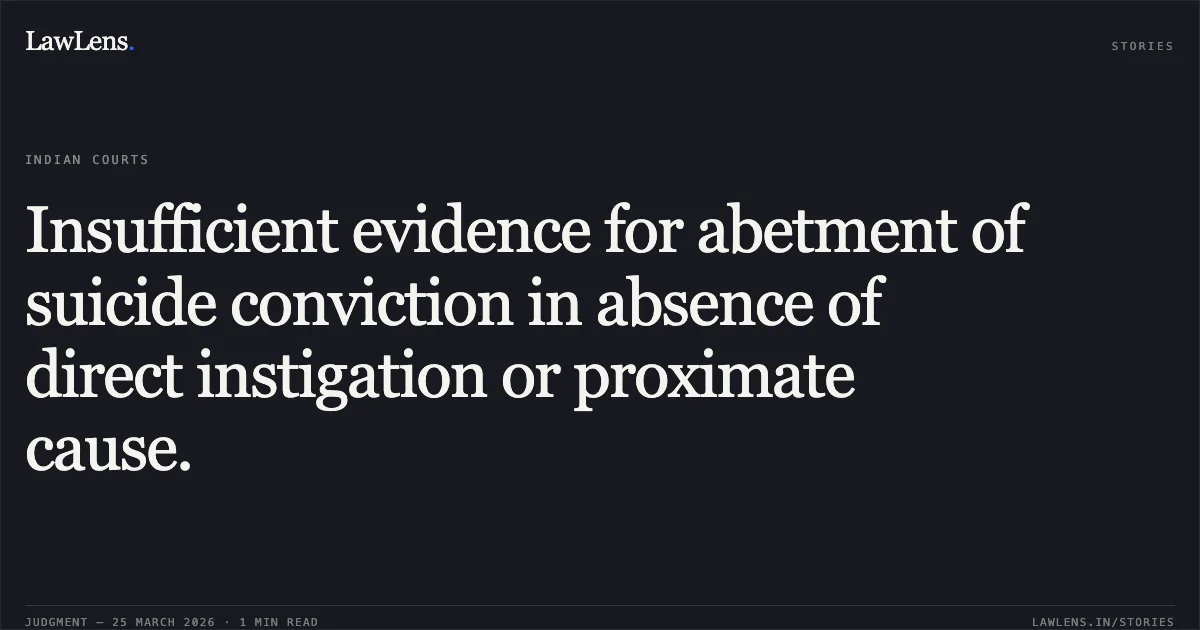
The court found the prosecution's evidence insufficient to meet the high legal threshold for abetment.
Source reference: no citationIt observed significant contradictions across multiple dying declarations: while the deceased named only Accused 1 and 2 in statements to the police and his brother, the formal dying declaration (Exh. 18) implicated all accused
Source reference: p. 8-9Furthermore, different doctors recorded varying motives provided by the deceased, ranging from generalized complaints about his wife's character to specific allegations of an affair
Source reference: p. 10Legally, the court reasoned that routine domestic disagreements or the existence of an illicit relationship do not ipso facto constitute instigation
Source reference: p. 13There was no evidence of a "live and immediate nexus" or a "proximate act" by the accused that forced the deceased to take his life
Source reference: p. 13Applying the standard for acquittal appeals, the court found that the trial court's view was plausible and not "vitiated by manifest illegality"
Source reference: p. 17, 22Holding
The High Court dismissed the appeal and upheld the trial court's order of acquittal
It held that the prosecution failed to establish the essential elements of abetment—specifically a culpable mental state (mens rea) and an active, proximate act of incitement
Source reference: p. 11, 14The court concluded that no patent perversity existed in the trial court’s judgment to justify overturning the acquittal
Source reference: p. 22The record and proceedings were ordered to be remitted to the trial court
Source reference: p. 23Acts & Sections Cited
7 provisions across 2 statutes referred to in this judgment. Each provision opens on LawLens.
Indian Penal Code, 18605
Code of Criminal Procedure, 19732
Original Court PDF
STATE OF GUJARATvsBHUPATBHAI NAGINBHAI BARAIYA
Click to open original judgment
Original judgment, available to read, download and summarize on LawLens.in