Facts
The State of Gujarat appealed an acquittal order dated 17.03.2012 passed by the Special Judge, Surendranagar
Source reference: para. 1The prosecution alleged that on 15.04.2008, the five respondents, armed with deadly weapons like a hand sickle (Dhariya) and scythe sickle (Farsi), assaulted the complainant and others due to a grudge over Panchayat complaints
Source reference: para. 2It was further alleged that the accused used caste-based slurs and threatened to kill the victims
Source reference: para. 2Following an investigation, charges were framed under Sections 323, 504, 506(2), and 114 of the IPC, and Section 3(1)(x) of the SC/ST (Prevention of Atrocities) Act
Source reference: para. 1The Trial Court acquitted the accused on the grounds that the prosecution failed to prove its case beyond reasonable doubt
Source reference: para. 5Issues
1. Whether the prosecution established the guilt of the accused for assault, criminal intimidation, and caste-based abuse beyond reasonable doubt
Source reference: para. 52. Whether the Trial Court’s judgment of acquittal was perverse or based on a misreading of evidence sufficient to warrant interference under Section 378 of the CrPC
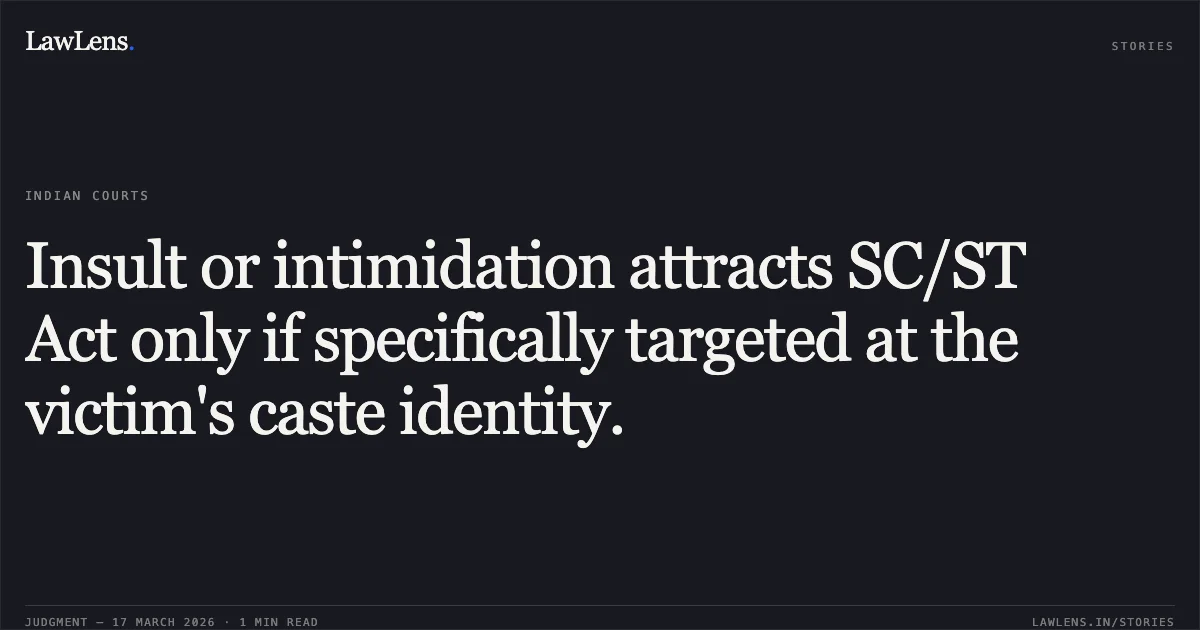
Source reference: para. 16, 183. Whether every insult or intimidation directed at a member of a Scheduled Caste automatically constitutes an offence under Section 3(1)(x) of the SC/ST Act
Source reference: para. 8.7Law Applied
Sections 323, 504, 506(2), and 114 of the Indian Penal Code and Section 3(1)(x) of the SC/ST (Prevention of Atrocities) Act
Source reference: para. 1Regarding appellate interference in acquittals, the Court relied on Chandrappa v. State of Karnataka, emphasizing the "double presumption" of innocence in favor of the accused
Source reference: para. 15It applied the principle from Sajan Sakhariya v. State of Kerala (2024 SC 4557), holding that an offence under the SC/ST Act requires the insult to be specifically targeted because the victim belongs to a protected class
Source reference: para. 8.7the Court followed State of Karnataka v. Hemareddy regarding the appellate court's duty when in agreement with the trial court's reasoning
Source reference: para. 11Reasoning
The High Court found significant discrepancies between the oral testimony and the documentary evidence. The complainant’s deposition (Exh. 18) contradicted the initial complaint (Exh. 19) regarding the specific words used for caste-based abuse
Source reference: para. 8.4Key witnesses failed to support the prosecution: P.W.3 (Majuben) did not mention caste-based slurs, P.W.4 (Dineshbhai) turned hostile, and P.W.5 (Kavjibhai), the alleged primary victim of the assault, denied any physical altercation occurred
Source reference: para. 8.5, 8.2Furthermore, P.W.9 (the complainant's brother) testified that no physical assault took place and he saw no weapons
Source reference: para. 8.2The Court noted the prosecution's failure to produce the alleged weapons or provide medical evidence for the purported injuries
Source reference: para. 8.6Applying the Sajan Sakhariya precedent, the Court observed that the prosecution failed to prove that any alleged insult was specifically motivated by the victim's caste status
Source reference: para. 8.7Holding
The High Court dismissed the appeal and upheld the Trial Court's judgment of acquittal
The Court held that the prosecution failed to provide direct evidence connecting the accused to the incident and failed to establish a motive
Source reference: para. 10It concluded that the Trial Court’s view was a "possible view" and did not suffer from patent perversity or misreading of material evidence; thus, the presumption of innocence reinforced by the acquittal remained undisturbed
Source reference: para. 14, 18The Court ordered the Record and Proceedings to be remitted to the Trial Court
Source reference: para. 19Acts & Sections Cited
7 provisions across 3 statutes referred to in this judgment. Each provision opens on LawLens.
Indian Penal Code, 18604
Scheduled Castes and the Scheduled Tribes (Prevention of Atrocities) Act, 19891
Code of Criminal Procedure, 19732
Original Court PDF
STATE OF GUJARATvsRANUBHAI DHUDABHAI MENIYA
Click to open original judgment
Original judgment, available to read, download and summarize on LawLens.in


