Facts
On April 16, 2013, Kannan died following a collision between his two-wheeler and a vehicle driven by the 5th Respondent.
Source reference: p. 3The claimants (wife and children) filed a claim petition under the Motor Vehicles Act, seeking ₹25,00,000.
Source reference: p. 3The Motor Accident Claims Tribunal, Tenkasi, awarded ₹16,82,000, holding the 2nd Respondent (Insurance Company) liable based on an insurance policy (Ex.R.2) produced by the owner.
Source reference: p. 4-5The Insurance Company appealed, contending that Ex.R.2 was a forged document and that the policy number actually corresponded to a different vehicle (TN 36 M 6466).
Source reference: p. 5They had already initiated criminal proceedings regarding this forgery.
Source reference: p. 5Issues
1. Whether the insurance policy (Ex.R.2) covering the offending vehicle at the time of the accident was genuine or fabricated.
Source reference: p. 82. Whether the Insurance Company can be held liable to indemnify the owner and pay compensation to third parties when the contract of insurance is based on a forged document.
Source reference: p. 11Law Applied
The court applied Section 173 of the Motor Vehicles Act regarding appeals against tribunal awards.
Source reference: p. 2The court relied on the principle that an insurance company’s liability is contractual; in the absence of a valid contract/policy, the insurer is not liable to indemnify the owner.
Source reference: p. 6, 11The court applied the Supreme Court’s direction in National Insurance Company vs. K. Saravanan (2026), which dictates that Insurance Companies must lodge police complaints to prove fraud and avoid liability for forged policies.
Source reference: p. 10Reasoning
Evidence from the District Crime Branch (R.W.1) confirmed that a charge sheet was filed against an agent for issuing forgeries and that the owner was exonerated from criminal intent but was using a non-existent policy.
Source reference: p. 9The Insurance Company’s manager (R.W.2) testified without cross-examination that the policy format did not match company standards and the policy number belonged to a vehicle in a different district.
Source reference: p. 8-9The claimants only produced a policy (Ex.P.6) for the year after the accident.
Source reference: p. 8, 11Since the Appellant took proactive criminal action—meeting the "stringent measures" cited by the Supreme Court—the Court held that no contractual obligation existed to satisfy the award.
Source reference: p. 10-12Holding
The Court allowed the appeal and set aside the judgment against the Insurance Company.
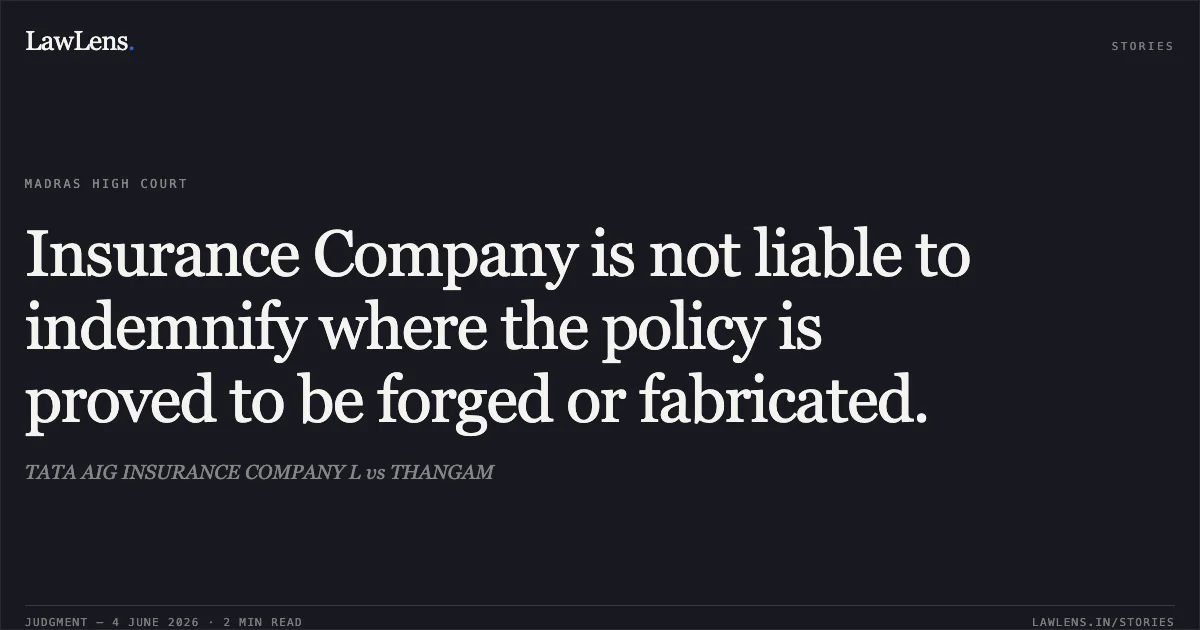
It held that when a policy is proven to be fake through criminal investigation, the insurer is exonerated from all liability, including "pay and recover".
Source reference: p. 12The 5th Respondent (Owner) was held solely liable to pay the ₹16,82,000 with 7.5% interest to the claimants.
Source reference: p. 13The Insurance Company was permitted to withdraw any amount previously deposited, and claimants were directed to refund any withdrawn sums to the Company.
Source reference: p. 13Acts & Sections Cited
1 provisions across 1 statute referred to in this judgment. Each provision opens on LawLens.
Motor Vehicles Act, 19881
Original Court PDF
TATA AIG INSURANCE COMPANY LvsTHANGAM
Click to open original judgment
Original judgment, available to read, download and summarize on LawLens.in