Facts
On August 26, 2012, the appellant, a luxury bus driver, sustained grievous injuries in a vehicular accident involving a trailer
Source reference: p. 2The United India Insurance Company insured both vehicles. The claimant filed for compensation under the Motor Vehicles Act, 1988
Source reference: p. 2In the impugned award dated October 7, 2021, the Motor Accident Claims Tribunal (MACT) awarded Rs. 54,666/- after deducting 70% of the total amount on account of the appellant's own "self-negligence"
Source reference: p. 3The appellant challenged this deduction and the quantum of compensation before the High Court
Source reference: p. 3Issues
1. Whether the Tribunal erred in deducting 70% of the compensation on the grounds of self-negligence given that the insurance policy covered the driver's risk through an additional premium
Source reference: p. 3 / para. 42. Whether the Tribunal failed to account for "future prospects" in calculating the monthly income of the 29-year-old claimant
Source reference: p. 4 / para. 5Law Applied
The court applied the principles governing compensation for "future prospects" established by the Supreme Court in National Insurance Company Ltd. v. Pranay Sethi (2017), which mandates a 40% addition to income for self-employed individuals below 40 years
Source reference: p. 5Regarding self-negligence and insurance liability, it applied IMT 40 (Indian Motor Tariff), which requires insurers to indemnify the insured against legal liability for paid drivers in consideration of an additional premium
Source reference: p. 7It further relied on the Full Bench decision in Valiben Laxmanbhai Thakore v. Kandla Dock Labour Board (2021), which held that if a premium is paid for a driver, the insurer cannot raise the defense of self-negligence to avoid liability
Source reference: p. 9Reasoning
The court found that because the insurance policy included a specific premium for "WC to employee" and was subject to IMT 40, the insurer had contractually accepted the risk of the driver
Source reference: p. 7Applying the Valiben Laxmanbhai precedent, the court reasoned that accepting such a premium expands the insurer's liability to include the driver's own negligence, thereby making the 70% deduction legally unsustainable
Source reference: p. 9-10Regarding quantum, the court noted that the claimant was 29 years old at the time of the accident; therefore, according to Pranay Sethi, the Tribunal was corrected by adding 40% to the assessed monthly income (Rs. 4,000 to Rs. 5,600) for calculating future loss
Source reference: p. 5-6Holding
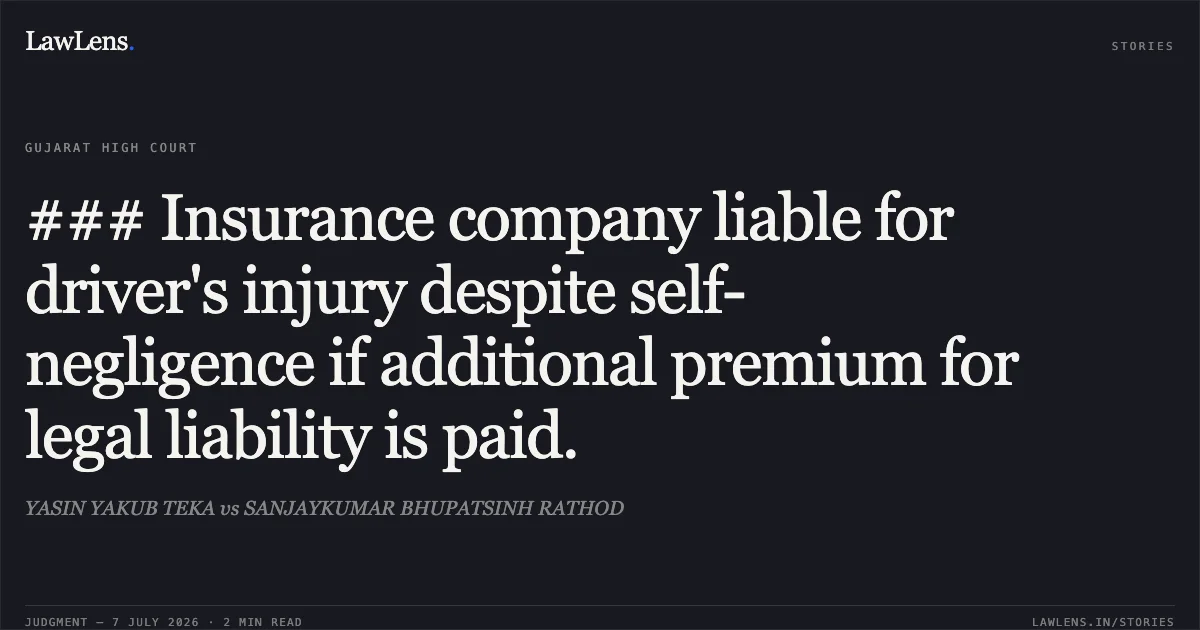
The High Court partly allowed the appeal, setting aside the 70% deduction for self-negligence
The court recalculated the total compensation to Rs. 2,37,708/- (an enhancement of Rs. 1,83,042/-)
Source reference: p. 6The United India Insurance Company was ordered to satisfy the enhanced award with 9% interest per annum within six weeks
Source reference: p. 7, 11The court held that once an additional premium is accepted under IMT 40, the insurer cannot mitigate its liability by alleging the driver’s own negligence
Source reference: para. 15Acts & Sections Cited
1 provisions across 1 statute referred to in this judgment. Each provision opens on LawLens.
Motor Vehicles Act, 19881
Original Court PDF
YASIN YAKUB TEKAvsSANJAYKUMAR BHUPATSINH RATHOD
Click to open original judgment
Original judgment, available to read, download and summarize on LawLens.in