Facts
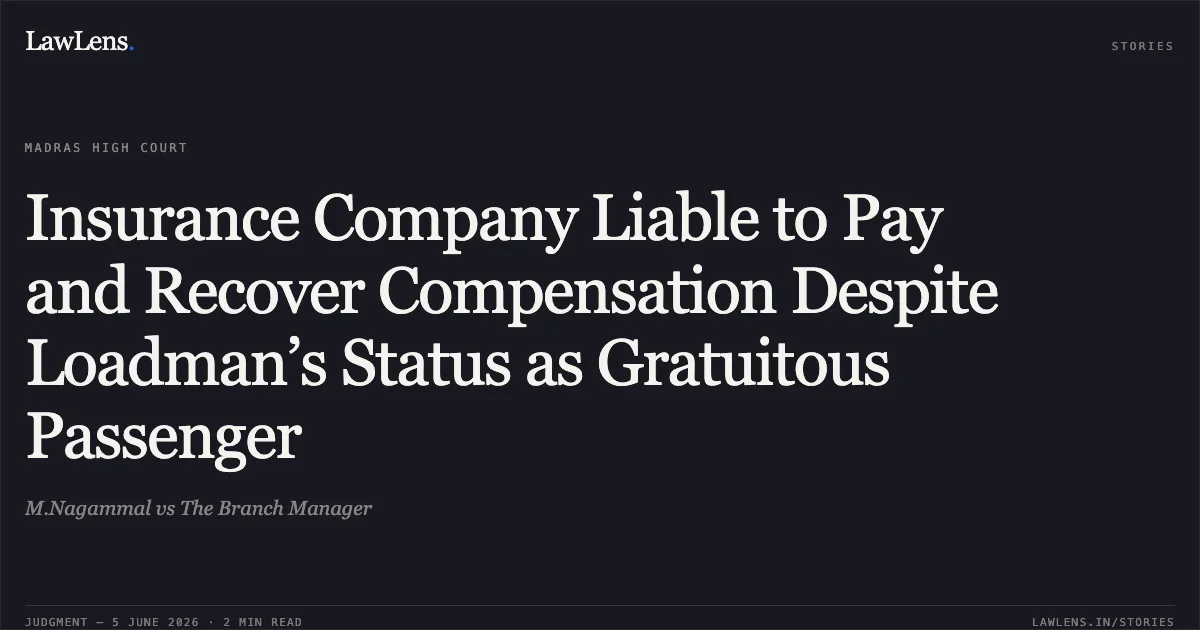
On 26.10.2021, the deceased, Murugan, was traveling as a loadman in an Eicher Lorry owned by Respondent No. 1 and insured by Respondent No. 2.
Source reference: para. 4The vehicle capsized due to the driver’s rash and negligent driving, resulting in Murugan’s death.
Source reference: para. 4The claimants sought compensation of Rs. 25,00,000/-.
Source reference: no citationThe Motor Accident Claims Tribunal (MACT) awarded Rs. 16,91,000/- but held the owner (Respondent No. 1) exclusively liable, exonerating the Insurance Company (Respondent No. 2) on the grounds that the deceased was a gratuitous passenger/loadman traveling outside the cabin for whom no additional premium was paid.
Source reference: para. 8The appellants (claimants) challenged this finding, seeking the application of the "pay and recover" doctrine.
Source reference: para. 11Issues
1. Whether the Insurance Company can be completely exonerated from liability when a passenger (loadman) travels in a goods vehicle without specific additional premium coverage.
Source reference: para. 152. Whether the principle of "Pay and Recover" should be applied to protect the claimants despite a violation of policy conditions by the insured.
Source reference: para. 17Law Applied
Section 147 of the Motor Vehicles Act, 1988, regarding the requirement of policies and limits of liability.
Source reference: para. 6Rule 236 of the Tamil Nadu Motor Vehicle Rules, 1929, which pertains to the number of loadmen permitted in a goods vehicle.
Source reference: para. 15The "Pay and Recover" doctrine as established by the Supreme Court in National Insurance Co. Ltd. v. Baljit Kaur and reaffirmed in Sunita v. United India Insurance Co. Ltd. [2026 (1) TN MAC 1 (SC)], which mandates that the insurer must first satisfy the award to third parties and subsequently recover from the owner in cases of policy violations involving gratuitous passengers.
Source reference: para. 12, 17The precedent in Kaminiben v. State of Gujarat (2026 Live Law SC 174) regarding insurer liability for gratuitous passengers.
Source reference: para. 16Reasoning
The Court observed that while the deceased was traveling as a loadman and the Insurance Company argued that no additional premium was paid for such risk under the "Liability Only" policy, the policy (Ex.R.1) did show a premium of Rs. 50/- for "persons employed for other operations".
Source reference: para. 15, 16Even if the deceased were classified as a gratuitous passenger traveling in violation of policy terms, the Court emphasized that statutory insurance aims to protect third parties.
Source reference: para. 17Following recent Supreme Court precedents, the Court reasoned that the Tribunal erred in exonerating the insurer entirely.
Source reference: para. 18The Court held that in the interest of social justice, the insurer must satisfy the judgment amount to the claimants and exercise its right of recovery against the insured owner for the breach of contract.
Source reference: para. 17, 20Holding
The High Court allowed the appeal in part and modified the Tribunal’s decree, setting aside the dismissal of the claim against Respondent No. 2 (Insurance Company).
The Court directed the Insurance Company to deposit the total compensation of Rs. 16,91,000/- with 7.5% interest within six weeks, with liberty to recover the deposited amount from Respondent No. 1 (Owner) as per the "Pay and Recovery Theory".
Source reference: para. 21(iii), 21(iv)Acts & Sections Cited
2 provisions across 1 statute referred to in this judgment. Each provision opens on LawLens.
Motor Vehicles Act, 19882
Original Court PDF
M.NagammalvsThe Branch Manager
Click to open original judgment
Original judgment, available to read, download and summarize on LawLens.in