Facts
On 3 May 2019, Manji Kesha Anavadiya was travelling as a pillion rider on a motorcycle from Rapar to Samakhiyali when a TVS Luna allegedly emerged from a railway gate without due caution and collided with the motorcycle.
Source reference: p.1–3The deceased sustained serious injuries and subsequently died.
Source reference: p.1–3The claimants instituted M.A.C.P. No. 300 of 2020 before the Motor Accident Claim Tribunal (Aux.), Kachchh at Bhachau.
Source reference: p.1–3The Tribunal awarded ₹47,70,001 with interest at 7.5% per annum from the date of filing until realization.
Source reference: p.1–3The insurer challenged the award, contending that the Tribunal had improperly assessed the deceased’s income on the basis of his income-tax return, awarded excessive medical expenses, and failed to exonerate the insurer despite the offending Luna allegedly being driven without a valid driving licence.
Source reference: p.3–4The claimants supported the award, relying on the deceased’s income-tax return and medical bills produced in evidence.
Source reference: p.4–5Issues
Whether the Tribunal correctly assessed the deceased’s income on the basis of his income-tax return rather than minimum wages?
Source reference: para. 4, 8; pp.3–5Whether the amount of ₹2,80,785 awarded towards medical expenses was excessive or unsupported by the evidence?
Source reference: para. 4, 8; pp.3–5Whether the insurer proved a breach of the insurance policy conditions by establishing that the Luna driver did not possess a valid driving licence, thereby entitling the insurer to exoneration?
Source reference: para. 4, 6, 9; pp.3–6Law Applied
The Court applied the principle that a deceased person’s established actual income may be assessed on the basis of a duly proved income-tax return, rather than by mechanically applying minimum wages.
Source reference: para. 8; p.5It relied on Anjali v. Lokendra Rathod, 2023 (3) GLR 1617 (SC), which supports reliance on income-tax records for determining income in motor accident compensation claims.
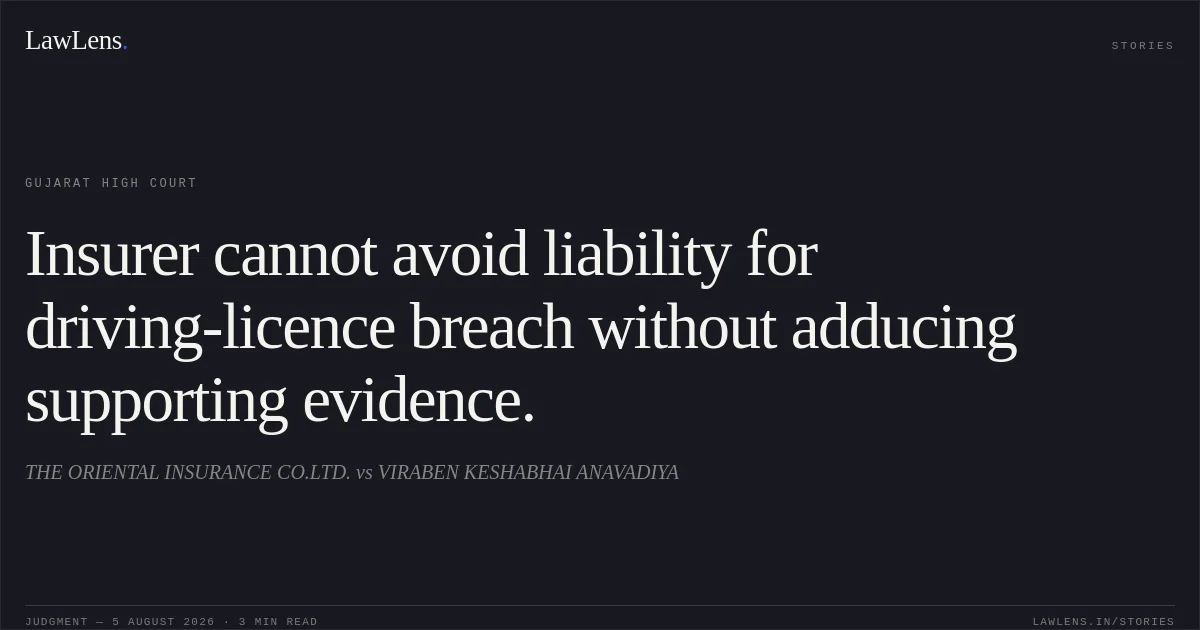
Source reference: para. 8; p.5The Court further applied the evidentiary principle that an insurer raising a defence of breach of policy conditions—such as absence of a valid driving licence—must substantiate that defence through oral or documentary evidence; a mere plea in the written statement is insufficient.
Source reference: para. 9; p.6Medical compensation may be awarded when supported by medical bills proved on record.
Source reference: para. 8; p.5Reasoning
The Court found no error in the Tribunal’s assessment of the deceased’s net annual income at ₹3,93,953 after deduction of income tax, because the income-tax return for 2018–2019 had been proved in evidence and the deceased was shown to be operating “M.K. Store”.
Source reference: para. 8; p.5The insurer’s contention that minimum wages should have been applied was therefore rejected.
Source reference: para. 8; p.5The award of ₹2,80,785 towards medical expenses was also upheld because the corresponding medical bills were produced collectively at Exh. 46 and supported the actual expenditure incurred after the accident.
Source reference: para. 8; p.5As to liability, although the insurer pleaded that the Luna driver lacked a valid driving licence, it adduced no oral or documentary evidence to establish that alleged breach.
Source reference: para. 9; p.6Since the defence remained unsupported beyond the written statement, the Court held that the insurer had failed to discharge the evidentiary burden necessary for exoneration.
Source reference: para. 9; p.6Holding
The High Court answered all issues against the insurer.
It upheld the Tribunal’s assessment of income, the award of ₹2,80,785 for medical expenses, and the insurer’s liability to satisfy the compensation award.
Source reference: para. 10–11; p.6–7The appeal was dismissed as devoid of merit.
Source reference: para. 10–11; p.6–7The award of ₹47,70,001 with interest at 7.5% per annum from the date of filing until realization was maintained.
Source reference: para. 10–11; p.6–7The Record and Proceedings were directed to be returned to the Tribunal, and the statutory amount deposited before the High Court was ordered to be remitted to the concerned Tribunal; no order was made as to costs.
Source reference: para. 10–11; p.6–7Original Court PDF
THE ORIENTAL INSURANCE CO.LTD.vsVIRABEN KESHABHAI ANAVADIYA
Click to open original judgment
Original judgment, available to read, download and summarize on LawLens.in