Facts
On April 26, 2010, Shivanand Khannanavar died from injuries sustained after falling from a Mahindra Jeep (KA-23/M-1655) due to the driver's rash and negligent driving
Source reference: p. 4, para. 3The Tribunal awarded ₹7,30,500/- but held only the owner liable, absolving the insurer because the vehicle was covered by an "Act Liability Only Policy," which the Tribunal concluded did not cover inmates/passengers
Source reference: p. 5, para. 6The owner appealed the liability, and the claimants appealed for enhancement
Source reference: p. 5, para. 6Issues
1. Whether the Tribunal was justified in dismissing the claim petition against the insurer despite the existence of an "Act Liability Only Policy"
Source reference: p. 9, para. 13(i)2. Whether the claimants are entitled to enhancement of the compensation amount
Source reference: p. 9, para. 13(ii)Law Applied
The court applied the "pay and recover" principle established by the Hon'ble Supreme Court in Sunita and Ors. v. United India Insurance Co. Ltd. (AIR Online 2025 SC 601), which holds that an insurer cannot be fully discharged from liability to third parties solely because the policy is an "Act Liability Only Policy"; instead, the insurer must pay the claimant and then recover from the insured
Source reference: p. 6, para. 7; p. 10, para. 15For quantum assessment, the court followed National Insurance Co. Ltd. v. Pranay Sethi (2017 (16) SCC 680) regarding the addition of 40% for future prospects for self-employed individuals under 40, standardized deductions for personal expenses, and fixed amounts for conventional heads like consortium and funeral expenses
Source reference: p. 10-11, para. 17-18Reasoning
The High Court found the Tribunal’s exoneration of the insurer erroneous. While the insurer cited National Insurance Co. v. Balakrishnan to argue lack of coverage for occupants under an Act-only policy, the Court clarified that more recent jurisprudence (Sunita) mandates a "pay and recover" direction to protect third-party claimants even in the absence of specific premium for passengers
Source reference: p. 8, para. 10; p. 10, para. 15Regarding quantum, the Court found the Tribunal's assessment of notional income at ₹4,500/- too low, raising it to ₹5,500/- based on 2010 standards. Applying Pranay Sethi, the Court added 40% for future prospects, applied a multiplier of 17, and awarded ₹40,000/- for each of the four types of consortium (spousal, filial, parental), totaling ₹1,60,000/-, plus standard funeral and estate expenses with a 20% escalation
Source reference: p. 10, para. 16; p. 11, para. 17-18Holding
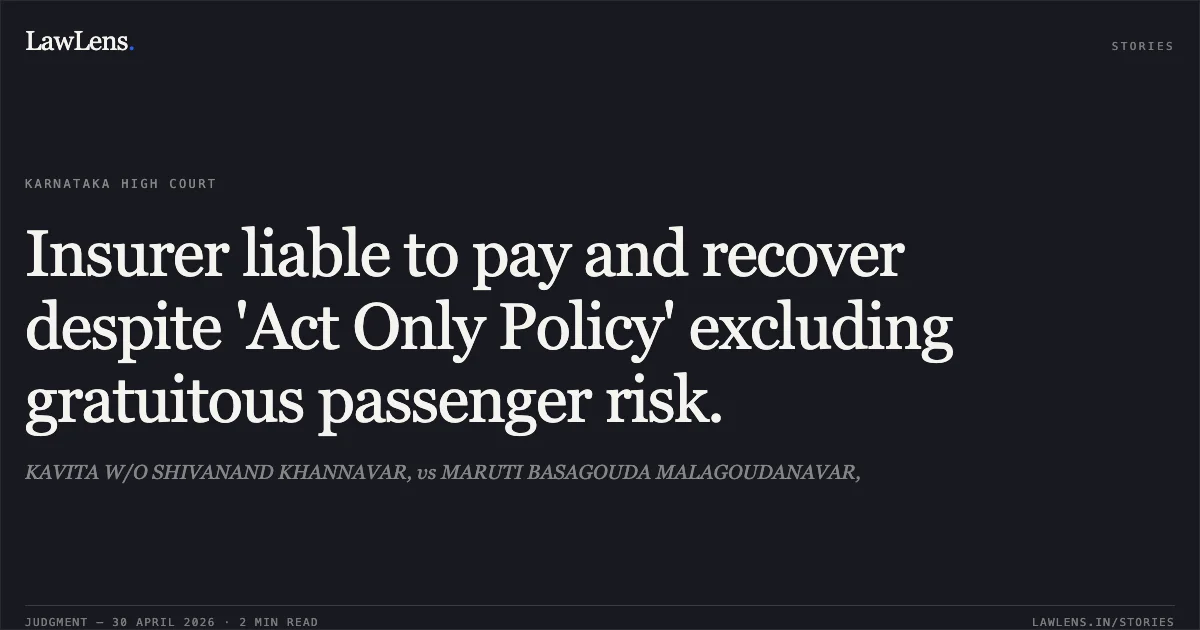
The Court allowed both appeals in part, modifying the award from ₹7,30,500/- to ₹14,06,100/- with 6% interest. It answered Issue 1 in the negative, holding the insurer liable to pay the compensation to the claimants in the first instance and subsequently recover the amount from the owner/insured
The Court answered Issue 2 in the affirmative, reassessing the dependency and conventional heads to reach the enhanced figure
Source reference: p. 11, para. 18Acts & Sections Cited
1 provisions across 1 statute referred to in this judgment. Each provision opens on LawLens.
Motor Vehicles Act, 19881
Original Court PDF
KAVITA W/O SHIVANAND KHANNAVAR,vsMARUTI BASAGOUDA MALAGOUDANAVAR,
Click to open original judgment
Original judgment, available to read, download and summarize on LawLens.in


