Facts
The deceased, traveling on a motorcycle, was fatally hit by a car (DL-5 CD-991) on January 11, 2012
Source reference: p. 1-2The Motor Accidents Claims Tribunal (MACT) found the driver negligent and awarded Rs. 66,92,300/-
Source reference: p. 2-4The Appellant (Insurance Company) challenged the award, contending that the insured (Trilok Chand) had obtained the policy by submitting a fake previous insurance policy purportedly issued by M/s IFFCO Tokio General Insurance
Source reference: p. 2-3An official from IFFCO Tokio (R3W2) testified that no such policy existed in the owner's name and the document was forged
Source reference: p. 3The owner and driver failed to cross-examine the witnesses or rebut the evidence
Source reference: p. 3, 7The High Court had previously remanded the matter, but the Supreme Court set aside that remand, directing the High Court to hear the appeal on its merits
Source reference: p. 8-9Issues
1. Whether an insurance company can be exonerated from third-party liability if the policy was obtained through the misrepresentation of a forged previous insurance document
Source reference: p. 3-42. Whether the insurer is entitled to recovery rights against the owner/insured for providing a fake policy to secure insurance coverage
Source reference: p. 5Law Applied
Section 149(2) of the Motor Vehicles Act, 1988, which provides specific defenses to insurers against third-party claims
Source reference: p. 2The principle of "pay and recover," emphasizing that third-party insurance is a mandatory social justice measure intended to protect victims
Source reference: p. 4, 6United India Insurance Co. Ltd. v. Santro Devi (2009) 1 SCC 558, which establishes that while a contract obtained by fraud may be voidable, in cases of third-party risk, the insurer remains liable to the claimant unless fraud is pleaded and strictly proved
Source reference: p. 6-7Order XII Rule 8 of the CPC regarding the notice to produce documents
Source reference: p. 2, 8Reasoning
The Court rejected the insurer’s plea for complete exoneration, ruling that the company failed to verify the previous policy or inspect the vehicle prior to issuance, and such internal administrative omissions cannot override mandatory statutory third-party liability
Source reference: p. 4The Court distinguished the present case from Santro Devi because here, the insurer successfully proved fraud through unrebutted testimony (R3W2) showing the previous policy was a forgery
Source reference: p. 7Since the insured failed to cross-examine the witnesses or respond to the Order XII Rule 8 notice, the Court found that the insurer was indeed misled into renewing the policy based on a fake document
Source reference: p. 8Consequently, while the insurer must satisfy the award to the third-party claimants to fulfill the social object of the Act, it is entitled to be indemnified by the tortfeasor/insured
Source reference: p. 8Holding
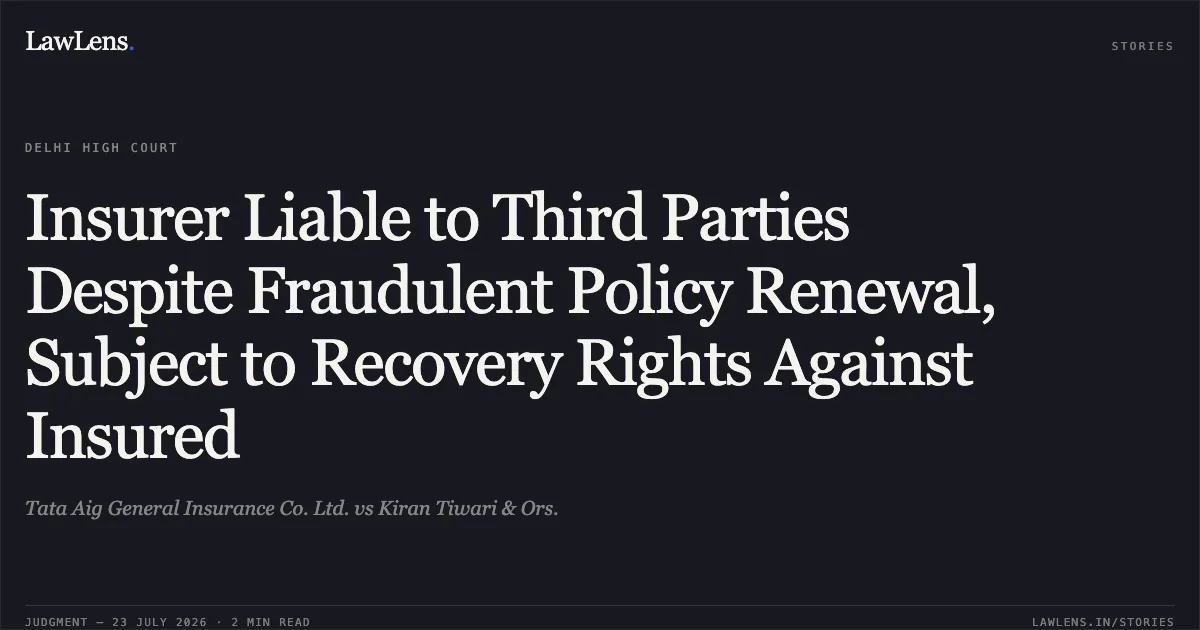
The Court upheld the MACT’s decision regarding the insurer’s liability to pay the claimants but modified the award to grant recovery rights to the Appellant Insurance Company against the owner of the offending vehicle
The Court directed the release of the entire balance compensation amount to the claimants, noting the thirteen-year pendency of the litigation and the appeal was disposed of with directions to deposit the remaining amount within six weeks
Source reference: p. 9-10Acts & Sections Cited
2 provisions across 2 statutes referred to in this judgment. Each provision opens on LawLens.
Code of Civil Procedure, 19081
Motor Vehicles Act, 19881
Original Court PDF
Tata Aig General Insurance Co. Ltd.vsKiran Tiwari & Ors.
Click to open original judgment
Original judgment, available to read, download and summarize on LawLens.in