Facts
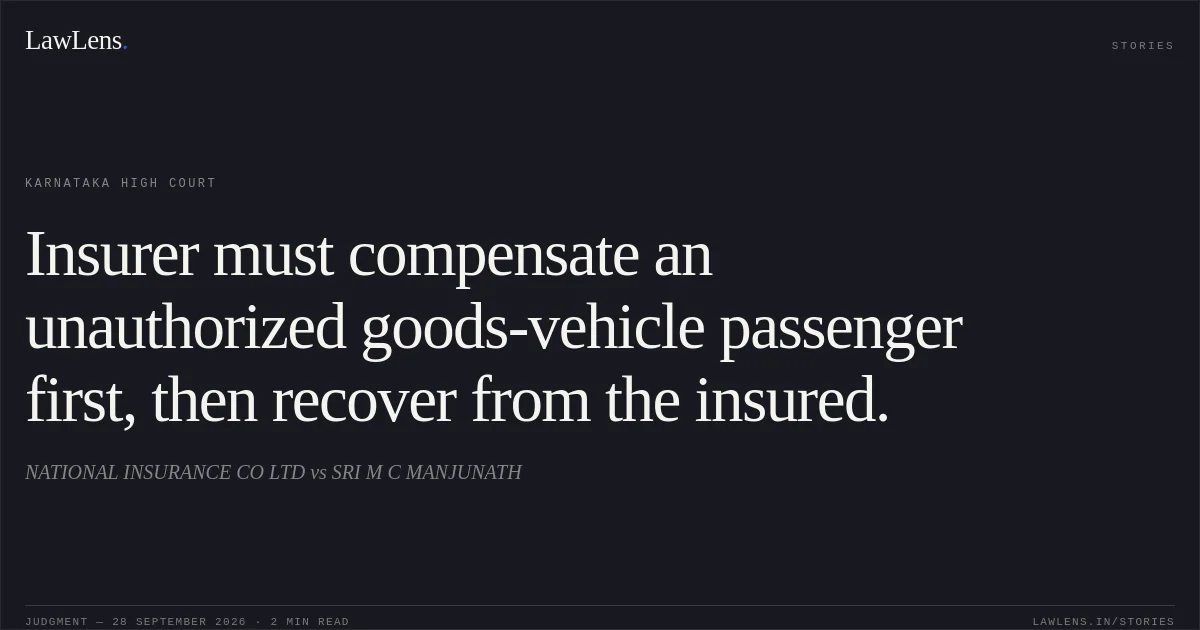
The claimant was injured while travelling in a goods tempo insured by the appellant. The insurer disputed liability, contending that the claimant was a gratuitous passenger.
Source reference: pp. 3–6The vehicle owner’s initial complaint stated that the claimant boarded the tempo on its return journey after the vehicle had unloaded watermelons; a later statement described the claimant as an unloader.
Source reference: pp. 3–6The Tribunal awarded ₹9,78,000 with 6% annual interest and held the insurer jointly and severally liable. The insurer appealed, challenging liability only; the accident, coverage, injuries and entitlement to compensation were not in dispute
Source reference: pp. 3–6Issues
Whether the Tribunal was justified in holding the insurer liable to pay compensation where the claimant travelled in a goods vehicle and the evidence did not establish that he was a loader or fair-paying passenger
Source reference: pp. 6–7Law Applied
Rule 100 of the Karnataka Motor Vehicles Rules, 1989 permits the carriage of up to two loaders in a medium goods vehicle.
Source reference: p. 7A person travelling in a goods vehicle without establishing a permitted role or status may be a gratuitous or fair-paying passenger, potentially in breach of policy conditions.
Source reference: p. 7Relying on Kaminiben v. Oriental India Insurance Co. Ltd., which considered Manuara Khatun v. Rajesh Kumar Singh, National Insurance Co. Ltd. v. Saju P. Paul and Amudhavalli v. HDFC Ergo General Insurance Co. Ltd., the Court applied the pay-and-recover principle: the insurer must satisfy the third-party award first and may then recover the amount from the insured in the same proceedings.
Source reference: pp. 7–8Reasoning
The complaint stated that the claimant boarded the tempo on its return journey after the watermelons had been unloaded. The record contained no evidence that the tempo was carrying goods on that journey or that the claimant had been engaged as an unloader.
Source reference: pp. 7–8Although Rule 100 permits loaders in a medium goods vehicle, the Court held that this did not establish the claimant’s entitlement to travel in the circumstances. Nor was there evidence that he was a fair-paying passenger. His carriage therefore breached the policy conditions; however, applying the Supreme Court authorities cited, that breach did not relieve the insurer of the obligation to pay the third-party claimant in the first instance
Source reference: pp. 7–8Holding
The appeal was allowed in part and the Tribunal’s award was modified. The insurer was directed to pay the compensation and interest to the claimant first, with liberty to recover the amount from the insured without separate proceedings.
The amount already deposited was to be transmitted to the Tribunal, any balance deposited within six weeks, and the compensation released to the claimant upon deposit
Source reference: pp. 8–9Acts & Sections Cited
2 provisions across 1 statute referred to in this judgment. Each provision opens on LawLens.
Motor Vehicles Act, 19882
Original Court PDF
NATIONAL INSURANCE CO LTDvsSRI M C MANJUNATH
Click to open original judgment
Original judgment, available to read, download and summarize on LawLens.in