Facts
The claimant, a 40-year-old coolie, suffered an open fracture to his right leg in a road accident on 20 September 2012.
Source reference: p.2–7Following complications, his right leg was amputated below the knee.
Source reference: p.2–7The Tribunal awarded him ₹5,20,000, assessing whole-body disability at 33%, and held the vehicle’s owner—not the insurer—liable because the driver held only a learner’s licence and was not accompanied by a person holding a valid driving licence.
Source reference: p.2–7The claimant appealed, seeking enhanced compensation and an order requiring the insurer to pay, with a right to recover from the owner.
Source reference: p.7–10Issues
1. Whether the Tribunal’s assessment of disability and compensation for loss of future earning capacity and other heads required enhancement, including an award for prosthetic limbs.
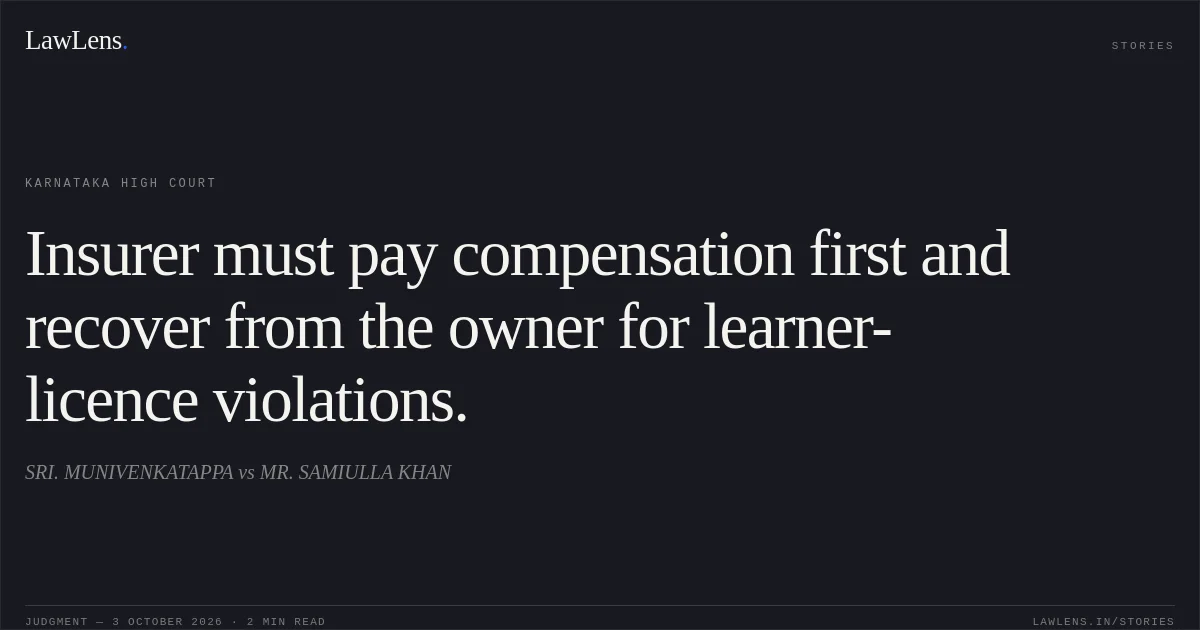
Source reference: p.8–132. Whether the insurer should be directed to satisfy the award first and recover the amount from the vehicle’s owner, notwithstanding the breach relating to the learner’s licence.
Source reference: p.7–9Law Applied
Under the Motor Vehicles Act, compensation must be just and reasonable, assessed with regard to the claimant’s injuries, disability, age, occupation, and resulting loss of earning capacity.
Source reference: no citationThe Court relied on State of Haryana v. Jasbir Kaur, AIR 2003 SC 3696, for the principle that compensation for loss of limbs cannot be measured with mathematical exactitude.
Source reference: p.11It relied on Prahlad Sahai v. Haryana Roadways, AIR 2026 SC 2024, in considering compensation for prosthetic limbs and their replacement over the claimant’s expected remaining lifespan.
Source reference: p.9–12On the insurance issue, the Court applied the pay-and-recover approach, relying on M/s Chatha Service Station v. Lalmati Devi, AIR 2025 SC 2324: the insurer must pay the claimant and may thereafter recover the amount from the vehicle’s owner where the relevant policy breach is established.
Source reference: p.7–9, 14–15Reasoning
The Court found that the claimant’s below-knee amputation was undisputed and that, as a coolie, he could no longer perform his previous occupation.
Source reference: p.10–11It therefore considered the Tribunal’s use of 33% whole-body disability inadequate for assessing loss of earning capacity, and adopted 65% disability, a monthly income of ₹7,000, 25% future prospects, and a multiplier of 15, assessing that head at ₹10,23,750.
Source reference: p.10–11Although the claimant had not proved the purchase of a prosthesis, the Court allowed ₹10,00,000 for the purchase and maintenance of prosthetic limbs, taking account of his remaining lifespan and the anticipated replacement period.
Source reference: p.11–12It also enhanced compensation for pain and suffering, laid-up-period income, attendant and related expenses, and loss of amenities.
Source reference: p.12–13As to liability, it held that the Tribunal’s finding concerning the learner’s licence did not justify absolving the insurer from paying the claimant; the insurer could pursue recovery against the owner.
Source reference: p.7–9, 14–15Holding
The appeal was allowed in part.
The Court modified the Tribunal’s award and reassessed total compensation at ₹23,00,750, as against ₹5,20,000.
Source reference: p.13–14The enhanced amount carries interest at 9% per annum from the date of the petition until realization, except for ₹10,00,000 awarded for prosthetic limbs, on which no interest is payable.
Source reference: p.14The insurer was directed to pay the compensation first and then recover it from the owner; release and deposit were to follow the Tribunal’s directions.
Source reference: p.14–15Acts & Sections Cited
1 provisions across 1 statute referred to in this judgment. Each provision opens on LawLens.
Motor Vehicles Act, 19881
Original Court PDF
SRI. MUNIVENKATAPPAvsMR. SAMIULLA KHAN
Click to open original judgment
Original judgment, available to read, download and summarize on LawLens.in